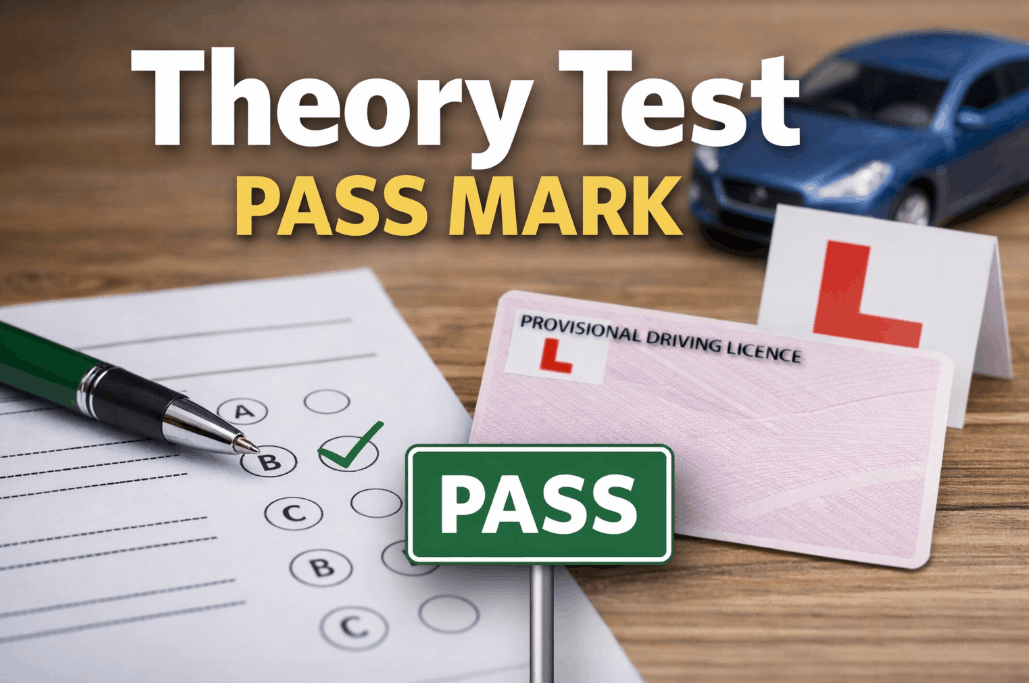
To achieve a successful result in the UK, the theory test pass mark for car drivers requires a score of at least 43 out of 50 in the multiple-choice section and 44 out of 75 in the hazard perception test.
Candidates must pass both sections during the same appointment to receive their certificate.
What is the official theory test pass mark for 2026?
Success depends on hitting two specific targets: the multiple-choice question bank and the hazard perception clips.
For car and motorcycle candidates, this means 43/50 and 44/75, respectively, meeting the strict criteria required by the Driver and Vehicle Standards Agency (DVSA).
The Essential Scoring Thresholds
In my experience assisting learners through the revision process, many underestimate the “Double-Pass” requirement.
You cannot use a high score in the multiple-choice section to compensate for a low score in hazard perception. If you achieve 50/50 on the questions but score 43/75 on the hazards, the result is an overall fail.
As of 2026, the test remains a dual-part assessment that requires a blend of road-law knowledge and split-second observation skills.
| Vehicle Category | Multiple Choice Pass Mark | Hazard Perception Pass Mark | Total Questions/Clips |
| Car (Category B) | 43 out of 50 | 44 out of 75 | 50 Qs / 14 Clips |
| Motorcycle | 43 out of 50 | 44 out of 75 | 50 Qs / 14 Clips |
| LGV (Lorry) Part 1a/1b | 85 out of 100 | 67 out of 100 | 100 Qs / 19 Clips |
| PCV (Bus) Part 1a/1b | 85 out of 100 | 67 out of 100 | 100 Qs / 19 Clips |
| ADI (Instructor) | 85 out of 100 | 57 out of 75 | 100 Qs / 14 Clips |

Have there been any theory test pass mark changes recently?
While the numerical pass marks for most categories have remained stable, the content and delivery of the test have evolved. In 2026, the DVSA added updated video footage and updated questions regarding electric vehicle (EV) safety and updated CPR protocols.
While the numerical pass mark remains unchanged for 2026, the inclusion of more modern scenarios means candidates need a sharper, more contemporary understanding of the road.
Step-by-Step Guide to the Testing Process
- Check-in: Arrive at the test centre 15 minutes early with your provisional photocard license.
- Storage: Place all personal belongings, including watches and phones, in the provided secure lockers.
- The Practice Session: Use the 15-minute practice time to get used to the touch screen or mouse.
- Multiple Choice: Complete 50 questions within 57 minutes, using the “flag” function for difficult items.
- The Break: Opt for the three-minute break between sections to reset your focus.
- Hazard Perception: Watch 14 video clips and identify developing hazards with timely clicks.
- Results: Collect your scoring breakdown from the test centre administrator immediately after finishing.
How is the theory test pass mark percentage calculated for instructors?
The theory test pass mark for driving instructor candidates (ADI Part 1) is significantly more demanding than the standard learner test.
A high total score isn’t enough; you need to prove competence across every topic. To pass, an aspiring instructor must achieve an overall mark of 85% or higher.
However, the 100 questions are split into four technical “bands,” and the candidate must score at least 20 out of 25 in each specific band.
- Band 1: Road procedure.
- Band 2: Traffic signs and signals, car control, pedestrians, and mechanical knowledge. This technical proficiency includes understanding vehicle reliability and common faults, mechanical knowledge (including identifying long-term reliability issues like specific Nissan Qashqai years to avoid when helping students choose their first car).
- Band 3: Driving test, disabilities, and the law.
- Band 4: Publications and instructional techniques.
I once consulted with a trainee instructor who scored 94/100 but failed because they only managed 18/25 in Band 4.
This “banding” ensures that instructors are well-rounded and do not have significant gaps in their professional expertise.

Why does hitting the pass mark feel more difficult this year?
The difficulty is often found in the hazard perception section’s “cheat detection” software. In practice, I have seen many tech-savvy learners fail because they clicked too rhythmically or too many times in a short window.
The software interprets this as an attempt to “game” the system rather than a genuine observation of a hazard.
- Developing Hazards: A hazard is only “developing” when it forces you to change speed or direction.
- Scoring Window: You can score up to five points per hazard, but the points decrease as the hazard gets closer.
- The Zero Rule: If you click too many times on one clip, you will receive a warning and score zero for that specific video.
The Math of the Test: Scoring Percentages for Cars
Statistically, car drivers must maintain an 86% success rate across the question bank. This is a high bar compared to many academic exams.
The questions are pulled from a bank of over 700 items based on the Highway Code, Know Your Traffic Signs, and Driving – The Essential Skills.
Identifying High-Risk Topics
When reviewing decisions made by the DVSA to update question banks, a common pattern is an increased focus on vulnerable road users. Statistics suggest that the most common reasons for missing the pass mark include:
- Complex junction rules involving cyclists.
- Stopping distances in varied weather conditions (e.g., ten times the distance in ice).
- The specific meanings of triangular vs. circular road signs.
Understanding safety symbols is equally vital; for instance, knowing how to react to a red exclamation mark on your dashboard is as critical for road safety as recognising a stop sign.
| Feature | Multiple Choice Section | Hazard Perception Section |
| Duration | 57 Minutes | Approx. 20 Minutes |
| Format | Touchscreen / Mouse | Video Clips / Mouse Clicks |
| Focus | Logic, Law, & Theory | Reaction, Observation, & Safety |
| Key Challenge | Distractor Answers | Timing & Anti-Cheat |
How to guarantee you reach the pass mark on your first attempt
The most prepared learners often adopt a ‘Buffer Strategy’ to ensure they aren’t relying on luck. If you only aim for 43, you leave zero room for error.
I always recommend that learners do not book their official test until they are consistently scoring 48 or higher on at least five consecutive mock exams.
Revision Checklist for Success
- Study the Source Material: Don’t just memorise questions; read the Highway Code.
- Use Official Apps: The DVSA official kit uses the actual CGI clips used in the test.
- Simulate Test Conditions: Practice in a quiet room without checking your phone or notes.
- Review Your Weaknesses: Focus 70% of your time on the categories where you score lowest.
Final Summary and Next Steps
Reaching the theory test pass mark in 2026 requires more than just memorisation; it requires a deep understanding of the road as a professional environment.
To succeed, start by mastering the Highway Code, then use mock tests to identify your “knowledge gaps.” Once you are consistently hitting the “buffer zone” of 47+ marks, you are ready to book your test.
If you are successful, remember that your certificate has a two-year shelf life, so move toward your practical test training immediately.

FAQ about Theory Test Pass Mark
Is 42 a pass in the UK theory test?
No. For car and motorcycle categories, 42 is a fail. You must achieve a minimum of 43 out of 50. There are no “near-miss” passes or discretionary marks given by the test centre.
Can I pass one part and fail the other?
You will receive a result for both parts, but you cannot “keep” a pass in one section. If you fail either the questions or the hazard clips, you must retake the entire test and pay the full fee again.
What is the pass mark for a motorcycle theory test?
The motorcycle theory test pass mark is exactly the same as the car test: 43/50 for multiple-choice questions and 44/75 for the hazard perception section.
How long is the theory test certificate valid?
Once you reach the pass mark, your certificate is valid for two years. If you do not pass your practical driving test within this timeframe, you must retake the theory test.
How many hazards are in the car theory test?
There are 14 clips in total. 13 clips contain one developing hazard, while one clip contains two. This means there are 15 scoreable hazards in total across the test.
Observation isn’t limited to the road; you must also spot internal warnings, such as when an engine mil inoperative or indicates a malfunction, which would immediately fail a car during the practical exam.
Is there a limit on how many times I can take the test?
There is no limit to the number of attempts. However, you must wait at least three working days before booking a retake if you do not meet the pass mark.
Does the ADI theory test have different hazards?
The clips are similar in style, but the theory test pass mark for driving instructor candidates is higher (57/75), requiring much faster and more accurate hazard identification.