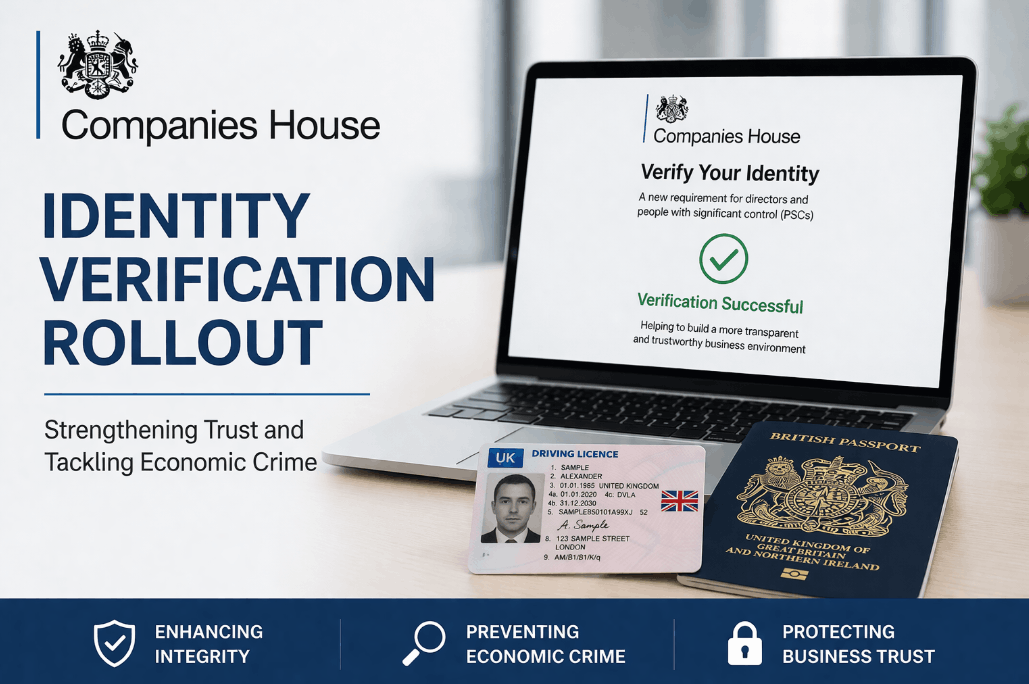
The Companies House identity verification rollout is a mandatory compliance phase under the Economic Crime and Corporate Transparency Act 2023, requiring all UK company directors and Persons with Significant Control (PSCs) to verify their identities.
Launched on 18 November 2025, the rollout features a 12-month transition period ending 17 November 2026, with specific deadlines triggered by your company’s confirmation statement date or your month of birth.
What is the Companies House identity verification rollout?
The Companies House identity verification rollout is the official process of linking every UK company officer to a verified “Personal Code” to prevent fraudulent appointments.
This system ensures that the person listed on the public register is exactly who they claim to be, using biometric technology or authorised third-party checks.
Navigating the 2026 Transition: Why the Deadlines Matter
While the requirement became law in late 2025, the practical impact is only now hitting the UK’s 5 million active companies.
Many boardrooms have operated under the assumption that they have until the end of the year to act, but the process is strictly event-driven.
This regulatory shift arrives at a challenging time for SMEs; while we watch UK house prices fall, and general overheads rise, these new administrative hurdles require immediate attention to avoid further operational friction.

How do you know when your identity verification is due?
The rollout does not apply a single “deadline day” for every business in the UK. Instead, Companies House has staggered the requirements to manage the millions of individuals needing verification.
For new appointments made after 18 November 2025, verification is a statutory precondition.
This means you cannot legally be appointed as a director until you have completed the check and obtained your 11-character personal code. For existing officers, the timeline is more nuanced.
Summary of 2026 Verification Deadlines
| Role Type | Deadline Trigger | Action Required |
| New Director | Before Appointment | Must verify to generate a Personal Code for form AP01. |
| Existing Director | Next Confirmation Statement (CS01) | Must verify before the first CS01 filed after 18 Nov 2025. |
| Existing PSC | Month of Birth | 14-day window starting on the 1st of your birth month. |
| Filing Agents | Spring/Summer 2026 | Must be verified or registered as an ACSP to submit documents. |
How to complete the identity verification process?
There are three primary routes to complete your verification. Current GOV.UK protocols show that while several methods exist, the digital route remains the most efficient for those with the correct hardware.
The 6-Step Guide to Verifying via GOV.UK One Login
- Download the App: Install the “GOV.UK ID Check” app on an NFC-enabled smartphone.
- Scan Your ID: Use the app to scan the biometric chip in your UK passport or driving licence.
- Face Scan: Complete the “liveness” check by following the on-screen prompts for a face scan.
- Log In: Connect the app to your GOV.UK One Login account (or create one).
- Verify Details: Confirm your National Insurance number and current residential address.
- Receive Code: Once approved, Companies House will issue your unique 11-character Personal Code via email.
What is the Companies House Personal Code?
The companies house identity verification rollout introduces the “Personal Code” as your lifelong digital identifier. This is a permanent code assigned to you, not your company.
Within the new corporate framework, this personal code acts as the primary “key” to the public register.
Once you have it, you use the same code for every directorship or PSC role you hold across multiple companies.
Why the Personal Code matters for PSCs
A common pattern is for an individual to be both a director and a PSC of the same company. In this scenario, you only verify once, but you must link that code to both roles.
For PSCs who are not directors, the 14-day window during their birth month is a strict requirement. If you were born in May, your window opens on 1 May 2026.
Failure to input your code into the system during this fortnight can trigger automated compliance flags.

Can you verify through an accountant or ACSP?
If you do not have a smartphone or a biometric ID, you cannot use the free GOV.UK app. In these cases, you must use an Authorised Corporate Service Provider (ACSP).
- Who are they? These are typically accountants, solicitors, or formation agents who are registered for Anti-Money Laundering (AML) supervision.
- The Benefit: They can verify your identity manually and file a “verification statement” on your behalf.
- The Cost: Unlike the free government app, ACSPs will charge a professional fee for this service.
- Requirement: The ACSP must be registered with the Registrar of Companies before they can verify others.
Many directors are choosing to align this verification check with a broader review of their corporate structure and tax health.
It is particularly common for those managing property portfolios to address capital gains tax on property at the same time, ensuring that both their personal tax positions and their Companies House filings remain beyond reproach.
Consider the recent case of a Highlands-based director without a biometric passport. They discovered that while the Post Office provides a vital in-person safety net, the process must still be initiated online.
For those with complex ID backgrounds or limited tech access, engaging an ACSP early in 2026 is the most reliable way to navigate these hurdles.
What are the penalties for missing the 2026 deadlines?
The companies house identity verification rollout is backed by criminal sanctions. This is not merely an administrative request; it is a legal mandate under the ECCTA 2023.
Consequences of Non-Compliance
- Blocked Filings: You will be unable to file your Confirmation Statement (CS01). If the CS01 is not filed, the company is at risk of being struck off the register.
- Criminal Prosecution: Failing to verify is an offence that can lead to an unlimited fine or a criminal record for the individual director.
- Director Disqualification: Persistent failure to comply with filing requirements can lead to being barred from acting as a director for up to 15 years.
- The “Presenter” Rule: By mid-2026, Companies House will stop accepting documents from unverified individuals. This means you could be physically unable to update your own company’s records.
Common Hurdles in the Companies House Identity Verification Rollout
Many users encounter issues when their name on the Companies House register does not perfectly match their passport.
For example, if you are listed as “Robert Smith” at Companies House but your passport says “Robert James Smith,” the automated system may reject the match.
Checklist for a Smooth 2026 Verification
- Audit Your Data: Ensure your name and date of birth at Companies House match your ID exactly.
- Check ID Expiry: A UK driving licence or passport must be valid; the system will reject expired documents.
- Email Access: Ensure each director has a unique email address. You cannot share one email for multiple verified accounts.
- Corporate Directors: If your company has a corporate director, note that the rollout for corporate entities is slightly later. However, the “Relevant Officer” of that corporate director must still verify individually.

Final Summary and Next Steps
The transition to a verified register represents the most significant change to UK company law in a generation.
To remain compliant, you must first pinpoint your specific trigger date, whether it is your next Confirmation Statement or your 2026 birth month.
Waiting for the final 14-day window is a high-risk strategy; securing your Personal Code via the One Login app now is the most effective way to prevent filing blocks and potential strike-off action.
FAQ about Companies House identity verification rollout
When does the identity verification rollout start?
The rollout officially began on 18 November 2025. Existing directors have until their first confirmation statement in 2026 to comply, while new directors must verify immediately before appointment.
Is identity verification free for UK directors?
Verifying directly through the GOV.UK One Login app is free. However, if you choose to verify through a third-party ACSP (like an accountant), you will likely be charged a fee.
What if I don’t have a biometric passport?
You can use a UK photo driving licence or a biometric residence permit. If you have no biometric ID, you may need to verify in person at a Post Office or via an ACSP.
Do I need to verify for every company I run?
No. You only verify your identity once to receive a Personal Code. You then provide this same 11-character code for every company where you hold a role.
What happens if a PSC is also a director?
You verify once. The code is linked to your director role during the confirmation statement filing and to your PSC role during your birth-month window or the CS01 process.
Can an overseas director verify their identity?
Yes. Overseas directors must use the GOV.UK One Login route with an international biometric passport or use an ACSP that is registered in the UK.
Is a Personal Code different from a Company Authentication Code?
Yes. The Company Authentication Code is for the business entity. The Personal Code is unique to you as an individual and stays with you for life.