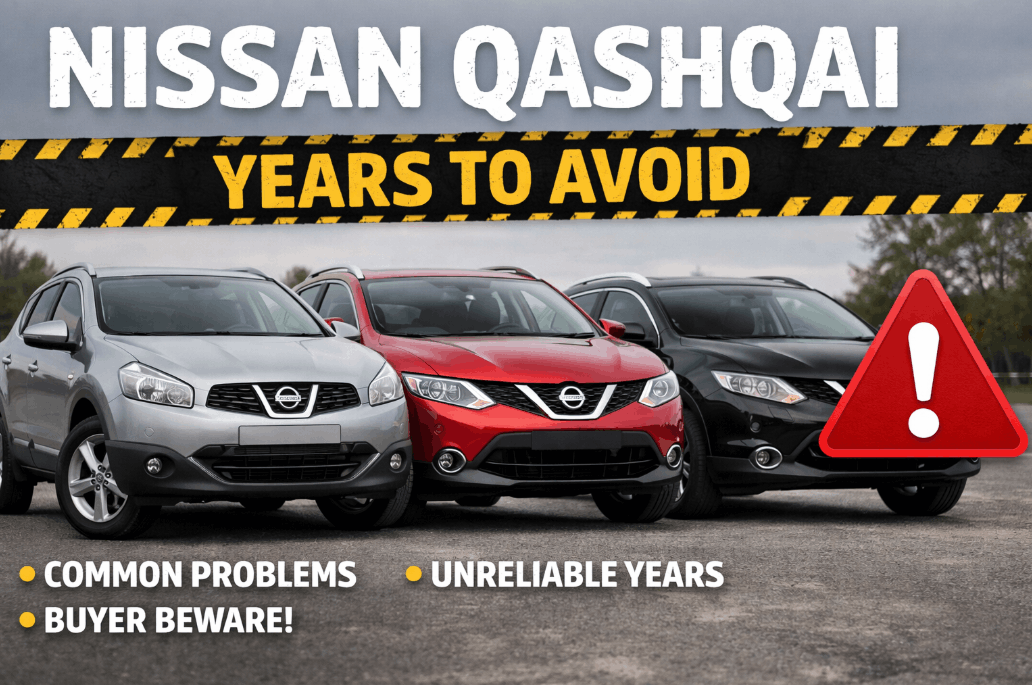
The Nissan Qashqai years to avoid primarily span from 2014 to 2017, specifically models equipped with the 1.2-litre DIG-T petrol engine and the early Xtronic CVT transmission.
These versions are prone to excessive oil consumption, premature timing chain wear, and gearbox hesitation. Additionally, 2007–2010 models often suffer from rear subframe corrosion and suspension bush failure.
Which Nissan Qashqai years to avoid for better reliability?
The most critical Nissan Qashqai years to avoid are 2014, 2015, 2016, and early 2017.
These years represent the initial release of the second-generation (J11) model, which was plagued by software glitches, battery drain issues, and significant mechanical flaws in the 1.2 petrol drivetrain and automatic gearboxes that often require expensive out-of-warranty interventions.
The Reality of Qashqai Ownership in the UK
While the Nissan Qashqai consistently tops the UK sales charts due to its practical dimensions and “built-in-Britain” appeal at the Sunderland plant, its reliability record is polarised.
In my experience reviewing MOT data and owner reports, the vehicle’s dependability depends almost entirely on the specific engine and transmission combination chosen, rather than just the mileage on the odometer.
What are the most common mechanical failures in early Mk2 models?
Between 2014 and 2017, the J11 Qashqai faced several high-profile issues that affected its reputation.
When Nissan shifted to Euro 6 standards, the pressure to deliver smaller, turbocharged engines resulted in a few costly oversights for those buying the first batch of J11 models.
The Major Weak Point: The 1.2 DIG-T Petrol Engine
The 1.2-litre petrol engine is frequently cited by UK mechanics as a high-risk unit. A manufacturing defect in the piston rings often leads to extreme oil consumption.
If the oil level drops unnoticed, the timing chain loses lubrication, stretches, and can eventually cause catastrophic engine failure.
The risk is even higher if the engine MIL inoperative or indicates a malfunction, as you might lose power on the motorway without the dashboard ever throwing a warning light.
Xtronic CVT Gearbox Hesitation
The Continuously Variable Transmission (CVT) used in recent years often suffers from “juddering” or a complete loss of power while accelerating.
In some cases, the transmission enters a “limp mode” on motorways, which is a significant safety concern for families.
Electrical and Battery Drain
Many 2014–2016 owners reported that the car’s stop-start system would fail, often leaving the battery flat after just a few days of inactivity.
This was frequently traced back to faulty sensor logic or poor-quality factory-fitted batteries. In many cases, the first sign of trouble is a persistent red exclamation mark on dashboard warning, which often points toward a failing electronic parking brake motor.
Comparison of Nissan Qashqai Reliability by Generation
| Generation | Production Years | Reliability Rating | Primary Concerns |
| Mk1 (J10) | 2007–2013 | Moderate | Subframe rot, DPF issues, suspension |
| Mk2 (J11) Early | 2014–2017 | Low | 1.2 Engine, CVT gearbox, Electrics |
| Mk2 (J11) Facelift | 2018–2021 | High | Minor infotainment bugs |
| Mk3 (J12) | 2021–Present | Very High | e-POWER software updates |
How to inspect a used Qashqai before purchase?
If you have your heart set on a car from these higher-risk years, you need to be extremely thorough with your pre-purchase checks to avoid getting stuck with a lemon.
- Check the Oil Level Immediately: Pull the dipstick; if the oil is significantly low or jet black on a petrol model, walk away.
- Listen for “The Rattle”: Start the engine from cold and listen for a metallic rattling sound for the first 5 seconds, which indicates a stretched timing chain.
- Inspect the Rear Subframe: Use a torch to check the metal frame near the rear exhaust for heavy, flaking rust (common on Mk1 models).
- Test the Gearbox: Drive at 30mph and floor the accelerator; if the revs rise but the car doesn’t speed up smoothly, the CVT is failing.
- Review Service History for Software Updates: Ask if the ECU and TCU (Transmission Control Unit) have received the official Nissan recalls and updates.
- Check the Battery Date: If the battery is the original Nissan-branded unit from 2015, expect to replace it immediately.
- Verify ULEZ Compliance: Ensure the diesel model is Euro 6 (usually 2015 onwards) to avoid daily charges in London or Birmingham.
Why is subframe corrosion a major issue for UK Qashqai owners?
A common pattern I see with the first-generation (J10) Qashqai (2007–2013) involves the structural integrity of the vehicle.
Due to the high volume of road salt used during UK winters, the rear subframe on these vehicles is highly susceptible to “perforation” (rusting through).
- MOT Failures: Many Mk1 models are now failing MOT tests because the subframe has become structurally unsound. When weighing up what part of the car does the law require you to keep in good condition, the chassis and subframe are non-negotiable; structural rot here is an automatic ‘dangerous defect’ fail.
- Repair Costs: Replacing a subframe is a labour-intensive job, often costing between £800 and £1,200 at a UK independent garage.
- The 1.5 dCi Dilemma: While the 1.5 diesel is excellent for fuel economy, older versions (pre-2012) had fragile timing belts. If you buy one, ensure the belt was changed every 5 years or 60,000 miles.
When reviewing decisions made by second-hand buyers, those who opted for the 1.6-litre naturally aspirated petrol (Mk1) generally reported far fewer engine headaches than those who chose the newer 1.2-litre turbo.
Is the 2018 facelift a safer investment?
By 2018, Nissan addressed many of the flaws found in the early J11 models. This year marked the introduction of the 1.3-litre DIG-T engine, developed in collaboration with Mercedes-Benz.
Significant Improvements in Post-2018 Models
- The 1.3-Litre Engine: This engine replaced the problematic 1.2 and has proven to be significantly more robust, with better fuel efficiency and a more reliable timing chain.
- Dual-Clutch Transmission (DCT): Nissan began phasing out the CVT in favour of a DCT on certain models, which offers a more traditional and reliable shifting feel.
- Infotainment Upgrades: The move to Apple CarPlay and Android Auto compatibility solved many of the “laggy” sat-nav complaints.
From a practical standpoint, a 2019 or 2020 plate is arguably the sweet spot, offering updated safety tech alongside a much sturdier mechanical setup.
Because the post-2018 models are so much more dependable and accessible, they have become a staple on the PIP mobility car list for UK drivers who can’t afford unexpected downtime.
According to the Driver and Vehicle Standards Agency (DVSA), recall rates for the Qashqai dropped significantly following the 2018 refresh, making these years the “sweet spot” for UK buyers.

The Bottom Line: Buying With Confidence
To secure a reliable used Nissan Qashqai in 2026, you should prioritise models built from 2018 onwards.
While the earlier 2014–2017 models are tempting due to their lower price point on the UK used market, the risk of “oil-thirst” in the 1.2 engine and CVT failure often results in repair bills that exceed the car’s value.
The Used Qashqai Buyer’s Verdict
- Avoid: 2014–2017 1.2 petrol and CVT models.
- Search for: 2018–2021 1.3-litre petrol manual or DCT models.
- Check: Always verify the subframe condition on any Qashqai older than 10 years.
- Verify: Ensure any diesel purchase has a documented DPF cleaning history if it was used primarily for short UK school runs.
Frequently Asked Questions about Nissan Qashqai years to avoid
Is the 2014 Nissan Qashqai a reliable car?
No, the 2014 model is widely considered the worst year. It suffered from the highest volume of recalls and owner complaints regarding battery failure, CVT transmission breakdown, and high oil consumption in petrol engines.
Which Qashqai engine is the most reliable?
The 1.3-litre DIG-T (140 or 160 PS) introduced in late 2018 is the most reliable petrol engine. For diesel, the later 1.6 dCi is preferred over the older 1.5 dCi due to its timing chain setup.
Does the Nissan Qashqai have gearbox problems?
Yes, the Xtronic CVT automatic gearboxes in 2014–2017 models are prone to overheating and “juddering.” These issues often require a total transmission replacement, which is uneconomical on older high-mileage cars.
Are there any Qashqai years that are ULEZ exempt?
Generally, petrol Qashqais from 2006 onwards are ULEZ-compliant. However, diesel models must be Euro 6, which usually means vehicles registered from September 2015 onwards. Always check the specific VRM on the TfL website.
What is the “Red Ring of Death” on a Qashqai?
Owners use this term to describe a critical fault with the Electronic Parking Brake. If this light stays on, it usually means a sensor or actuator has failed, which can leave the car immobilised.
How many miles will a Nissan Qashqai last?
With meticulous servicing, a Qashqai can reach 150,000 miles. However, the 1.2 petrol engines rarely reach 100,000 miles without requiring a timing chain replacement or dealing with high oil consumption issues.
Is the new e-POWER Qashqai (2022+) reliable?
The J12 e-POWER has shown strong early reliability. It uses a petrol engine as a generator for an electric motor, avoiding the mechanical strain typical of traditional gearboxes, though software updates are occasionally required.