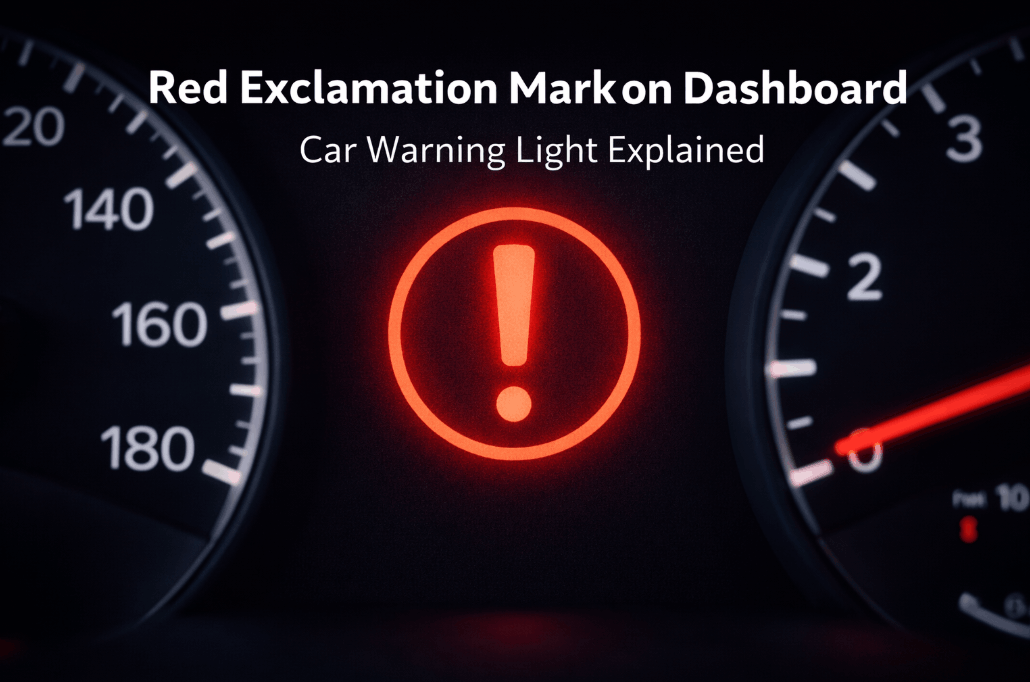
A red exclamation mark on your dashboard indicates a critical safety failure that requires immediate attention to prevent vehicle damage or an accident.
Depending on the symbol’s shape, it typically signals a hydraulic brake system failure, a master warning fault, or dangerously low tyre pressure.
You must safely pull over and identify the specific icon before continuing your journey.
What is the red exclamation mark on dashboard meaning?
Seeing a red exclamation mark on your dashboard serves as a high-priority alert that a primary vehicle system has either failed or reached a dangerous limit.
Unlike amber lights, which suggest a scheduled check-up, this red icon is a stop-now command.
In the UK, this most commonly refers to the braking system, but modern digital cockpits also use it for engine management and EV battery faults.
Why do red lights take priority over amber?
When I investigate dashboard alerts for motorists, the most vital distinction is the colour. Red is reserved for Danger or Immediate Failure.
Under the Road Vehicles (Construction and Use) Regulations, you are legally responsible for your vehicle’s roadworthiness.
Staying compliant requires you to know what part of the car does the law require you to keep in good condition, particularly when safety-critical components like brakes are involved.
Driving with a known braking or steering defect is not only dangerous but can invalidate your insurance if it leads to an incident.
Which red exclamation mark are you seeing?
The three distinct versions of this warning. UK car manufacturers use three distinct geometric frames to categorise the severity and location of the fault.
| Symbol Shape | Common Name | Primary Meaning | Urgency Level |
| Inside a Circle | Brake Warning | Low fluid, handbrake on, or hydraulic failure | Critical: Stop immediately |
| Inside a Triangle | Master Warning | General serious fault (Engine, Cooling, or EV) | High: Pull over safely |
| Inside Brackets | TPMS Warning | Critical tyre pressure loss or puncture | Immediate: Check all tyres |
Understanding the Red Exclamation Mark in a Circle
This is the most frequent red warning UK drivers encounter. Usually accompanied by a chime, it serves as a direct monitor of your car’s ability to stop.
- Handbrake Engagement: Ensure your manual or electronic parking brake (EPB) is fully disengaged.
- Brake Fluid Levels: The sensor detects when fluid in the master cylinder reservoir drops below the ‘MIN’ line.
- Hydraulic Pressure Loss: A leak in the brake lines will trigger this light as pressure is lost.
- Brake Pad Wear: On many 2026 models, sensors embedded in the pads trigger this light once the friction material is dangerously thin.
- ABS Conflict: If your Anti-lock Braking System fails, this light often illuminates alongside the ABS symbol.
- Sensor Failure: A faulty brake fluid level switch can occasionally trigger a false positive.
Is it safe to drive with a red exclamation mark?
In practice, you should assume the vehicle is unroadworthy until proven otherwise. If the light is inside a circle, your braking distance could be significantly increased, or your brake pedal may fall to the floor without warning.
Owners of older UK models, such as the Fiesta or Corsa, often report this light flickering specifically during tight cornering, a classic symptom of low fluid levels.
While it might feel fine to drive, it indicates a leak or severely worn pads that could fail completely during an emergency stop.

What does a red exclamation mark in a triangle mean?
The triangular red exclamation mark is known as the Master Warning Light. It acts as a catch-all for serious issues that don’t have a dedicated icon or when multiple systems fail simultaneously.
- General System Failure: It often appears alongside a text message on your digital dash, such as Engine Overheating or Oil Pressure Low.
- Safety System Faults: Issues with the Airbag (SRS) or Electronic Stability Control (ESC) can trigger the red triangle.
- Transmission Errors: In automatic cars, a gearbox fault that risks a total breakdown will illuminate this light.
Beyond general mechanical failures, modern UK cars rely heavily on electronic monitoring.
If you notice your engine mil inoperative or indicates a malfunction, the car’s internal computer is effectively blind to further faults, necessitating an immediate diagnostic scan to prevent a total breakdown.
Why do Electric Vehicles (EVs) show a red exclamation mark?
For UK owners of EVs like the Tesla Model 3, Nissan Leaf, or MG ZS EV, the red exclamation mark takes on a different meaning related to high-voltage systems.
- Stop the vehicle safely: Pull into a layby or car park away from traffic.
- Check for Limp Mode: EVs often restrict power (Turtle Mode) when this light appears to protect the battery.
- Inspect the 12V Battery: In many instances, we find that a failing standard 12V battery triggers these alerts in EVs before the main battery shows any signs of trouble.
- Check Charging Status: If the light appears while plugged in, it indicates a Handshake failure or a thermal issue with the charging cable.
- Thermal Management: If the battery cooling system fails in high-demand situations, the red master warning will stay on until the pack cools.
- Restart the System: Some EV software glitches can be cleared by exiting the car, locking it for 10 minutes (allowing it to sleep), and restarting.
Will a red exclamation mark fail an MOT in 2026?
As of 2026, the DVSA (Driver and Vehicle Standards Agency) categorises any illuminated red warning light as a Dangerous Defect.
Under the current MOT inspection manual, if a brake system warning light (the red circle with an exclamation mark) remains on after the engine starts, the vehicle will receive an immediate failure.
Unlike Major defects, a Dangerous defect means the car cannot be driven away from the test centre. You will be required to have the vehicle repaired on-site or recovered by a low-loader to a garage.
When repairs become too frequent, or a car is no longer safe to drive, it may be time to consider a more reliable alternative.
Many UK drivers in this position investigate their eligibility by asking can i get a mobility car on standard rate PIP to see if they can access a newer, warrantied vehicle.

Summary of Next Steps
If you are currently looking at a red exclamation mark on your dashboard, follow these steps:
- Decelerate gently: Do not slam on the brakes, as the system may be compromised.
- Find a safe spot: Pull over into a safe area, ideally off the main carriage.
- Check the manual: Verify the exact icon shape.
- Inspect fluid and tyres: Do a visual check under the bonnet for fluid levels and check tyres for visible flats.
- Call for recovery: If the light relates to brakes or a master engine fault, do not attempt to drive home. Contact a breakdown service like the RAC or AA.
FAQ about red exclamation mark on dashboard
Why is my red exclamation mark flashing?
A flashing red light signifies a more urgent, active failure than a steady light. For brakes, it may indicate a total loss of hydraulic pressure. For engine-related master warnings, it often means a condition that will cause immediate catalytic converter or motor damage.
Can I top up brake fluid to get home?
If the level is low, topping it up with the correct fluid (e.g., DOT 4 or DOT 5.1) may temporarily extinguish the light. However, you must identify why it was low. Brake fluid does not evaporate; it only disappears due to leaks or pad wear.
Does a red exclamation mark mean I need a new battery?
Not necessarily, but low voltage can cause the car’s ECU to panic and throw false red lights. This is particularly common in UK winters when cold starts put immense strain on the 12V system.
Is the red triangle light the same as the oil light?
No. The red triangle is a general warning. If your oil pressure is low, you will usually see a red oil can symbol. However, the triangle may illuminate alongside it to emphasise the severity of the situation.
My handbrake is off, so why is the light still on?
The handbrake switch may be stuck, or the fluid is low. Try gently lifting and lowering the handbrake lever; if the light stays on, it is almost certainly a hydraulic or fluid level issue.
What should I do if the light turns amber?
An amber light is a Caution signal. It means the system is still functioning but needs an inspection soon. For example, amber TPMS means your air is slightly low; red TPMS means you likely have a puncture.
Can a faulty sensor cause a red exclamation mark?
Yes. Corroded wiring or a failed sensor in the brake fluid reservoir can trigger the light. However, you should never assume it is just a sensor until a mechanic verifies the physical fluid levels and mechanical components.