Whether you receive pay when off sick for two days in the UK depends primarily on your specific employment contract and the latest legislative reforms. Following the 2026 employment law reforms, workers in the UK now benefit from strengthened Day One rights, which have significantly altered how short-term absences are remunerated compared to previous years.
Under current UK legislation, employees are entitled to receive pay for a two-day sickness absence if their contract includes Occupational Sick Pay or if they meet the criteria for Statutory Sick Pay (SSP).
Crucially, as of April 2026, the previous requirement for waiting days has been abolished, meaning statutory payments now trigger from the very first day of illness for eligible workers.
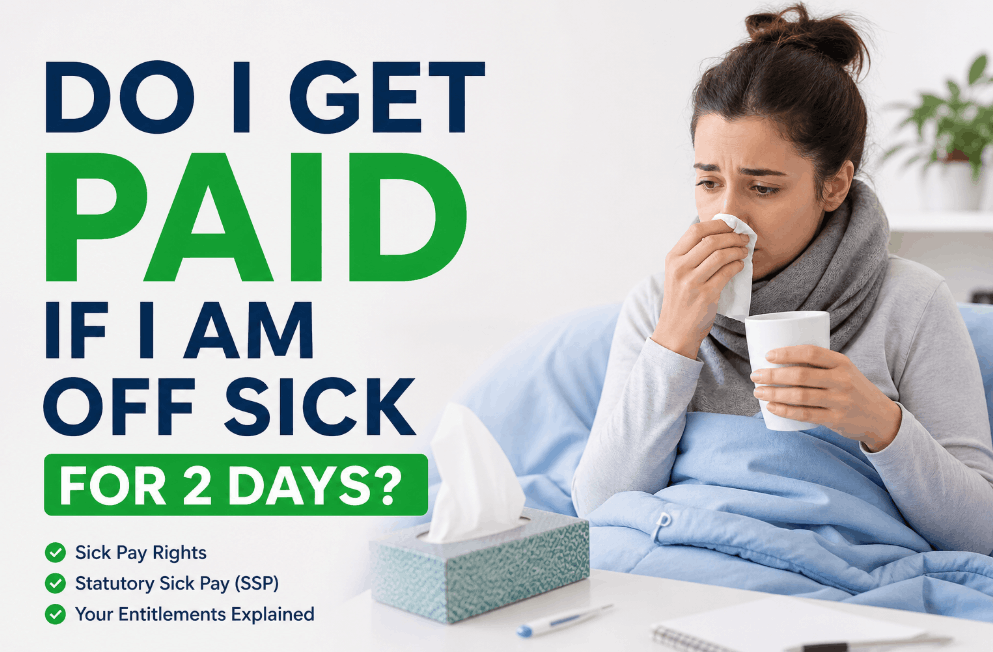
Do i get paid if i am off sick for 2 days under current UK law?
In the UK, you are legally entitled to be paid for a two-day sickness absence provided you are classified as a worker and earn enough to meet the updated eligibility thresholds.
Most staff members are entitled to either Statutory Sick Pay (SSP) at the mandatory government rate or Company Sick Pay, which is a more generous internal scheme provided by many firms across the UK.
The Shift to Day One Rights
The most significant change in recent years is the removal of the three-day waiting period. Previously, an individual missing only two days of work would receive nothing under the statutory system.
In the current 2026 landscape, the UK government has mandated that SSP must be paid from the first day of incapacity. This shift ensures that a brief period of ill health no longer results in an immediate loss of earnings for the workforce.

This protection is particularly important if your absence isn’t due to a seasonal bug but a workplace incident; in such cases, understanding I had an accident at work, what are my rights UK is essential to ensure you are claiming the correct level of support.
Staying informed on these changes is essential for navigating sudden changes to your health or work schedule effectively.
| Feature | Statutory Sick Pay (SSP) | Company (Occupational) Pay |
| Payment Starts | Day 1 (as of 2026) | Usually Day 1 |
| Minimum Amount | £123.25 per week (pro-rata) | Full basic salary (typically) |
| Duration | Up to 28 weeks | Varies by contract length |
| Eligibility | Earn at least £123/week on average | All contracted employees |
How much is the 2-day sick pay rate in 2026?
For those relying on the statutory minimum, the amount received for two days of absence is calculated as a pro-rata portion of the weekly SSP rate.
As of the April 2026 rate adjustment, the weekly SSP figure stands at £123.25. To find the daily rate, this figure is divided by the number of qualifying days you normally work in a week.
Calculating Your Payment
If you work a standard five-day week, your daily sick pay is approximately £24.65. Therefore, a two-day absence would result in a gross payment of £49.30. It is important to note that for lower-income earners, a secondary calculation exists: the 80% rule.
This ensures that if the standard SSP rate exceeds 80% of your usual earnings, your payment may be capped at that 80% threshold to maintain a balance between support and earnings replacement.
Consider an analyst working a four-day week. If they fall ill for two days, the absence is now calculated based on 2/4ths of the weekly rate. She sees an additional £61.63 on her next payslip, as her company does not offer an enhanced scheme.
What are the requirements for claiming sick pay for two days?
To secure payment for a short absence, you must adhere to the notification procedures set out by your employer. While the law protects your right to pay from day one, failing to report your absence correctly can lead to delays or disputes regarding your eligibility.
Essential Steps for Documentation
For any absence under seven days, you do not need a Fit Note from a GP. Instead, you are entitled to self-certify. This involves informing your employer, usually via email, a phone call, or an internal HR portal, that you are unfit for work due to illness.
- Notify your supervisor before the designated cut-off time (usually within an hour of your start time).
- Clearly state the first day of your illness, even if it was a non-working day.
- Confirm your expected return-to-work date.
- Complete any internal self-certification forms provided by your HR department upon your return.
- Ensure your earnings meet the Lower Earnings Limit (LEL) if applicable to your specific contract type.
- Verify that the days missed were qualifying days (days you were scheduled to work).
- Keep a written record of your communication in case of payroll errors.

Does Day One sick pay apply to zero-hours contracts?
A common area of uncertainty involves flexible or zero-hours agreements. However, under the 2026 rules, the Fair Work Agency (FWA) confirms that worker status includes those on irregular hours.
If you were scheduled to work a shift and could not attend due to illness, you are entitled to SSP for those two days, provided you meet the basic earnings criteria.
To maintain compliance, many businesses have tightened their internal auditing processes following increased HMRC wage raid payroll checks which aim to catch firms failing to pay the statutory minimum. Under current enforcement, if you have a consistent pattern of work, you are protected.
Fair Work Agency Enforcement
In practice, some employers previously attempted to bypass sick pay for short-term staff by claiming they weren’t permanent.
This level of oversight is maintained by the FWA, which now monitors digital payroll submissions to ensure Day One rights are applied consistently to part-time and gig-economy workers.
Can an employer refuse to pay for a 2-day illness?
While the statutory right is clear, there are specific instances where an employer might legally withhold pay. This usually occurs if the employee has already exhausted their 28-week SSP entitlement or if they failed to notify the company within the timeframe specified in their employment handbook.
Common Grounds for Withholding Pay
If your employer refuses to pay for those two days based on an old policy of waiting days, they are in breach of current 2026 regulations.
A common pattern seen in recent tribunal cases involves small businesses failing to update their handbooks to reflect the abolition of waiting days. In these instances, the worker is entitled to back-pay.
A recent case involved a retail assistant in Birmingham whose manager claimed we don’t pay for the first three days. After the employee cited the 2026 SSP reforms, the HR department intervened to correct the payroll, acknowledging the manager was following an obsolete 2024 policy.
| Reason for Non-Payment | Legal Status | Action Required |
| Late Notification | Potentially Legal | Check contract for notification windows |
| Waiting Days Policy | Illegal (Post-2026) | Request payroll correction |
| Under Earnings Limit | Legal | Check if 80% rule applies |
| Already had 28 weeks | Legal | Transition to Universal Credit/ESA |
Do I need a doctor’s note for a two-day absence?
There is often a misconception that a GP appointment is required for any period of paid leave. However, the seven-day rule remains the standard for medical evidence.
You only require a medical Fit Note if you are off for more than seven consecutive days (including weekends).
Self-Certification Limits
For a two-day absence, your employer cannot legally demand a doctor’s note as a condition for SSP. If your company policy insists on a private certificate for shorter periods, the employer is typically responsible for covering any costs associated with the GP’s fee for that letter.
In most professional environments, a simple internal form or email notification is sufficient to trigger the payroll process.

How does the Linked Periods rule work for short absences?
If you are off for two days, return to work, and fall ill again shortly after, these may be considered linked absences. In the 2026 system, linking is less critical for the start of payment (since waiting days are gone) but remains vital for tracking the 28-week maximum limit.
Understanding Linking
Absences are linked if they last at least one day and are eight weeks (56 days) or less apart. If you have a recurring condition that causes frequent two-day absences, the total days are added together.
This is a crucial protection for those with chronic health issues, ensuring that their tenure of support is accurately recorded by HMRC systems.
- Absences must be at least 1 day long to count.
- The gap between illnesses must be 8 weeks or less.
- Linking ends if the gap exceeds 56 days.
- The total duration cannot exceed 28 weeks of pay.
Summary of Next Steps for UK Workers
If you have missed two days of work due to illness, your priority should be ensuring your employer has processed the Day One payment correctly.
Start by checking your employment contract on your staff portal—many modern UK businesses now offer Occupational Health benefits that pay full salary from the first hour of absence.
If you are on the statutory minimum, verify your next payslip against the 2026 SSP daily rate of approximately £24.65 (based on a 5-day week).
If your payment is missing or your manager mentions waiting days, gently remind them of the April 2026 legislative update or contact the Fair Work Agency for guidance.
FAQ about Do I get paid if i am off sick for 2 days
Does my 2-day sick pay get taxed?
Yes. Statutory Sick Pay is treated like regular wages. Your employer will deduct Income Tax and National Insurance (NI) through the PAYE system before the money reaches your bank account.
Can I get sick pay for 2 days if I am self-employed?
No. Self-employed individuals are generally not eligible for SSP. Instead, they may need to claim Employment and Support Allowance (ESA) or rely on private income protection insurance.
What if I am sick during my annual leave for 2 days?
You have the right to reclaim your holiday. If you fall ill during a booked holiday, you can report it as sick leave instead, allowing you to use those two days of annual leave at a later date.
Is sick pay different for 16-18 year olds?
No. As long as you are classed as a worker and meet the earnings threshold, the same Day One SSP rules apply regardless of your age.
Do I get paid for 2 days if I’m an agency worker?
Yes. Agency workers have the same rights to SSP as permanent employees, provided they have started their assignment and meet the standard eligibility criteria.
Can my boss use the Bradford Factor to penalise me for 2 days?
While companies use the Bradford Factor to track absence patterns, they cannot use it to withhold statutory pay. However, frequent short-term absences may trigger internal review meetings.
Does sick pay apply if my child is sick for 2 days?
No. SSP is only for your own illness. If you take time off to care for a child, this usually falls under Dependant Leave, which is often unpaid unless your contract states otherwise.