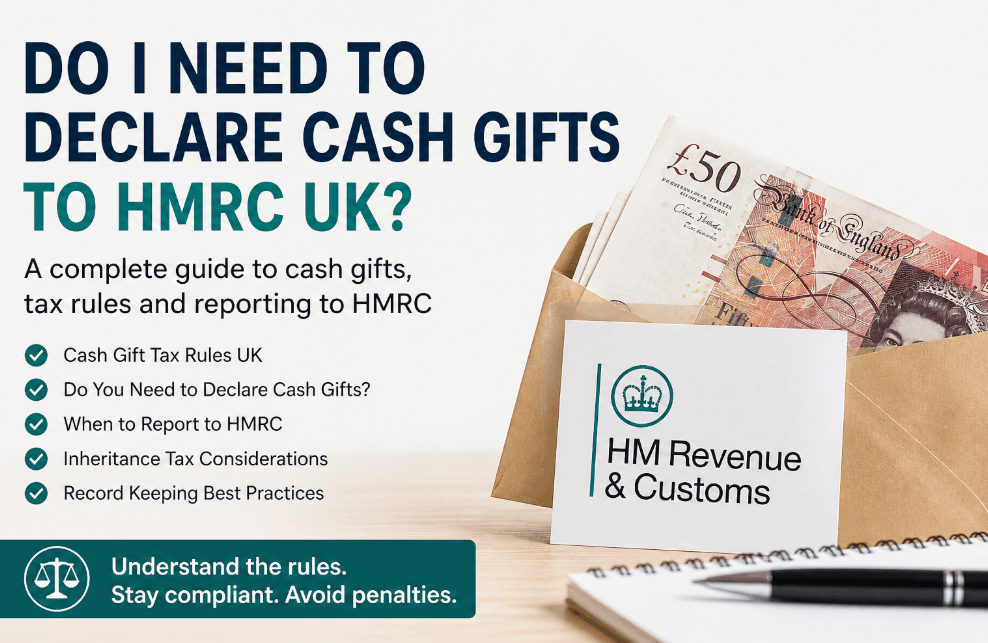
In the UK, receiving a cash gift is not considered taxable income, meaning you generally do not need to declare it to HMRC on a Self Assessment tax return. Most personal gifts from parents, family, or friends are free from immediate tax.
However, you must track these gifts for Inheritance Tax (IHT) purposes if the giver passes away within seven years or if the gift exceeds specific annual exemptions.
Do I need to declare cash gifts to HMRC UK?
The simple answer for the vast majority of UK residents is no; you do not need to declare cash gifts to HMRC at the point of receipt. Unlike a salary or business profits, HMRC does not classify a genuine gift as income.
Consequently, the receiver pays £0 in Income Tax, and there is no specific box on a standard tax return to report personal cash gifts.
The Truth About Gifting and Reporting
While you don’t declare the gift as income, the responsibility often shifts to the giver’s estate or the executors later. If a gift is large (exceeding the £3,000 annual allowance), it is classed as a Potentially Exempt Transfer (PET).
This means it only stays tax-free if the giver survives for seven years after making the payment. If they pass away sooner, the gift must then be declared during the probate process to calculate the Inheritance Tax.

Are cash gifts considered taxable income in the UK?
It is a common misconception that large sums of money landing in your bank account must be taxed. In the UK, the tax system distinguishes between earned and unearned money.
Because a gift has no consideration (you didn’t work for it or provide a service in return), it falls outside the scope of the Income Tax Act.
Whether you receive £100 for your birthday or £50,000 for a house deposit, the tax liability at the moment of transfer is zero for the recipient.
The only exception is if that money starts generating its own income—for example, if you put the cash in a savings account, you will owe tax on the interest earned if it exceeds your Personal Savings Allowance.
It is worth noting that HMRC warns that savings over £3,501 may incur tax depending on your total annual earnings and interest rates.
When must you actually report a gift to HMRC?
While the receipt of the money is invisible to the taxman, there are three specific scenarios where a paper trail becomes essential for HMRC compliance.
Following the Death of the Giver
If the person who gave you the money dies within seven years, the gift is added back into their estate. The executors must report all gifts exceeding the annual exemptions made in the seven years prior to death using form IHT403.
If the total estate (including these gifts) exceeds the £325,000 Nil-Rate Band, tax may be due.
Large Deposits and Anti-Money Laundering (AML)
Under the Money Laundering Regulations 2026, UK banks are required to monitor unusually large or complex transactions.
If you deposit a significant cash gift, your bank may freeze the funds until you provide a Gift Letter or evidence of the source of wealth. This isn’t a report to HMRC for tax, but it is a regulatory requirement for financial transparency.
This transparency is part of a broader trend of HMRC personal expenditure crackdown measures aimed at ensuring large transfers align with declared wealth.
Regular Gifts for Living Costs
If you are receiving regular payments, such as a parent paying your monthly rent, these can be exempt under the Normal Expenditure out of Income rule.
To qualify, these don’t need to be declared, but you must keep records showing the giver could afford the gift from their surplus monthly income without dipping into their savings.

How much cash can I gift tax-free in 2026?
HMRC provides several safe zones where gifts are immediately exempt and never need to be declared or tracked for the 7-year rule.
| Exemption Type | Amount | Key Condition |
| Annual Exemption | £3,000 | Can be given to one person or split; carries forward 1 year. |
| Small Gift Allowance | £250 | Per person, per tax year; cannot be combined with other gifts. |
| Wedding Gift (Child) | £5,000 | Must be given on or shortly before the wedding date. |
| Wedding Gift (Grandchild) | £2,500 | Specific to grandchildren or great-grandchildren. |
| Wedding Gift (Other) | £1,000 | For friends or other relatives. |
Understanding the 2026 Thresholds
As of May 2026, the Inheritance Tax Nil-Rate Band remains frozen at £325,000. This freeze, recently extended through to 2031, means that more families are being caught in the IHT net as asset values rise.
Using your £3,000 annual allowance is one of the most effective ways to reduce a future tax bill without needing to notify HMRC.
What is the 7-Year Rule and how does Taper Relief work?
If a gift exceeds the allowances mentioned above, it enters a probationary period. This is known as the 7-year rule. If the giver survives three years, the potential tax rate on that specific gift starts to reduce. This reduction is called Taper Relief.
The Taper Relief Schedule
If tax is due on a gift because the Nil-Rate Band has been exhausted, the following rates apply:
- Years 0 to 3: 40% tax (No relief)
- Years 3 to 4: 32% tax (20% relief)
- Years 4 to 5: 24% tax (40% relief)
- Years 5 to 6: 16% tax (60% relief)
- Years 6 to 7: 8% tax (80% relief)
- After 7 Years: 0% tax (Full exemption)
Practical Example: In 2024, a grandfather gifted his grandson £400,000 (exceeding his £325,000 limit). If the grandfather passes away in 2029 (5.5 years later), the tax on the £75,000 excess is reduced by 60%. Instead of the estate paying £30,000, it would pay £12,000.
Receiving cash gifts from abroad: Do the rules change?
When money crosses borders, the scrutiny increases. If you are a UK tax resident receiving a gift from a non-UK resident (e.g., a parent living in India or the USA), the Income Tax rules remain the same: it is not taxable income.
However, you should prepare for Source of Funds checks.
- Bank Triggers: Transfers over £10,000 often trigger automatic flagging.
- Documentation: Keep a signed letter from the sender stating: I, [Name], am gifting [Amount] to my child [Name] as an unconditional gift with no expectation of repayment.
- Double Taxation: While the UK won’t tax the gift, ensure the sender’s home country doesn’t have Gift Tax laws that require them to report the transfer locally.

7 Steps to Documenting a Large Cash Gift
If you are involved in a significant transfer, follow this protocol to satisfy both banks and future HMRC audits:
- Draft a Gift Letter: Clearly state it is a gift, not a loan.
- Identify the Source: Keep a copy of the bank statement showing the money leaving the giver’s account.
- Check Allowances: Note if the £3,000 annual exemption or wedding allowances apply.
- Record the Date: This is the start date for the 7-year clock.
- Calculate Surplus Income: If giving regularly, keep a simple spreadsheet of the giver’s monthly income vs. expenses.
- Store Centrally: Keep these records with the giver’s Will; executors will need them.
- Monitor the 7-Year Clock: Use a calendar reminder to note when the gift becomes fully exempt.
Summary
The burden of answering do i need to declare cash gifts to HMRC UK is lighter than many expect. For the person receiving the money, there is no tax to pay and no immediate paperwork to file with HMRC. The complexity lies entirely within the realm of Inheritance Tax and the 7-year clock.
Next Steps:
- For Receivers: Ensure you have a gift letter if the sum is for a property purchase.
- For Givers: Keep a Gift Log documenting the date, amount, and recipient for your executors.
- For Large Estates: If your total assets exceed £325,000, consult a tax professional to ensure your gifting strategy doesn’t create an accidental tax trap for your heirs.
If you have a unique case that requires direct verbal confirmation, you can use the HMRC telephone number free 0800 0345 opening times to speak with an agent.
FAQ about Do I need to declare cash gifts to HMRC UK
Can my parents give me £10,000 for a house deposit?
Yes. You do not need to declare this to HMRC, but your mortgage lender will require a Gifted Deposit Letter and proof of your parents’ ID to comply with anti-money laundering regulations.
Do I include gifts on my Self Assessment tax return?
No. There is no requirement to include personal cash gifts on a UK tax return as they are not classified as taxable earnings, regardless of the amount.
Is there a limit to how many £250 gifts I can give?
You can give £250 to as many people as you like, provided you haven’t used any other exemption (like the £3,000 allowance) on that same person in the same tax year.
What happens if I don’t declare a taxable gift after a death?
If an executor fails to report taxable gifts, HMRC can issue significant penalties. In extreme cases of deliberate concealment, this can lead to criminal investigations for tax evasion.
Does the receiver ever pay the tax?
Usually, the tax is paid by the estate. However, if the estate cannot cover the bill, HMRC may legally pursue the recipient of the gift for the outstanding Inheritance Tax.
Can I give money to my spouse tax-free?
Yes. Gifts between spouses or civil partners who are both permanently living in the UK are exempt from Inheritance Tax, regardless of the amount or when they are given.
Is there tax on cash gifts from friends?
The same rules apply as with family. It is not income tax, but it falls under the 7-year rule for Inheritance Tax if the friend passes away within that timeframe.
For those in retirement, it is also essential to ensure that gifting doesn’t inadvertently complicate HMRC pensioner tax codes if other income streams are being adjusted simultaneously.