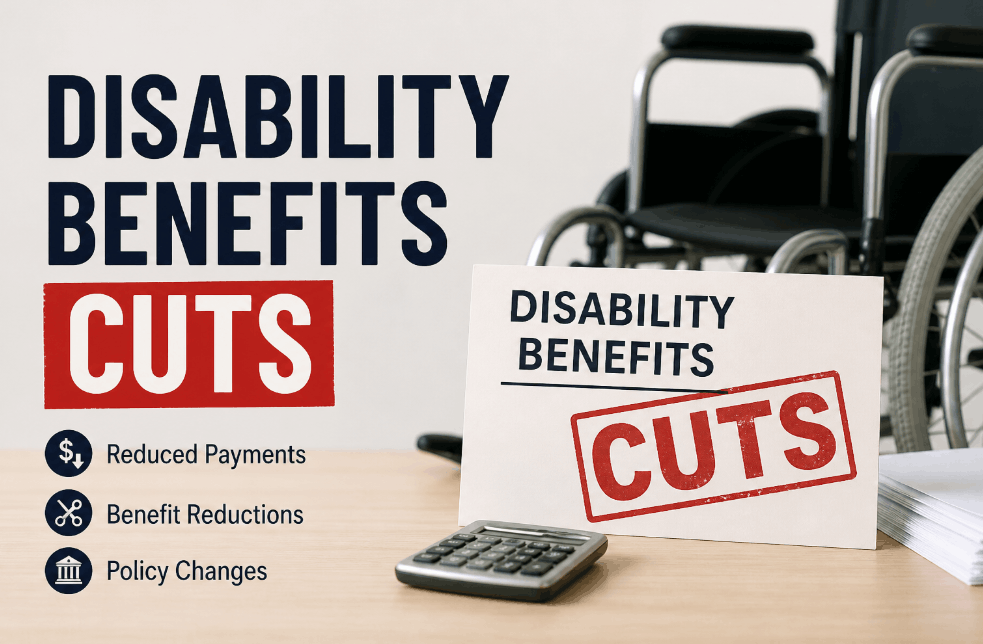
The landscape of UK welfare is shifting significantly this year as the Department for Work and Pensions (DWP) implements the Universal Credit Act 2025. For many, the primary concern revolves around disability benefits cuts that specifically target the “health element” of Universal Credit and tighten Personal Independence Payment (PIP) assessment criteria.
While existing claimants often retain legacy protection, new applicants from April 2026 face a tiered system where support is increasingly linked to the severity of a condition rather than its mere presence.
Understanding the wider context of these PIP cuts is essential for anyone navigating the current welfare landscape.
What are the major disability benefits cuts in 2026?
The most significant change in 2026 is the nearly 50% reduction in the Universal Credit (UC) “health element” for new claimants.
Previously known as the LCWRA element, this payment was worth approximately £432 per month; however, for those claiming after 6 April 2026 who do not meet the new “severe conditions” criteria, the payment has been cut to £217.26.
Furthermore, this lower rate is frozen until 2030, meaning its value will decrease in real terms as inflation rises.
Core Truth: The Two-Tiered System
The 2026 reforms create a two-tiered welfare state. If you were already receiving disability elements before April 2026, your income is generally protected.
If you are a new claimant, you are subject to the lower Health Element unless you can prove a severe, life-long condition. This shift moves the focus from “limited capability for work” to a medicalised severity model.

How do the 2026 Universal Credit changes impact your budget?
For a single person over 25, the combined loss of the higher health element and the inflationary freeze could lead to a household budget deficit of over £2,700 per year by 2030.
While the DWP has increased the “Standard Allowance” of Universal Credit above inflation to compensate the general population, this does not cover the shortfall for disabled individuals who face higher daily living costs.
| Benefit Component | Pre-April 2026 Rate | Post-April 2026 (New Claims) | Change Impact |
| UC Health Element (LCWRA) | £432.27 | £217.26 | -£215.01 per month |
| PIP Daily Living (Enhanced) | £110.40 (weekly) | £114.60 (weekly) | +3.8% (Uprated) |
| PIP Mobility (Standard) | £29.20 (weekly) | £30.30 (weekly) | +3.8% (Uprated) |
| UC Standard Allowance (25+) | £400.14 | £424.90 | +Above Inflation Uplift |
Data Source: DWP Uprating Schedule 2026 & House of Commons Library Research.
When calculating these figures, many claimants often ask how much is pip per month under the new uprated schedules to ensure their household accounts remain accurate.
Who is protected as a “Pre-2026 Claimant”?
Protection is the word of the year for existing claimants. If your entitlement to the Universal Credit health element (LCWRA) began on or before 5 April 2026, you are classified as a “pre-2026 claimant.”
This means you will continue to receive the higher rate of support, and your payments will continue to be uprated in line with inflation (CPI), unlike the new lower rate which remains frozen.
Are there exceptions for new claimants?
Yes. Even if you claim after the April deadline, you may still receive the higher “protected” rate if you meet one of the following:
- Terminal Illness: You have a progressive disease where death can reasonably be expected within 12 months.
- Severe Conditions Criteria: You have a condition that is “life-long, severe, and requires high levels of support,” a definition currently being refined by the Timms Review (due Autumn 2026).
- ESA Migration: You are moving from Employment and Support Allowance (ESA) to Universal Credit and already held the “Support Group” status.
How to navigate the new PIP assessment rules?
While PIP remains a non-means-tested benefit, the DWP has increased the proportion of face-to-face assessments to 30% in 2026.
Evidence suggests that face-to-face assessments currently have a lower success rate (44%) compared to telephone assessments (57%). In practice, this means applicants must be more rigorous in providing medical evidence from the outset.
A Step-by-Step Guide to Claiming in 2026:
- Check Eligibility: Ensure you have had difficulties for 3 months and expect them to last 9 more.
- Request Form PIP1: Call the DWP to start the Part 1 process and verify identity.
- Gather Evidence of Impact: Do not just list your diagnosis; explain how it prevents you from cooking, washing, or moving safely.
- Complete the How Your Disability Affects You Form: Be specific about bad days.
- Prepare for the Assessment: If called for a face-to-face meeting, bring a companion for support.
- Review the Health Professional’s Report: You can request a copy before the final decision is made.
- Mandatory Reconsideration: If denied, you have one month to challenge the decision.
- Appeal to Tribunal: If the reconsideration fails, independent tribunals still rule in favour of the claimant in roughly 68% of cases.

Why is the DWP increasing face-to-face reviews?
The shift back to in-person meetings is part of a broader strategy to “ensure accuracy” and “release health professionals for more complex reassessments.” However, for many claimants, this adds a layer of physical and mental stress.
A common pattern in 2026 is the DWP extending existing award periods to a minimum of three years to reduce the backlog, while simultaneously making new claims harder to verify without an in-person appointment.
How can you plan a budget with reduced benefits?
When reviewing decisions and planning for a lower income, focus on “hidden” support. Many disability-related expenses can be offset through schemes that do not depend on the Universal Credit health element.
- Social Tariffs: Most broadband and water providers (like BT or Thames Water) offer significantly reduced rates for those on any element of Universal Credit.
- The Motability Scheme: While tax breaks under Motability are being reviewed in July 2026, the scheme remains the most cost-effective way to lease a wheelchair-accessible vehicle.
- Council Tax Support: Each local council in the UK has its own “Council Tax Reduction” scheme. Being on disability benefits often qualifies you for the maximum 100% discount.
- Household Support Fund: If the benefit cuts leave you in immediate crisis, contact your local authority to apply for emergency grants for food or fuel.
While past initiatives like the DWP £299 cost of living payment provided temporary relief, current planning should focus on long-term social tariffs and local discounts.
Summary
The disability benefits cuts of 2026 represent a major shift toward a medical-severity model. If you are an existing claimant, ensure your Change of Circumstances are reported accurately to avoid losing your protected status.
If you are a new applicant, focus heavily on gathering secondary medical evidence to meet the “Severe Conditions” threshold. Always check for local council tax discounts and social tariffs to bridge any budget gaps.

FAQ about disability benefits cuts
Is PIP being abolished in 2026?
No, PIP is not being abolished. However, the 2026 reforms aim to make PIP the “sole gateway” to health-related support, eventually removing the need for a separate Work Capability Assessment (WCA) by 2029.
What is the new “Severe Conditions” criteria?
This is a new status for claimants with life-long disabilities. Those who meet it are exempt from the 2026 UC health element cuts and are rarely called for reassessments.
Will my current benefits be cut if I stay on them?
Generally, no. Existing claimants are protected under “transitional protection” or “pre-2026” status. A cut usually only occurs if your claim stops and you have to make a brand-new application.
How much did benefits go up in April 2026?
Most disability benefits, including PIP and Attendance Allowance, increased by 3.8%. However, Universal Credit only saw a 2.3% base increase, with some elements being frozen or cut for new claims.
Can I lose my disability status if I try to work?
Under the 2026 “Transforming Future Support” rules, the DWP claims that seeking work should not automatically trigger a reassessment of your disability elements, though this is still in the implementation phase.
What happens if I miss my face-to-face assessment?
Missing an assessment without a “good reason” can lead to your benefit being suspended. The DWP now requires health professionals to “seek to understand” the reason before applying sanctions.
Is there a cap on disability benefits in 2026?
Disability benefits like PIP and the UC health element are usually exempt from the “Benefit Cap,” meaning your total income can exceed the standard limits if you have high care needs.