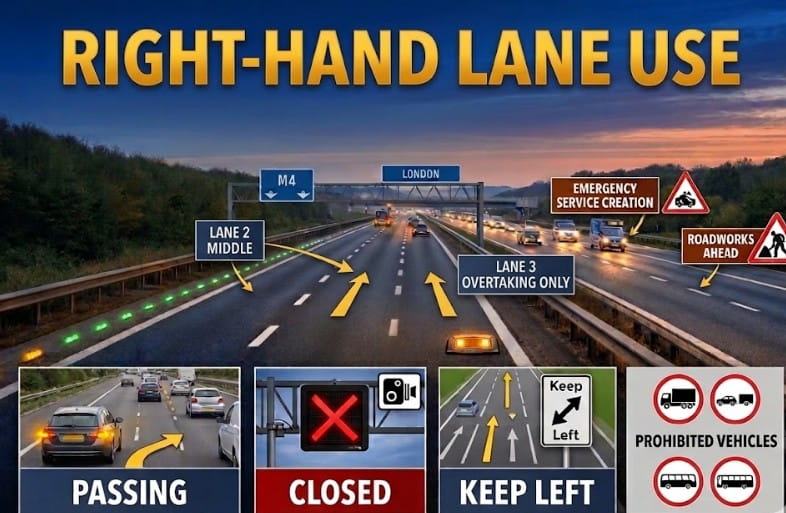
According to the Highway Code, you should only use the right-hand lane for overtaking slower-moving traffic or when directed by signs. If you are wondering, When would you use the Right-Hand Lane on a Three-Lane Motorway? the answer is strictly for passing vehicles before returning to the left.
When would you use the right-hand lane on a three-lane motorway?
On a three-lane UK motorway, you use the right-hand lane exclusively as an overtaking lane. Under Highway Code Rule 264, you must drive in the left-hand lane if the road ahead is clear.
You should only enter the right-hand lane to pass slower vehicles in the middle lane and must return to the left as soon as it is safe.
The Reality of Lane 1 as Your Default
The backbone of safe motorway travel is the Keep Left rule. Motorways function as a hierarchy where Lane 1 is the default driving lane for all vehicles. Lanes 2 and 3 are temporary extensions of the road designed to facilitate flow.
Staying in the outer lanes when the inside is clear, commonly known as lane hogging, is not just poor etiquette, but a prosecutable traffic offence regardless of your speed.
What are the 3 lanes on a motorway?
Understanding the designation of each lane is essential for safety and legal compliance. While many drivers refer to them by nicknames, the DVSA identifies them numerically, starting from the left.
- Lane 1 (Left-hand lane): This is the primary driving lane. Every vehicle should stay in this lane unless they are overtaking. Drivers should also look for green reflective studs on a motorway to identify slip road boundaries and lay-bys during night driving.
- Lane 2 (Middle lane): Used for overtaking vehicles in Lane 1.
- Lane 3 (Right-hand lane): Used for overtaking vehicles in Lane 2.
On a standard UK motorway, the three lanes are designated by their position relative to the verge. Knowing what colour reflective studs are on each part of the road helps you identify your lane position during poor visibility. Lane 1 is the left-hand lane for normal driving, while Lane 2 and Lane 3 are for overtaking.
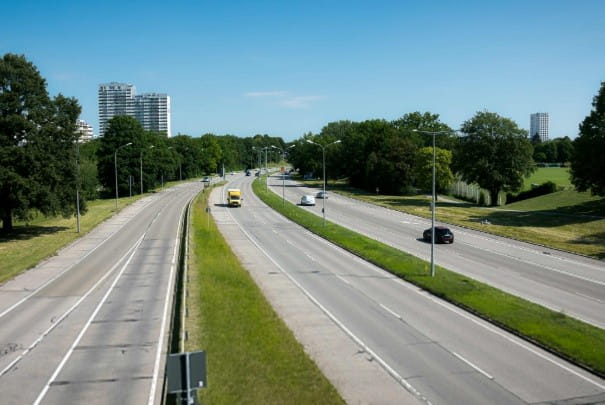
When may you use the right-hand lane?
While overtaking is the primary reason, there are specific legal and safety scenarios where occupying the right-hand lane is necessary or required by law.
- Overtaking: When a vehicle in Lane 2 is travelling slower than you, and you wish to maintain your progress without undertaking (passing on the left).
- Congestion: Under the stay in lane rule during heavy traffic, if all lanes are moving at similar slow speeds, you may remain in the right-hand lane to maintain flow.
- Emergency Services: Moving to the right to create space for an emergency vehicle on the hard shoulder or in Lane 1.
- Roadworks or Obstructions: When Lane Closed signs or Red X signals indicate that the left or middle lanes are blocked. You should also be prepared for a motorway contraflow system during major repairs, which may require you to switch sides of the carriageway.
- Large Scale Junctions: On some modern expressways, the right-hand lane may eventually become a dedicated lane for a specific motorway-to-motorway link.
Required Steps for Passing Overtaking Manoeuvres:
- Check your interior and right-wing mirrors for approaching high-speed traffic.
- Perform a blind spot check over your right shoulder.
- Signal right early to inform Lane 3 drivers of your intent.
- Accelerate smoothly into the gap, ensuring you do not cut off the vehicle behind.
- Maintain a safe distance from the vehicle in front (the two-second rule).
- Check your left-wing mirror to ensure you can see the front of the vehicle you just passed.
- Signal left and return to Lane 2 or Lane 1.
Under Highway Code Rule 264, you should always drive in the left-hand lane if the road ahead is clear. If you stay in the right-hand lane unnecessarily, you are lane hogging, which is a prosecutable offence.
Which vehicle is not allowed to use the right-hand lane?
Not every driver has the legal right to enter Lane 3. Under Highway Code Rule 265, certain vehicles are prohibited from using the right-hand lane on a motorway with three or more lanes, primarily due to speed and size restrictions.
Prohibited Vehicles Summary Table:
| Vehicle Type | Restriction Detail | Legal Basis |
| Heavy Goods Vehicles (HGVs) | Any vehicle with a maximum laden weight exceeding 7.5 tonnes. | Rule 265 |
| Vehicles with Trailers | Any car or van towing a caravan, horsebox, or trailer. | Road Traffic Act |
| Speed-Restricted Coaches | Coaches or buses exceeding 12 metres in length or restricted to 60mph. | Rule 265 |
| Speed-Limited Vans | Certain commercial vehicles have mandatory speed limiters. | Driver Regulations |
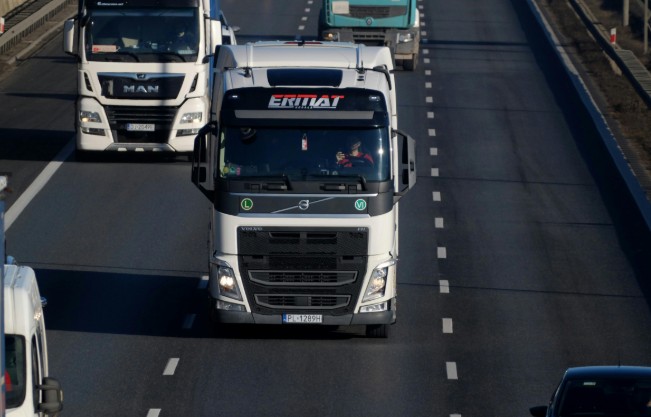
Mastering Motorway Compliance
Mastering motorway compliance involves knowing more than just basic rules. To fully answer, when would you use the Right-Hand Lane on a Three-Lane Motorway? You must look at specific legal prohibitions, such as those affecting heavy goods vehicles and trailers, which are barred from Lane 3 entirely.
Entry Protocols
Safe motorway lane discipline starts before you even enter Lane 1. The slip road is not merely an access path; it is a high-speed acceleration zone designed to allow your vehicle to match the ambient speed of motorway traffic, typically 60–70mph.
- The Full-Length Rule: In practice, many drivers make the mistake of merging too early at a lower speed. You must use the full length of the slip road to build momentum.
- The Merge: You should identify a safe gap in Lane 1, signal your intent, and merge smoothly.
- The Right-Hand Lane Restriction: It is both dangerous and a breach of good driving practice to dive across from a slip road directly into Lane 2 or the right-hand lane. You must establish your position in Lane 1 first before considering any overtaking manoeuvres.
Understanding Rule 265 and Prohibited Vehicles
While the right-hand lane is an asset for maintaining progress, it is legally off-limits to specific classes of vehicles.
Under Highway Code Rule 265, any vehicle towing a trailer or any goods vehicle with a maximum laden weight exceeding 7.5 tonnes is prohibited from using the right-hand lane on a motorway with three or more lanes.
The technical reasoning behind this restriction involves power-to-weight ratios and kinetic energy. Larger vehicles or those with trailers have significantly longer braking distances.
Allowing these vehicles into the right-hand lane, where speeds are consistently higher, would create a substantial safety deficit.
Furthermore, speed limiters on HGVs (usually capped at 56mph) would lead to elephant racing in Lane 3, where one slow vehicle attempts to pass another for several miles, causing catastrophic congestion for faster-moving business commuters.
Red X Enforcement
As of 2026, the enforcement of Red X signals on smart motorways has reached a zero-tolerance threshold.
A Red X displayed over the right-hand lane (or any lane) indicates that the lane is closed due to an accident, a broken-down vehicle, or roadworks ahead.
- Automated Enforcement: These signals are now integrated with HADECS3 camera systems. If you pass under a Red X in the right-hand lane, the camera triggers automatically.
- Fixed Penalties: The standard penalty is a £100 fine and 3 penalty points. In more severe cases where a driver endangers recovery crews, it can result in a court summons for dangerous driving.
- The Closed Lane Fallacy: Some drivers mistakenly believe they can use a closed right-hand lane to bypass congestion until they reach the obstruction. This is a criminal offence under the Road Traffic Act; the lane is considered dead the moment the first signal appears.
| Scenario | Legal Requirement | Penalty for Breach |
| Joining via Slip Road | Match speed and merge into Lane 1 only. | Careless Driving charge. |
| HGV in Lane 3 | Must stay in Lane 1 or 2 (Rule 265). | Fixed Penalty / Operator License check. |
| Red X Signal | Immediate exit from the lane. | £100 fine and 3 points (Automatic). |
| Middle Lane Hogging | Return to Lane 1 when clear. | £100 fine and 3 points. |
What is the 3-click method theory test?
For those preparing for the DVSA Theory Test, instructors recommend the 3-click method in the Hazard Perception module:
- Click 1: When you spot a vehicle ahead in Lane 2 slowing down.
- Click 2: As the situation develops, and you check your mirrors.
- Click 3: When the hazard requires you to change lanes or adjust speed.
What is the purpose of the right-hand lane on a three-lane expressway?
While motorways and expressways share similarities, an expressway (like certain sections of the A1(M) or high-grade A-roads) may have unique configurations. On a three-lane dual carriageway or expressway, the right-hand lane may be used for:
- Turning Right: Unlike motorways, dual carriageways often have junctions or gaps in the central reservation. You must take up the correct position in the right-hand lane in good time to turn right.
- U-Turns: Where legally permitted via a designated break in the central reservation.
- Overtaking: Standard overtaking rules apply exactly as they do on a motorway.
While the Keep Left rule is universal, expressways and three-lane dual carriageways introduce a critical exception: you may need the right-hand lane to prepare for an upcoming right-hand turn or a gap in the central reservation, manoeuvres you will never encounter on a standard motorway.
The Cost of Getting it Wrong
Poor lane discipline is not just a nuisance; it is a punishable offence. Since 2013, UK police have had the power to issue On-the-Spot Fines for middle-lane hogging and inappropriate use of the right-hand lane.
- Fixed Penalty Notice: Typically a £100 fine.
- Penalty Points: 3 points on your driving licence.
- Careless Driving: If your lane choice forces others to swerve or brake, you could be charged with Driving without reasonable consideration for other road users.
Consider the impact of a vehicle maintaining 65mph in the right-hand lane while the inner lanes are vacant. This creates a rolling roadblock, forcing other motorists to either brake or risk an illegal ‘undertake’ on the left.
Since 2013, UK roads policing units have actively targeted this behaviour with on-the-spot fixed penalties
The M4 Lane Discipline Penalty
A driver on the M4 was recently fined for remaining in the right-hand lane for several miles while Lane 1 was empty. The driver argued they were doing 70mph, but the police upheld the fine: Speed is irrelevant to lane discipline.

Summary of Key Takeaways
Modern driving standards recommend 9 and 3. This position offers better control, especially on high-speed motorways, and prevents injury if the steering wheel airbag deploys.
- Keep Left: Always drive in the left-hand lane unless overtaking.
- Right-Hand Lane is for Overtaking: Use it to pass traffic in Lane 2 and move back immediately after.
- Know the Prohibitions: HGVs and vehicles with trailers are strictly forbidden from Lane 3.
- Expressways Differ: On three-lane dual carriageways, the right-hand lane may be used to prepare for a right-hand turn.
- Avoid Fines: Stay alert to Red X signals on smart motorways and avoid lane hogging to stay clear of £100 penalties.
FAQ
When would you use the Right-Hand Lane on a Three-Lane Motorway versus a dual carriageway?
On a motorway, it is for overtaking only. However, on a three-lane dual carriageway, you may use the right-hand lane for overtaking slower traffic or when you intend to turn right at an upcoming junction or gap in the central reservation.
Which lane is the fast lane on a 3-lane highway?
There is no fast lane. This is a common misconception. All lanes have the same speed limit (70mph unless signs say otherwise). The right-hand lane is for overtaking only.
Can you stay in the right-hand lane on a motorway?
No. You should only stay in the right-hand lane for the duration of the overtaking manoeuvre. Once the lanes to your left are clear, you must move back.
What is lane 1 and lane 2?
Lane 1 is the driving lane on the far left. Lane 2 is the middle lane, used specifically for overtaking vehicles in Lane 1.
Is the theory test 50 questions?
Yes, as of 2026, the car theory test consists of 50 multiple-choice questions. You must answer at least 43 correctly to pass.
What lane should you be in for the 3rd exit?
On a motorway roundabout, you typically use the right-hand lane for any exit to the right (usually the 3rd exit or beyond), unless road markings indicate otherwise.
Should hands be at 10 and 2 or 9 and 3?
Modern driving standards recommend 9 and 3. This position offers better control, especially on high-speed motorways, and prevents injury if the steering wheel airbag deploys.