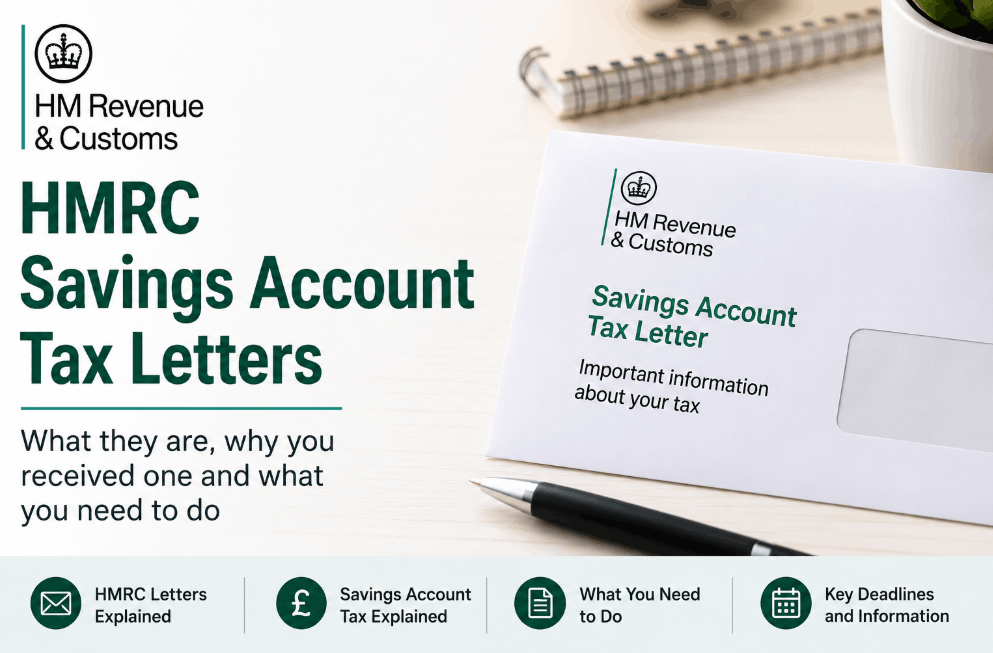
HMRC savings account tax letters are official notifications sent to UK taxpayers when bank-reported interest data suggests that untaxed income exceeds the Personal Savings Allowance.
In 2026, these letters, often titled P800 Tax Calculations or Simple Assessments, inform individuals of tax underpayments resulting from high-interest rates or frozen tax thresholds, requiring either a tax code adjustment or direct payment.
Why is HMRC sending more savings account tax letters in 2026?
HMRC is currently issuing a record volume of correspondence regarding savings interest due to fiscal drag and enhanced digital surveillance. As interest rates remain higher than in previous decades, thousands of savers are unintentionally breaching their Personal Savings Allowance (PSA).
Simultaneously, the HMRC Connect system now automatically cross-references data from UK banks and building societies against individual tax records, triggering automated letters whenever a discrepancy in declared interest is detected.
This digital vigilance is part of a broader transparency initiative. For instance, recent reports on the HMRC personal expenditure crackdown highlight how the agency is scrutinizing lifestyle spending against reported income to ensure total compliance.
The Reality of Savings Taxation
Under the Current Year Basis (CYB) system, HMRC does not wait for you to report interest manually if you are a PAYE employee. Banks are legally mandated to share your interest data at the end of each tax year.
If you earned £1,001 in interest as a basic-rate taxpayer, the system flags that £1 excess immediately. This real-time data sharing is why many people who have never engaged with HMRC are suddenly receiving letters in 2026.
How can you tell if your HMRC savings account tax letters are genuine?
With the rise in sophisticated phishing, verifying the authenticity of a tax letter is a critical first step for any UK resident.
Genuine letters regarding savings interest usually arrive in two specific formats: the P800 Tax Calculation or a Simple Assessment (PA302).
HMRC savings account tax letters will never ask for your bank details via a link or provide a refund that requires an upfront fee.
Official letters are sent by post and will direct you to log in to your Personal Tax Account via GOV.UK or the official HMRC app to settle any liabilities.
6 Steps to Verify and Handle an HMRC Tax Letter
- Check the Postage: Official HMRC mail is usually sent via second-class post with a distinctive HMRC or Revenue & Customs return address.
- Verify the Reference: Locate your National Insurance (NI) number on the letter; scams often use generic greetings like Dear Taxpayer.
- Cross-reference with the App: Log in to your official HMRC Personal Tax Account to see if the same notification exists digitally.
- Audit Your Statements: Total the interest from every non-ISA account you held between 6 April 2025 and 5 April 2026.
- Check the Calculation: Ensure HMRC hasn’t accidentally included ISA interest or Premium Bond winnings, which are tax-free.
- Contact via Official Channels: If in doubt, call the HMRC helpline using the number found on the official GOV.UK website, not a number provided in a suspicious letter.
How does the Personal Savings Allowance affect your tax letter?
The Personal Savings Allowance (PSA) dictates how much interest you can earn before a letter is generated. In the 2026/27 tax year, these thresholds remain strictly tied to your income tax band.
If your total income moves you into a higher bracket, your allowance drops significantly, often leading to an unexpected tax bill.
| Income Tax Band | Annual Income Range | 2026/27 Savings Allowance |
| Basic Rate (20%) | £12,571 to £50,270 | £1,000 Tax-Free |
| Higher Rate (40%) | £50,271 to £125,140 | £500 Tax-Free |
| Additional Rate (45%) | Over £125,140 | £0 (No Allowance) |
A common pattern observed in 2026 involves individuals whose salary is near the £50,270 mark. A small pay rise can push them into the Higher Rate band, which slashes their savings allowance from £1,000 to £500, instantly making their existing savings interest taxable and triggering a letter from HMRC.
It is also worth noting that the thresholds for triggering these alerts are lower than many realize. Specifically, HMRC warns that savings over £3,501 may incur tax depending on your total annual income and the current interest climate.
Why does HMRC already know about your bank interest?
Many taxpayers are surprised by the accuracy of the figures listed in their HMRC savings account tax letters. This is due to the Connect database, which aggregates data from over 30 different sources, including every UK-regulated financial institution.
- Automatic Reporting: UK banks report interest earned on all taxable accounts (excluding ISAs) directly to HMRC after the tax year ends.
- Third-Party Data: The system tracks interest from peer-to-peer lending, offshore accounts (via international agreements), and even digital payment platforms.
- The Nudge Strategy: HMRC often sends nudge letters to those they suspect have offshore interest, even if the exact figures aren’t yet confirmed, encouraging voluntary disclosure before penalties are applied.
In practice, trying to hide interest from a high-street bank account is virtually impossible in the current digital landscape. The Connect system is designed to identify these omissions with nearly 98% accuracy.
What should you do if the HMRC savings interest figures are wrong?
Mistakes can happen, particularly if you hold joint accounts or have recently closed an account. If the figure in your HMRC savings account tax letters does not match your bank statements, you must act within 60 days to prevent the tax from being collected automatically via your PAYE code.
A common issue occurs with joint accounts where HMRC may attribute 100% of the interest to one person rather than splitting it 50/50. When reviewing decisions made by the automated system, it is vital to provide certificates of interest from your bank to prove the correct split.
| Factor | How it Impacts the Letter |
| Joint Accounts | Interest is usually split 50/50 unless specified otherwise. |
| ISA Accounts | These should never be included; if they are, it is an error. |
| Premium Bond Prizes | These are 100% tax-exempt and should not trigger a letter. |
| Closed Accounts | HMRC may estimate projected interest based on the previous year. |
How is the tax collected once the letter is sent?
Once a letter is issued and the liability is confirmed, HMRC typically uses one of two methods to collect the funds. For those in retirement, the agency often utilizes specific HMRC pensioner tax codes to recover underpayments directly from monthly pension disbursements.
- PAYE Coding Notice: HMRC adjusts your tax code (e.g., from 1257L to a lower number). This means your employer deducts a little more tax from your wages each month to cover the savings debt.
- Simple Assessment: If you are a pensioner or your income isn’t easily adjusted via PAYE, you will receive a PA302 letter. This requires you to pay the tax online or via cheque by 31 January of the following year.
- Self Assessment: If your savings interest exceeds £10,000, you cannot be handled via letters alone; you must register for and file a full Self Assessment tax return.
FAQ
Does HMRC see my bank accounts automatically?
Yes, UK banks are legally required to send interest data to HMRC annually. While HMRC doesn’t see every transaction, they receive a total interest figure for every account linked to your National Insurance number.
What happens if I ignore the letter?
If you ignore a P800 or a Simple Assessment, HMRC will eventually force the collection by changing your tax code. If that isn’t possible, they may apply interest and penalties for late payment.
I’ve never paid tax on savings before—why now?
Frozen tax thresholds (fiscal drag) and higher interest rates mean your money is earning more than it used to, while the £1,000 and £500 allowances haven’t increased since 2016.
Can I pay the tax in a lump sum instead of through my wages?
Yes, you can log in to your Personal Tax Account and choose to pay the balance immediately via bank transfer or debit card to avoid a tax code change.
Are ISAs included in the interest HMRC tracks?
No, Cash ISAs, Stocks and Shares ISAs, and Premium Bonds are tax-exempt. If these appear on your letter, you should contact HMRC immediately to have them removed.
Why did I get a letter for interest from two years ago?
HMRC sometimes takes 12–24 months to reconcile data from multiple banks. These historic letters are common as the system catches up with older bank reports.
How do I dispute a letter if I think the bank made a mistake?
You should first request a Certificate of Interest from your bank. If this differs from the HMRC letter, call HMRC and provide the specific figures and account numbers to update your record.
Summary and Next Steps
Receiving HMRC savings account tax letters in 2026 is becoming a standard part of the UK tax experience for many savers. The most important action is to verify the figures against your actual bank statements.
If the letter is accurate, the tax will likely be collected automatically via your 2026/27 tax code. This is particularly relevant given the recent surge in HMRC savings notices for UK pensioners, who are increasingly being brought into the tax net due to rising interest rates on their nest eggs.
To minimize future letters, consider moving non-ISA savings into a Cash ISA or using a spouse’s unused Personal Savings Allowance through a joint account.