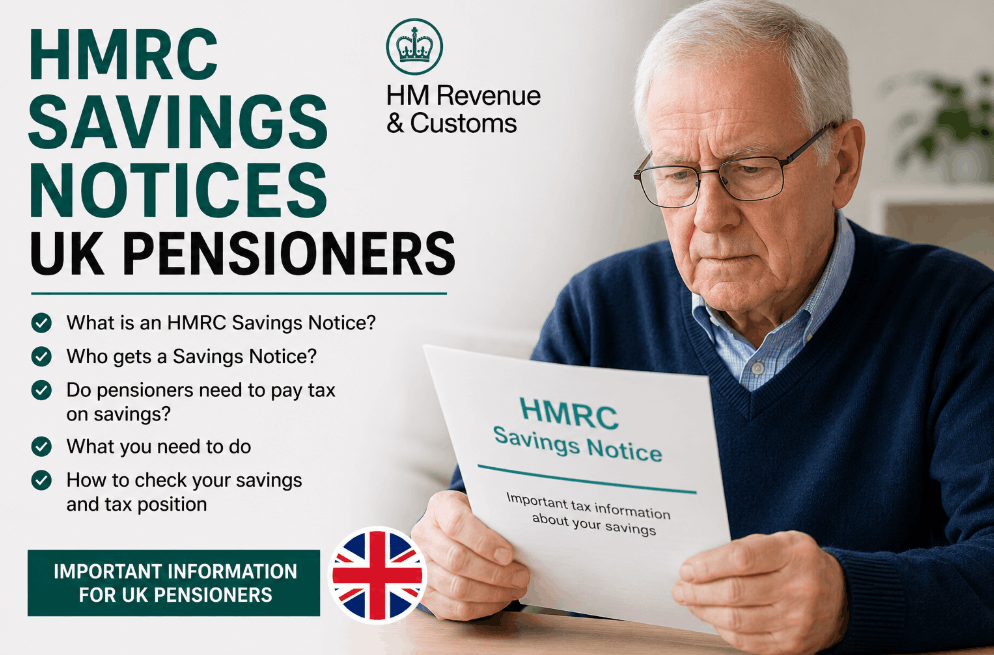
HMRC savings notices for UK pensioners are official communications, such as the PA302 Simple Assessment, sent to retirees whose savings interest exceeds their tax-free allowances. In the 2026/27 tax year, many pensioners are receiving these for the first time due to higher interest rates and frozen tax thresholds.
These notices calculate tax owed on bank and building society interest that has not been taxed at source.
Key Takeaways
- Check Your Form: Most savings tax bills arrive via a PA302 Simple Assessment rather than a standard tax return.
- Verify the Thresholds: In 2026/27, you only pay tax on interest if your total income exceeds your £12,570 Personal Allowance plus your Personal Savings Allowance.
- Watch for Errors: HMRC data often overlooks tax-free ISAs or shared interest from joint accounts; always cross-reference notices with your bank certificates.
- Act Fast: You generally have 60 days to challenge an incorrect notice before the debt is formalised.
What are HMRC savings notices UK pensioners receive?
Essentially, a savings notice is HMRC’s way of catching up with retirees whose combined income, state pension, private drawdowns, and bank interest has finally tipped over the tax-free thresholds.
These notifications, often delivered via a PA302 form, inform the individual that they owe Income Tax on interest earned from non-ISA savings accounts, which banks now report directly to HMRC.
HMRC uses a system called Simple Assessment for individuals whose tax affairs are straightforward but cannot be handled entirely through PAYE (Pay As You Earn).
Getting to the bottom of these figures requires a close look at your annual coding notice. If the DWP and your pension provider aren’t aligned, HMRC pensioner tax codes can often fall out of sync, causing your personal allowance to be applied incorrectly.
For many pensioners, the State Pension is paid gross (without tax deducted), meaning if your total income is even slightly above the £12,570 threshold, any additional savings interest quickly becomes taxable.

How do UK pensioners determine if a savings notice is accurate?
When a notice arrives, the first step is to cross-reference the figures with actual year-end certificates from banks and building societies.
HMRC receives data directly from financial institutions, but errors can occur if accounts are held jointly or if the interest was earned within a tax-free wrapper like an ISA, which should not be included in these calculations.
Steps to verify your HMRC savings notice:
- Gather all Certificate of Interest statements from your banks for the relevant tax year.
- Check your P60 statement from the DWP to confirm the exact amount of State Pension received.
- Identify any private pension income using P60S provided by your pension administrator.
- Calculate your total income by adding pensions and gross savings interest together.
- Subtract your Personal Allowance (£12,570) and your applicable Personal Savings Allowance.
- Compare your final taxable figure against the Total Tax Due listed on the PA302 notice.
- Ensure that interest from ISAs or Premium Bond winnings has been excluded from the HMRC total.
What are the tax-free limits for savings interest in 2026/27?
Taxation on savings depends entirely on your total annual income. Most pensioners benefit from two distinct allowances: the Starting Rate for Savings and the Personal Savings Allowance (PSA).
These work in tandem to protect smaller pots from taxation, but they diminish as your other income (like pensions) increases.
The threshold for intervention has become significantly lower in recent years due to the combination of rising rates and frozen allowances.
The margin for error is slimmer than most realise; current data suggests HMRC warns that savings over £3,501 may incur tax once a pensioner has already utilised their basic allowances through standard monthly payments.
| Income Type/Tax Band | Starting Rate for Savings (£5,000) | Personal Savings Allowance (PSA) |
| Total Income below £12,570 | Fully Available | £1,000 |
| Income between £12,571 – £17,570 | Partially Available (Sliding Scale) | £1,000 |
| Basic Rate Taxpayer (£17,571 – £50,270) | Not Available | £1,000 |
| Higher Rate Taxpayer (£50,271 – £125,140) | Not Available | £500 |
Why the Starting Rate for Savings matters for low-income pensioners?
In practice, if your combined pension income is less than £17,570, you may be eligible for the £5,000 Starting Rate for Savings. This means you could potentially earn a significant amount of interest before paying a penny in tax.
However, for every £1 of other income (like a private pension) above the Personal Allowance, your £5,000 starting rate is reduced by £1.
A common pattern observed in 2026 is pensioners with modest private pensions finding that their Starting Rate for Savings has been eaten away, leaving them with only the standard £1,000 PSA. This often results in an unexpected HMRC notice if they have moved funds into high-interest fixed-term bonds.
How should you respond to an HMRC savings notice?
If you receive a PA302 Simple Assessment, you generally have 60 days to challenge the figures if you believe they are incorrect. If the figures are correct, the tax must usually be paid by 31st January following the end of the tax year.
Failure to respond or pay within these windows can lead to interest charges or late payment penalties.
When reviewing decisions made by HMRC, it is vital to check if you have a Marriage Allowance transferred from a spouse. Case studies from this tax year show that simple clerical oversights, like a missing Marriage Allowance transfer, regularly result in incorrect bills for hundreds of pounds.
Upon checking, he realised HMRC had not applied the 10% tax-free transfer from his wife’s unused allowance. Once corrected, his tax bill was reduced to zero.
Common reasons for receiving a Nudge Letter about savings
Before a formal PA302 notice is issued, HMRC may send a nudge letter. This is a less formal correspondence suggesting that their records show you may have earned more interest than reported or allowed.
Rather than a formal demand, these are effectively ‘shot across the bows’ intended to let you correct your position before HMRC escalates to a formal enquiry.
While these notices target interest, many pensioners worry that other incoming funds might be flagged by the same automated systems.
For example, if you’ve recently helped a family member or vice versa, you should clarify: Do I need to declare cash gifts to HMRC UK to prevent any unnecessary red flags on your record?
- Joint Accounts: HMRC sometimes attributes 100% of the interest to one person rather than splitting it 50/50 between spouses.
- Fixed Bond Maturities: If a three-year bond matures, all the interest is usually taxed in the year of maturity, which can push you into a higher tax bracket.
- Estimated Income: HMRC often rolls forward previous years’ interest figures, which may be inaccurate if you have since spent the capital or moved it to an ISA.

Summary
HMRC savings notices are increasingly common as interest rates remain competitive. A savings notice isn’t an accusation of wrongdoing, but it does require prompt attention to ensure you aren’t paying more than the law requires.
Verify the interest totals against your bank statements, ensure your Marriage Allowance is correctly applied, and respond within 60 days if the data is incorrect. For most, the simplest way to avoid these notices in the future is to maximise the use of ISA allowances.
FAQ
Does the State Pension count towards my savings allowance?
The State Pension counts as taxable income. While it doesn’t reduce your £1,000 Personal Savings Allowance, it does reduce your £5,000 Starting Rate for Savings if your total income exceeds £12,570.
What is a PA302 form?
The PA302 is a Simple Assessment tax bill. HMRC sends this to pensioners when they owe tax that cannot be collected automatically from other income sources, such as a private pension.
Can I pay my savings tax through my pension?
If you have a private pension, HMRC can sometimes adjust your tax code so the tax is deducted monthly. However, if the amount is large or you only have a State Pension, you must pay it directly.
Do I need to complete a Self Assessment for savings interest?
Most pensioners do not need to file a full tax return for savings interest. HMRC usually handles this via Simple Assessment based on data provided by banks.
How do I contact the HMRC pensioner helpline?
Pensioners can contact the HMRC Income Tax helpline. It is helpful to have your National Insurance number and the reference number from your PA302 notice ready before calling.
What happens if I ignore an HMRC savings notice?
Ignoring a notice leads to automatic debt collection processes. HMRC may apply late payment penalties and daily interest, and they have the power to deduct the debt directly from your future pension payments.
Is interest from ISAs included in the HMRC notice?
No. Interest earned in a Cash ISA or Stocks and Shares ISA is strictly tax-free and should never be included in the totals on an HMRC savings notice.