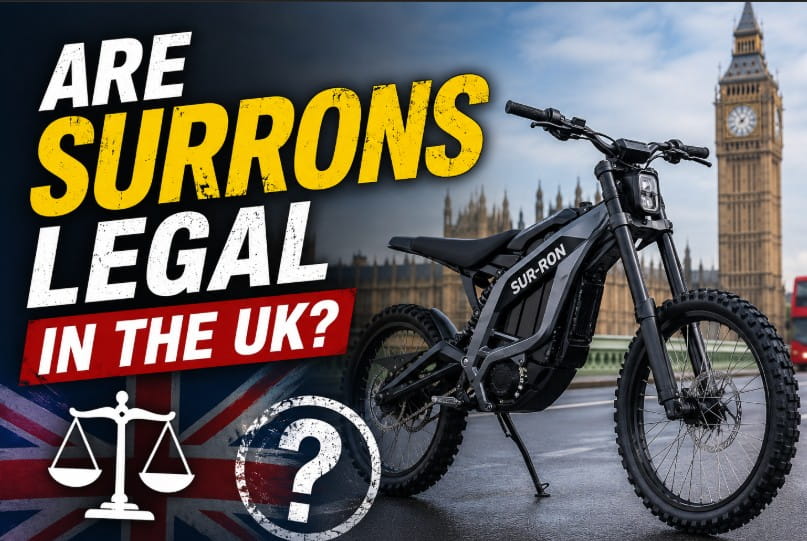
Whether you are wondering Are SurRons legal in the UK? Sur-Rons are generally not legal on UK public roads unless they are specific, factory-homologated L1e models that have been registered, taxed, insured, and fitted with a number plate.
Most off-road Sur-Ron variants fail the Electrically Assisted Pedal Cycle (EAPC) criteria and are legally classified as motor vehicles. Operating these on public roads without registration leads to seizure, fines, and points on your licence.
Are SurRons legal in the UK?
Sur-Rons are not classed as EAPCs (electric bicycles) because they generally exceed 250W of continuous rated power and do not feature functional pedals as their primary means of propulsion. As a result, they are classified as mopeds or motorcycles, meaning they must be registered, taxed, and insured before you can take them on public roads.

The EAPC Threshold Explained
An EAPC (electric bike) is a vehicle that must have pedals for propulsion, a motor with a maximum continuous rated power of 250W, and an electrical assist that cuts out at 15.5 mph. Sur-Ron models exceed these power outputs and typically offer throttle-only operation, disqualifying them from EAPC status.
The Consequences of Non-Compliance
Any Sur-Ron model failing the specific EAPC criteria is legally a motor vehicle. Therefore, riders must hold a valid licence, insurance, and tax for the vehicle.
If you still have questions regarding Are SurRons legal in the UK?, remember that using a non-compliant model on public roads is a serious offence.
Operating a non-compliant vehicle on public land leads to immediate seizure under Section 165A of the Road Traffic Act.
If you are caught on an unregistered, uninsured Sur-Ron, you face vehicle confiscation, heavy fines, and potential prosecution. Ignorance of these regulations is not a legal defence.
To qualify as an EAPC (electric bike) in the UK, a vehicle must have functional pedals, a motor with a maximum continuous rated power of 250W, and an electrical assist that cuts out at 15.5 mph. Any Sur-Ron model failing these specific criteria is a motor vehicle, not an e-bike.
Which SurRon Models Are Road-Legal?
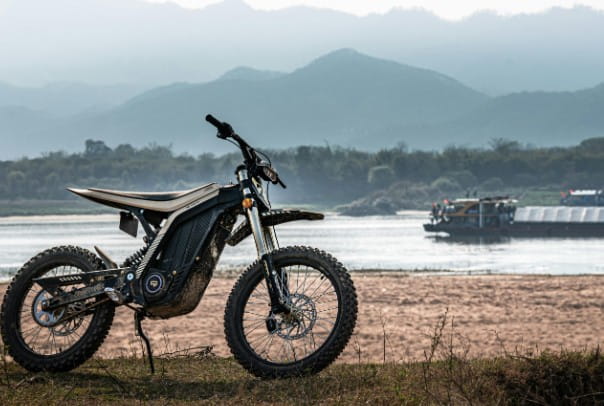
Sur-Ron offers specific L1E variants designed to comply with European and UK type-approval standards. These models are engineered with the necessary safety features required for public road use, including specific lighting, registration plate mounts, and speed-limiting components to ensure they meet moped or motorcycle classifications.
Comparison of SurRon Legal Status
The table below breaks down the UK legal status, vehicle classification, and licensing requirements for the most popular Sur-Ron models:
| Model | Classification | Licensing Requirement | Road-Legal Status |
| Light Bee X (Off-Road) | Motorcycle | Full Licence/CBT | No |
| Light Bee L1E | L1e-B Moped | AM Licence / CBT | Yes |
| Ultra Bee T | L3e Motorcycle | A1 / A2 Licence | Yes |
| Storm Bee (Road) | L3e Motorcycle | A1 / A2 Licence | Yes |
Note: The Off-Road variants lack the VIN (Vehicle Identification Number) and Certificate of Conformity (CoC) required for standard DVLA road registration.
How to Register a SurRon in the UK?
Attempting to register a standard off-road Sur-Ron (like the Light Bee X) is rarely successful. These models lack the required CoC and VIN documentation necessary for standard DVLA registration. Only factory-homologated L1E models are intended for road registration.
Steps to Register a Factory-Compliant Model
- Verify Compliance: Confirm your model has a valid VIN and meets UK type-approval standards.
- Obtain Documentation: Secure a Certificate of Conformity (CoC) or an age-related certificate if the vehicle is imported.
- Insurance: Insure the vehicle using the frame number (VIN) as the identifier.
- Registration Application: Submit the V55/5 form (for used vehicles) or V55/4 (for new vehicles) to the DVLA.
- NOVA Declaration: Complete the Notification of Vehicle Arrivals (NOVA) process to confirm VAT status on imported goods.
- Inspection (If Required): If the vehicle was not originally type-approved, it may require a Motorcycle Single Vehicle Approval (MSVA) test.
- Taxation and Plates: Once approved, pay the zero-rated vehicle tax (VED) and display a regulation-compliant number plate. You must also remain familiar with the Highway Code and traffic signs to ensure you operate your vehicle safely and legally on public roads.
What Happens if You Get Caught on a SurRon in the UK?
If caught riding an off-road Sur-Ron on a public highway, you are treated as operating an uninsured, unregistered motor vehicle.
This results in the immediate seizure of the bike, fixed penalty notices, and potential court summons for driving without insurance or a licence.
- Vehicle Seizure: The police possess the authority to seize any vehicle being used on a public road without valid insurance or registration. This is especially relevant if you are unsure when to use the right-hand lane on a motorway, as any traffic violation combined with an unregistered vehicle can lead to compounding legal issues.
- Fines and Penalty Points: Offenders can face heavy fines, prosecution, and penalty points on their driving licence.
- Criminal Record: Depending on the severity of the offence (e.g., riding without a licence or insurance), you may be summoned to court, leading to a criminal record.
- Confiscation: In many cases, seized vehicles are not returned unless the owner can prove they have become fully road-legal, which is often logistically impossible for off-road models.
Why are police crackdowns increasing?
UK police are targeting unregistered electric two-wheelers to prevent road traffic incidents. Riding on pavements, cycle lanes, or bridleways is illegal, and authorities are proactively seizing bikes that do not meet EAPC standards.
Buying a Road-Legal SurRon
To stay on the right side of the law, ensure you buy a factory-homologated, road-legal variant. Attempting to convert an off-road Light Bee X is usually a legal and financial headache; it is much easier to purchase a model that comes pre-registered or with the correct road-use paperwork.
Final Checklist for Buyers
- Check the VIN: Ensure it is stamped on the frame.
- Request Documentation: Never buy an off-road model if you intend to use it on the road.
- Stay Informed: Regularly check GOV.UK guidelines for changes to electric vehicle legislation.
Verified against: Official GOV.UK Electric Bike Regulations and Road Traffic Act 1988.
FAQ about Are SurRons legal in the UK?
Can a 14-year-old ride a SurRon?
No. An EAPC allows 14-year-olds to ride, but because SurRons are legally classified as mopeds or motorcycles, the rider must be at least 16 and hold a valid provisional licence with a Compulsory Basic Training (CBT) certificate.
Can a SurRon go 70 mph?
The Storm Bee and certain derestricted models can reach high speeds, but the road-legal variants are restricted to comply with local regulations (typically 28 mph for L1e mopeds). Exceeding these limits on public roads is illegal.
Is the SurRon Ultra Bee road-legal in the UK?
Yes, provided you purchase the “Ultra Bee T” or road-legal variant, which comes equipped with indicators, mirrors, and the necessary lighting to pass registration requirements.
Do police care about e-bikes in the UK?
Yes. UK police forces are actively cracking down on non-compliant electric motorbikes. Riding a non-EAPC vehicle on pavements, cycle lanes, or bridleways is the quickest way to get stopped and have your bike seized
How do I tell if an e-bike is illegal?
If the bike has a motor exceeding 250W, cuts out above 15.5 mph, or can propel itself without you pedalling, it does not qualify as an EAPC. Unless it is registered with the DVLA, it cannot be ridden on public infrastructure.
Are throttle-only electric bikes legal?
Only if they have obtained a specific type approval. Most “twist and go” bikes that do not meet EAPC requirements are treated as motor vehicles and require full registration and insurance.
Is a 750W or 1000W electric bike legal?
No. Any electric bike with a continuous power rating exceeding 250W is not an EAPC and must be registered as a moped or motorcycle to be used legally on UK roads.