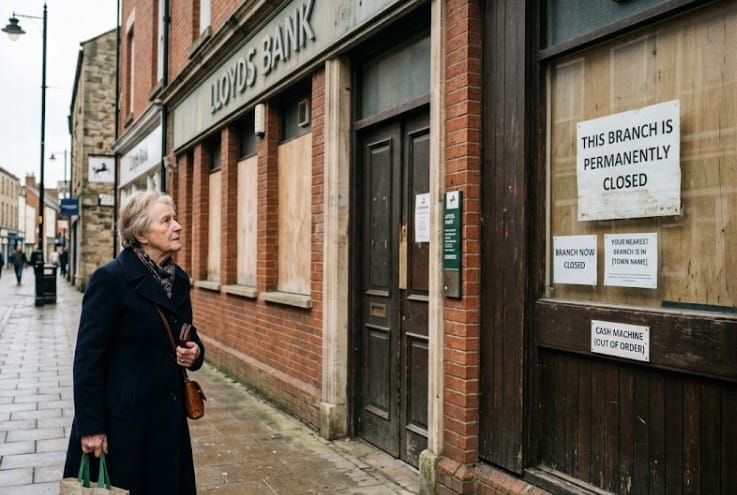
The Impact of Banking Branch Closures in the UK manifests as a severe disruption to local cash infrastructure, stripping high streets of face-to-face services. This rapid contraction creates localised banking deserts, leaving vulnerable demographics without financial access and imposing a hidden productivity tax on small businesses reliant on physical currency deposits.
What is the Current Scale of High-Street Bank Closures in the UK?
The structural contraction across the UK retail banking network has turned hundreds of traditional town centres into financial deserts. Major clearing groups, including Lloyds Banking Group, NatWest, Barclays, HSBC, and Santander, have aggressively reduced their brick-and-mortar presence to cut operational real estate costs and force migration toward mobile banking applications.
The National Impact of Banking Branch Closures
Data from consumer champion Which? confirms that 6,719 high-street branches have shut permanently since 2015, wiping out roughly 68% of the UK’s total physical branch network.
This sweeping data highlights how the ongoing impact of banking branch closures is no longer confined to remote rural locations but is now directly transforming busy suburban commercial hubs.
While historical pullouts concentrated heavily on isolated rural outposts, the current wave of closures is now hit-and-miss across densely populated urban suburbs and busy commercial towns alike.
The speed of these closures has left entire communities without a single brick-and-mortar financial institution, fundamentally changing the commercial dynamics of the traditional British high street.
The Impact of Recent Closures
Recent bank closures, such as Lloyds Banking Group’s retirement of an additional 44 storefronts, signify a structural retreat where even the largest institutions abandon physical estates.
Between 2015 and 2026, the UK lost over 68% of its physical banking network. While digital migration drives these closures, the Financial Conduct Authority (FCA) warns that vulnerable demographics and small businesses face severe financial isolation without face-to-face services.
Why Are Banking Branch Closures Happening Across the UK?
The accelerating withdrawal of physical bank networks is driven by an industry-wide pivot toward cloud-managed operating models and high-margin digital transactions.
Major clearing groups are actively consolidating their expensive physical footprints to drastically reduce corporate real estate overheads, reallocating capital into automated app development while phasing out costly counter service infrastructure.
The Aggressive Push Toward App Migration
Financial institutions frequently justify these restructuring pipelines by pointing to steep drops in over-the-counter footfall as consumer habits evolve.
Banking industry group data indicates that a vast majority of routine daily balance inquiries, money transfers, and bill payments have migrated permanently to mobile applications.

Pressures from Digital-First Competitors
Traditional high-street brands are also facing intense market pressure from lean, digital-only challenger banks that operate entirely without physical overheads.
To maintain profitability margins and satisfy institutional shareholder demands, traditional lenders are copying these digital-first models, choosing automated credit algorithms over maintaining local, fully staffed brick-and-mortar storefronts.
How Banking Branch Closures Impact Local Communities?
When a town loses its last bank, a predictable economic decline triggers. The immediate loss of local cash machines and counter services strips away the basic transaction infrastructure that keeps local trade moving, directly resulting in lower high-street footfall and increased social isolation.
To fully understand the social impact of banking branch closures, analysts point directly to how the loss of an in-person branch disproportionately harms vulnerable demographics, including senior citizens, disabled individuals, and those lacking digital access.
These groups face steep mobility and technical barriers when managing complex tasks like fraud resolution, power of attorney filings, and bereavement accounts online.
This lack of support adds severe distress when grieving families are forced to navigate digital portals to find out what happens to a bank account when someone dies without a will in the UK. Which particularly challenging for retirees trying to stay compliant with specific DWP pension banking rules without internet access.
A common pattern observed across affected local councils is an increase in financial vulnerability and isolation, as consumers are forced to navigate convoluted public transport routes simply to execute basic wealth-management tasks.

What Are the Impacts of Bank Branch Closures on Local Firms?
For small and medium-sized enterprises across the UK, the disappearance of physical bank branches introduces major operational friction and unexpected financial burdens.
Local traders, independent retailers, hospitality venues, and mobile service providers rely heavily on local drop-off points to securely manage their physical earnings and obtain change.
The Productivity Tax on Physical Cash Management
On the ground, when a high street branch shuts, it imposes what business leaders call a hidden productivity tax. Instead of completing a five-minute walk to deposit cash at the end of the day, business owners must travel significant distances to reach an open commercial vault.
This operational burden takes business owners away from their core work, increases fuel costs, and extends the window of time that unbanked cash is exposed to security risks.
The Erosion of Regional Commercial Intelligence
The loss of local branch managers also damages relationship-driven lending across regional economies. Historically, local managers understood the unique seasonal cash flow patterns of their area’s businesses.
Today, loan applications are routed through centralised, automated credit-scoring algorithms. Lacking local context, these digital platforms regularly reject viable independent firms, choking off the vital capital needed for high-street business expansion.
What Happens if Your Branch Closes?
When a bank branch closes, your primary account numbers, sort codes, direct debits, and standing orders transfer automatically to the nearest regional hub. However, face-to-face features do not seamlessly transition, forcing account holders to adapt across three main areas:
- Daily Cash Deposits: Business owners face longer travel times and higher security risks. Practical workarounds include using local Post Office cash deposit facilities or hiring private cash couriers.
- Complex Mandate Updates: Standard web forms often cannot process specialised tasks like Power of Attorney or corporate mandate changes. You will need to book a verified video-link appointment or travel to a regional flagship hub.
- This disruption becomes a major friction point, especially when grieving families are forced to navigate digital portals to find out what happens to a bank account when someone dies without a will in the UK.
- SME Credit Access: Without local branch managers providing an underwriting context, businesses must rely on automated credit scoring. Firms should maintain clean, multi-year financial statements to satisfy centralised algorithms.
The Regulatory Gap
This shift to automated tracking mirrors wider state initiatives, including plans by the DWP to launch bank account checks to clamp down on fraud even among individuals who are not claiming benefits.
The core issue is that the Financial Conduct Authority (FCA) cash-access rules introduced in September 2024 only protect basic cash withdrawals.
They do not safeguard essential face-to-face banking services like commercial lines of credit, specialised wealth advice, or manual security verification.
As a result, when a physical site closes, consumers and business owners lose access to vital, in-person financial management tools.
Will the Government Intervene?
In response to growing public concern, the economic landscape changed significantly on 14 May 2026. Lucy Rigby MP, the Economic Secretary to the Treasury, officially commissioned an independent Access to Banking Review to evaluate the true impact of banking branch closures on commercial growth.
This urgent inquiry is led by Richard Lloyd OBE, the former executive director of Which? and a former non-executive board member of the Financial Conduct Authority.
The review is tasked with gathering evidence on how branch pullouts damage local economic productivity, with a final report due by October 2026. Crucially, this review works alongside the Enhancing Financial Services Bill.
This bill aims to give ministers statutory powers to intervene directly when an area’s financial services are at risk. This marks a major shift from treating branch networks as purely commercial assets to treating face-to-face financial services as essential public utilities.
What Are the Real-World Alternatives to Traditional Bank Branches?
As traditional storefronts disappear, communities must rely on alternative cash-management and in-person banking solutions. These bridge options help mitigate service gaps but come with clear operational limitations.
Are Shared Banking Hubs Rolling Out Fast Enough?
Shared banking hubs, coordinated by Cash Access UK, offer a collaborative solution for the retail banking sector. These shared spaces feature a counter managed by the Post Office alongside a rotating schedule of staff from major high-street brands to handle complex, brand-specific inquiries.
| Bank Network / Infrastructure | Branch Closures (Since 2015) | Current 2026 Operational Status |
| UK High-Street Network | 6,719 Branches Closed | ~32% of the original network is remaining active |
| Shared Banking Hubs | N/A | ~230 hubs live (Target: 350 hubs) |
| Post Office Framework | N/A | 11,500+ branches handling basic transactions |
Can the Post Office handle day-to-day commercial and consumer banking?
The Post Office Banking Framework allows consumers and businesses to complete basic cash transactions at over 11,500 branches across the UK. For everyday cash withdrawals and balance checks, this infrastructure provides a vital alternative.
However, sub-postmasters are facing heavy operational strain from the sudden influx of commercial banking customers.
The model also falls short for small businesses, as it cannot accommodate deep relationship-lending discussions, commercial loan originations, or complex corporate financing structures.
How Local Firms Can Mitigate the Loss of an In-Person Bank?
When reviewing business cash options after a branch closure, local firms can protect their cash flow and remain efficient by following this structured process:
- Conduct an Internal Payment Audit to review your business’s incoming revenue and determine your exact ratio of physical currency to digital card payments.
- Register for Post Office Commercial Services to establish formal barcoded business deposit setups with your primary clearing bank, allowing seamless cash drops at local Post Office counters.
- Verify Local Deposit and Counter Limits to check the specific daily cash volume limits at your nearest alternative counter, avoiding unexpected security rejections during busy trading periods.
- Upgrade In-Store Point-of-Sale Infrastructure to deploy modern, offline-capable mobile payment terminals that ensure continuous digital card processing even during local network outages.
- Optimise Cash-in-Transit Schedules by partnering with certified local courier networks for high-volume cash needs, minimising the safety risks of staff making manual trips to distant vaults.
- Establish Digital Lending Channels to connect with verified fintech platforms and regional mutual credit funds ahead of time, securing backup capital options outside traditional big-bank systems.

Conclusion & Vision for Late 2026
The widespread reduction of physical bank branches has forced the UK to completely rethink how communities access financial services. While digital banking offers undeniable convenience, the hollowing out of high street infrastructure has created real challenges for local businesses and vulnerable consumers alike.
However, the launch of the landmark Access to Banking Review in May 2026 shows a clear shift toward treating face-to-face financial services as an essential public utility.
Moving forward, managing the impact of banking branch closures means establishing mandatory public utility protections for local businesses and vulnerable consumers across the UK in 2026.
Verified against official Financial Conduct Authority (FCA) regulatory data and live UK parliamentary legislative progress reports.
FAQ about Impact of Banking Branch Closures
What happens if a bank branch closes without a nearby alternative?
No community is left entirely without recourse. Under 2026 rules, the area immediately undergoes an independent assessment by LINK to check if it qualifies for a shared banking hub or an enhanced deposit machine to prevent a total banking desert.
What happens if your branch closes but you still rely heavily on cash?
You can still execute everyday transactions locally. You can process basic deposits and withdrawals through the Post Office Banking Framework or visit a shared banking hub, though complex services like commercial loans or mandate changes will require digital or phone support.
Which banks are closing the most branches across the UK in 2026?
Lloyds Banking Group, NatWest, and Santander are leading the current 2026 closure schedules, driving a major push to consolidate real estate costs and move users toward automated mobile applications.
Does the Post Office charge fees for business cash deposits?
No, direct fees are rarely charged at the counter, but backend limits apply. Basic deposit terms are handled through your bank’s commercial agreement, though high-volume traders often face caps or processing surcharges depending on their specific business account rules.
Can a shared banking hub handle business loans?
No. Shared banking hubs are designed for basic cash transactions and account maintenance. Complex commercial lending decisions remain managed by your bank’s centralised, digital underwriting systems.
How do I request a formal cash access assessment for my town?
Local community groups and business organisations can submit an official request directly to LINK. This triggers a formal evaluation of the area’s remaining cash infrastructure under current FCA guidelines.