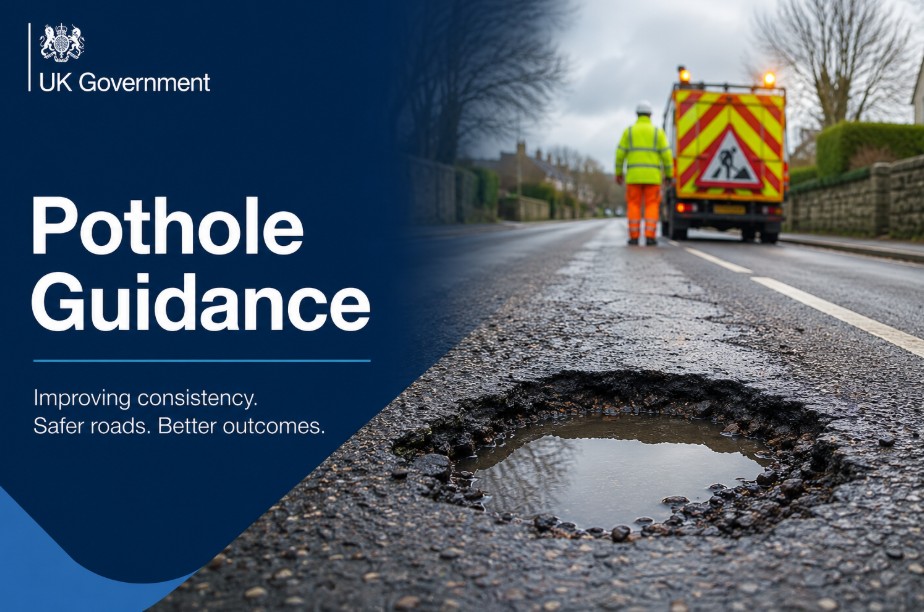
The state of local roads remains an operational risk for commercial vehicle operators and local enterprises across the United Kingdom. The UK government pothole guidance enforces strict accountability, linking local highway authority infrastructure funding directly to the performance and permanence of asphalt resurfacing schemes.
The Department for Transport (DfT) updated its mandatory reporting framework to eliminate temporary patch and dash repairs.
Under the current criteria, local authorities must publicly publish comprehensive highway transparency reports detailing long-term structural renewals.
Failure to deliver these metrics by the autumn deadline results in the withholding of up to one-third of a council’s allocated highways maintenance funding, shifting the national strategy from reactive filling to permanent network prevention.
What is a Pothole and Cause of a Pothole?
A pothole is defined as a deep, steep-sided structural failure in an asphalt road surface. It is caused by water ingress, sub-surface cavitation via freeze-thaw cycles, and continuous mechanical displacement from heavy vehicle tyres crushing the unsupported wearing course.
The Mechanics of Sub-Base Failure
The primary cause of road surface craters across the UK is a combination of hydraulic pressure and temperature fluctuation, commonly known as the freeze-thaw cycle. The breakdown occurs via a specific sequence:
- Micro-Fissure Formation: Micro-cracks develop in the upper asphalt wearing course due to heavy commercial axle loading and structural ageing.
- Water Ingress: Rainwater penetrates these fissures, settling deep into the underlying binder course and granular sub-base.
- Volumetric Expansion: During winter sub-zero temperatures, this trapped water freezes, expanding by approximately 9% in volume. This exerts immense upward hydraulic pressure, fracturing the surrounding aggregate matrix.
- Sub-Surface Cavitation: As temperatures rise, the ice melts, leaving behind an unsupported, hollow subterranean cavity.
- Surface Collapse: Mechanical displacement from passing commercial fleet tyres crushes the weakened asphalt skin down into the void, rapidly tearing away the loose aggregate and exposing a raw structural pothole.
Investigatory and Intervention Thresholds
From a strict engineering and risk-management perspective, not every surface imperfection meets the criteria for immediate intervention.
Pursuant to the UK Code of Practice for Highway Maintenance, local authorities operate an investigatory framework that determines whether a defect requires an emergency response or can be logged into a planned resurfacing schedule.
| Feature Type | Investigatory Depth Trigger | Minimum Surface Area | Critical Legal Context |
| Carriageway (Main Road) | Greater than 40mm | 300mm x 300mm | Triggers statutory intervention under the Well-Managed Highway Infrastructure Code of Practice. |
| Footway / Pedestrian Zone | Greater than 20mm to 30mm | 150mm x 150mm | Lower depth requirement due to the high risk of pedestrian trip injuries and litigation. |
| Cycle Lane / Cycle Track | Greater than 20mm | 100mm x 100mm | Tight horizontal tolerances; minor defects pose an immediate stability hazard to two-wheeled transport. |
The Scale of the Infrastructure Backlog
According to data from the Asphalt Industry Alliance (AIA), the total financial cost required to permanently clear the national road maintenance backlog in England and Wales exceeds £16 billion. This deep backlog forces local authorities to rely heavily on inefficient reactive maintenance.
What Is the New UK Government Pothole Guidance for 2026?
The UK Government Pothole Guidance is a statutory framework issued by the Department for Transport (DfT) that links £7.3 billion of local highways maintenance funding directly to repair performance.
Under the rules, councils must submit transparency reports proving they are prioritising permanent road resurfacing over temporary patching.
The Financial Enforcement Mechanism
The central mechanism of the guidance is the strict conditionality attached to the annual highways maintenance incentive funding allocation. The DfT has established that local highway authorities (LHAs) across England must submit formal transparency reports using standardised government templates.
If a council fails to publish these documents on time or cannot prove that its budget is used exclusively for preventative resurfacing, the government withholds nearly one-third of its annual capital funding pot.
Nationally, this places hundreds of millions of pounds at immediate risk for underperforming authorities.
The Red, Amber, Green Transparency Matrix
The Red, Amber, Green (RAG) Transparency Matrix is a live public performance map grading England’s 154 local highway authorities.
Green indicates best-practice full-width resurfacing; Amber identifies heavy reliance on reactive patching; Red triggers a mandatory support program backed by a shared £300,000 expert planning allocation.
- Green Rating: Awarded to authorities demonstrating sector best practices, high percentages of full-width road resurfacing, and strategic deployment of long-term preventative asphalt treatments. These high-performing networks provide optimal driving surfaces that seamlessly connect with major national infrastructure, where understanding highway markings, such as knowing exactly where would you find green reflective studs on a motorway, ensures transport fleets navigate slip roads and junctions with maximum visibility.
- Amber Rating: Assigned to councils heavily reliant on reactive emergency patching, showing an escalation in repeat defects on identical stretches of asphalt. This continuous deterioration often forces drivers to change lanes suddenly, making an understanding of what colour are the reflective studs between the lanes on a motorway absolutely critical for fleet operators manoeuvring safely around failing surfaces during nighttime hours.
- Red Rating: Given to the lowest-performing councils facing systemic backlog infrastructure failures. According to the Department for Transport’s latest efficiency review, the 13 worst-rated authorities receive a targeted £300,000 expert planning allocation spread over two years to restructure their engineering pipelines and avoid permanent funding clawbacks.
Deployment of Advanced Repair Machinery
The UK Government Pothole Guidance explicitly mandates a shift from manual asphalt shovelling to automated mechanical repair machinery.
Local highway authorities are leveraging specialised assets, such as high-output pothole repair machine units like the JCB PotholePro.
These machines cut, crop, and clean a standard road defect in under eight minutes, ensuring a clean, squared edge that prevents water ingress and ensures the subsequent asphalt binder course achieves a permanent mechanical bond with the surrounding road base.

Road Condition Monitoring
The PAS 2161 standard is the mandatory road condition monitoring framework developed by the British Standards Institution (BSI) and the DfT. It requires English local authorities to use approved digital survey technologies to classify road conditions consistently for national statistics.
To secure their full capital funding allocations, local authorities must transition their road network data collection to the BSI PAS 2161 data specification.
Unlike historical, subjective visual inspections, this framework utilises accredited third-party computer vision and connected vehicle sensors to run continuous surface scans.
It standardises how road condition categories are captured, processed, and reported to the DfT across classified A, B, C, and unclassified roads.
Mandatory DfT Reporting and Funding Deadlines
Local highway authorities in England must publish their comprehensive highway transparency reports and PAS 2161 technical annexes by the annual September 10 deadline. Missing this autumn deadline results in the automatic clawback of up to 33% of their incentive maintenance funding.
Timelines are strictly monitored by central government to ensure public transparency. The network coverage required under the new metrics mandates that councils scan a minimum of 90% of their A roads, 85% of their B roads, and 80% of their C roads annually.
These datasets must be ingested into verified asset management software to calculate national statistics before the autumn funding review.
Who Is Responsible for Fixing Potholes in the UK?
Under Section 41 of the Highways Act 1980, legal responsibility for fixing potholes rests with the designated highway authority for that road. Local councils manage local, residential, and unclassified routes, while National Highways is responsible for major trunk roads and motorways in England.
Local Highway Authorities vs. National Agencies
For the vast majority of urban, rural, and residential routes, responsibility rests with the local county council, metropolitan borough, or unitary authority. These bodies manage unclassified roads, local B-roads, residential cul-de-sacs, and urban footways.
Conversely, the Strategic Road Network (SRN), comprising major trunk roads and all motorways across England, falls under the direct jurisdiction of National Highways. In the devolved nations, identical asset management is handled by separate administrative bodies:
- Scotland: Transport Scotland manages the trunk route network.
- Wales: Traffic Wales oversees strategic transport corridors.
- Northern Ireland: The Department for Infrastructure retains centralised control over the entire public road network.

Is It Illegal to Fill a Pothole in the UK?
Yes, it is entirely illegal for private citizens, community groups, or unauthorised businesses to fill a pothole on a public highway. Under the Highways Act 1980, performing unauthorised works on a public road is a criminal offence that carries severe civil liability.
Attempting to pour concrete or aggregate into a pothole alters the surface skid resistance, disrupts local drainage channels, and introduces severe civil liabilities.
If an unapproved third-party repair causes a vehicular accident or a cyclist to fall, the individual who deposited the material faces direct personal injury claims and prosecution for criminal damage to the highway surface.
How Do I Report a Pothole in the UK and Check Its Status?
To report a pothole in the UK, log the exact GPS location, photograph the defect safely with a scale object for depth reference, and submit the data via the official GOV.UK portal or FixMyStreet. This generates an alphanumeric reference code required for insurance claims.
The Digital Defect Reporting Pipeline
The digital defect reporting pipeline is a five-step triage process: locate the defect using smartphone coordinates, capture scale photographs from safety, select the appropriate local council or GOV.UK portal, input traffic risk specifics, and record your automated reference tracking receipt.
The following step-by-step reporting methodology ensures structural compliance:
- Locate the Defect: Identify the exact location using a smartphone mapping tool or specific global positioning coordinates. Never step into an active live lane to inspect a road defect.
- Document Visual Attributes: Photograph the pothole safely from the pavement. Include surrounding landmarks to help maintenance crews find it, and use a standard item (like a plastic card or coin) next to the edge to show scale and depth.
- Select the Appropriate Portal: Access the central GOV.UK portal, which routes the defect based on postcode, or utilise independent national map infrastructure systems such as Fix My Street potholes.
- Input Operational Specifics: Specify whether the defect sits inside a high-speed live traffic lane, near a pedestrian crossing, or hidden inside a dark blind bend. This structural data directly influences the council’s response priority.
- Log and Record Reference Codes: Submit the data and save the automated tracking reference number. This unique alphanumeric code serves as your legal receipt, proving the council has formal notice of the road defect.
Checking Repair and Inspection Progress
Pothole repair status is tracked via local authority live asset mapping using colour-coded pins.
Grey or blue pins signify a queued report; yellow or orange shows a completed inspection with an assigned repair window; red signals an urgent Category 1 hazard; green confirms a closed, hot-rolled asphalt repair.
Most local highway databases assign standardised colour-coded progress pins to reported defects:
- Grey/Blue Pin: Report received and queued for physical engineering assessment.
- Yellow/Orange Pin: Physical inspection completed. The defect has been structurally measured, categorised, and assigned a specific repair window based on network risk.
- Red Pin: Urgent Category 1 hazard. Scheduled for emergency temporary make-safe work within a 2-hour to 24-hour window.
- Green Pin: Repair fully completed using compliant hot-rolled asphalt and edge-sealing materials. The asset is officially closed.
How to Report Pothole Damage to a Car and Seek Compensation?
To seek pothole compensation for car damage, drivers must compile a comprehensive evidence file containing time-stamped defect photographs, independent garage repair invoices, an MOT roadworthiness verification, and formal proof that the local council failed its mandatory statutory inspection intervals.
Immediate On-Scene Response Protocol
The immediate on-scene protocol following a pothole strike requires pulling over safely, checking vehicle alignment and steering mechanisms, photographing the road layout and defect depth, and acquiring third-party contact details or witness statements immediately.
- Prioritise Safety: Pull over immediately in a safe, legal parking zone. Do not attempt to walk onto an active carriageway to inspect a pothole.
- Conduct a Physical Inspection: Check the vehicle’s tracking, steering alignment, alloy rims, and lower suspension arms. Note that low tyre pressure can amplify impact forces, causing direct wheel rim cracking.
- Gather Contextual Evidence: Photograph the defect, the wider road layout, missing warning signs, and weather conditions.
- Acquire Third-Party Verification: Obtain statements and contact information from any witnesses who observed the impact.
Navigating the Section 58 Statutory Defence
The primary barrier to a successful compensation claim is Section 58 of the Highways Act 1980.
This provision allows a local council to completely reject a claim for vehicle damages if it can prove it took reasonable care to ensure the highway was not dangerous to traffic.
To trigger this defence, the council must show:
- Their official inspection regime matched the category of the road.
- The road was inspected at its mandatory scheduled interval (e.g., monthly for principal A-roads, annually for rural lanes).
- No defect matching the intervention criteria was recorded during that last authorised inspection.
To defeat a Section 58 defence, a claimant must prove that the council either ignored their own inspection frequency, executed a sub-standard visual check, or failed to act on historical public reports logged via tools like FixMyStreet.
The Formal Compensation Submission Path
To claim for pothole damage, submit a structured evidence file directly to the executive highways claim department of the responsible authority.
This formal package must include the exact road location, date, time, detailed photographs of the defect next to a physical scale, a copy of an independent garage’s mechanical repair invoice, and an official MOT history report to prove pre-existing vehicle roadworthiness.
Summary and Next Steps
The updated UK government pothole guidance marks a clear shift away from temporary, reactive patching toward permanent, machine-driven resurfacing.
For local businesses and transport managers, managing road risks requires consistent reporting through verified public portals and maintaining clear, accurate evidence logs whenever vehicle damage occurs.
Moving forward, businesses should audit their fleet tracking logs against council inspection data and check public RAG performance maps to assess infrastructure risks across their core regional distribution routes.
FAQ about UK Government Pothole Guidance
How much does it cost to repair a pothole in the UK?
A basic manual patch repair typically costs a local authority between £50 and £70 in materials and labour. However, large-scale, machine-driven permanent resurfacing operations cost several thousand pounds per lane mile.
Does tyre pressure affect pothole damage?
Yes. Both under-inflation and over-inflation increase the risk of structural vehicle failure. Under-inflated tyres compress completely against the wheel rim under heavy impact, causing rim fractures, while over-inflated tyres lack structural compliance, transferring the impact energy directly into expensive suspension components.
What is the 2 second rule in the UK?
The 2-second rule is a safety spacing buffer requiring a vehicle to remain a minimum of two seconds behind the lead car. In wet weather or poor light, doubling this to four seconds allows drivers to see, react to, and safely navigate around sudden road defects without dangerous, erratic swerving.
What is the most expensive part of a car to repair after a pothole strike?
While a tyre puncture fix costs between £20 and £40, damage to electronic steering racks, bent suspension wishbones, cracked alloy rims, or ruptured shock absorbers can quickly push professional garage repair costs beyond £1,500.
Can a council refuse a pothole claim based on the new 2026 rules?
Yes. The new 2026 DfT guidance penalises councils for bad long-term planning, but it does not alter the underlying Highways Act 1980 framework. If a council demonstrates full compliance with its inspection schedules, it can still legally deploy the Section 58 defence to refuse a claim.
What happens to councils that receive a Red RAG rating?
Councils graded as Red enter a mandatory support and recovery program. They receive £300,000 in specialised engineering assistance over two years to restructure their preventative maintenance operations and avoid losing up to one-third of their central funding.
Can I claim compensation if my insurance company has already paid out?
Yes, but you cannot double-recover the same costs. If an insurer covers your structural repairs, you can claim to recover your policy excess and any lost no-claims bonus directly from the liable local highway authority.