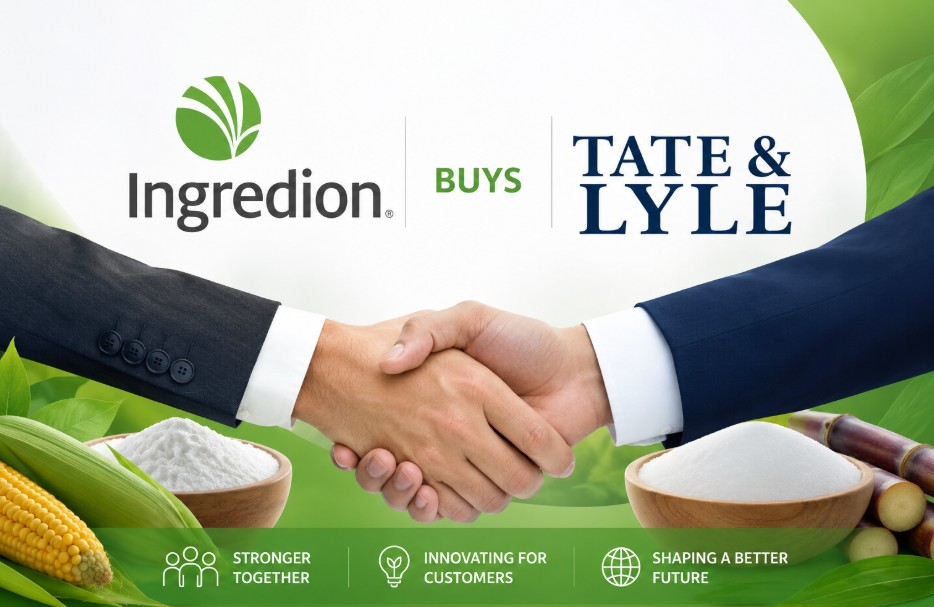
Ingredion buys Tate & Lyle for 595p per share in an all-cash deal valuing its equity at £2.7 billion ($3.6 billion) and enterprise value at £3.7 billion ($5.0 billion). Announced on 8 June 2026, the transaction targets completion in late 2027, creating a global B2B powerhouse in clean-label texturants and sugar-reduction ingredient solutions.
This consolidation unifies two massive business portfolios to address shifting global consumer demands for clean-label, lower-sugar, and high-fibre formulations within the food and beverage industry.
Why Does Ingredion Buys Tate & Lyle?
Ingredion buys Tate & Lyle to eliminate overlapping operational costs and establish a scaled, comprehensive one-stop-shop B2B provider of speciality ingredient solutions.
The combined firm can simultaneously solve food and beverage client formulation challenges across texture, taste, and nutritional profiles.
The overarching strategic driver is portfolio integration. Food and beverage manufacturers are actively consolidating their supplier networks, preferring single-source vendors. This merger capitalises on four distinct industry tailwinds.
Accelerating the Clean-Label and Sugar-Reduction Movement
Consumer preferences in the UK and European markets have shifted decisively toward clean-label alternatives, products with simplified, easily recognisable ingredient lists free from artificial additives.
By combining forces, engineering teams can pair Ingredion’s extensive texturants and functional native starches with Tate & Lyle’s deep expertise in precision sugar reduction, removing synthetic binders or high-fructose corn syrups without sacrificing food sensory properties.
Boosting the Health Profile of Global Food Products
Regulatory bodies across Europe and the UK continue to penalise high-fat, sugar, and salt (HFSS) products through strict advertising restrictions and taxation. Executives at Tate & Lyle stated that this ingredients deal will directly help boost the health profile of consumer products.
The integration allows the combined firm to manufacture advanced, health-forward items incorporating soluble dietary prebiotic fibres (such as Tate & Lyle’s PROMITOR line) and natural sweeteners like stevia and monk fruit to align with national nutritional mandates.
Offsetting the Commercial Shifts of the GLP-1 Era
The rapid market adoption of GLP-1 receptor agonists, appetite-suppressing weight-loss medications, is altering broad human dietary habits.
Patients undergoing these medical treatments generally reduce their overall caloric intake, display a lower preference for high-sugar foods, and actively seek out products fortified with dense proteins and dietary fibres to preserve lean muscle mass.
The merged entity is intentionally insulated against this shifting volume decline.
By focusing its capital on texturants that replicate mouthfeel in low-fat applications and advanced sweetening systems that omit raw carbohydrates, the combined firm can capture high-margin formulation contracts as CPG brands rush to reformulate portfolios for the GLP-1 consumer demographic.
Capturing $130 Million in Corporate Synergies
From an operations standpoint, the transaction is projected to deliver significant financial efficiencies. The corporate boards expect to realise approximately $130 million (£97 million) in run-rate annual net cost synergies by the final quarter of 2030.
Achieving these structural savings will require an estimated one-time integration expenditure of approximately $175 million, which will be deployed sequentially across the next four fiscal years to consolidate logistics networks, ERP software architecture, and corporate back-office functions.
What Are the Key Financial Terms of the Ingredion and Tate & Lyle Deal?
The key financial terms include an all-cash consideration of 595 pence per share, scaling up to a total value of 615 pence per share when permitted dividends are included. This represents a 64% premium over Tate & Lyle’s undisturbed closing stock price of 375 pence on 13 May 2026.
The financial architecture relies on a cash consideration model structured under United Kingdom laws. Under the terms of the formal Rule 2.7 announcement, shareholders receive substantial premiums, backed by major institutional bridge loans.
- Dividend Scaling: When factoring in permitted final dividends for the financial year ending 31 March 2026 (up to 13.2 pence) and interim dividends for the period ending 30 September 2026 (up to 6.8 pence), the absolute cash value delivered to investors climbs to 615 pence per share.
- Funding Mechanism: To secure immediate liquidity, Ingredion arranged a $4.225 billion senior unsecured 364-day bridge loan facility, fully underwritten and led by JPMorgan Chase Bank.
- Irrevocable Voting Commitments: Ingredion obtained concrete voting commitments to clear the UK High Court of Justice. Huber Equity Corporation, which commands a critical 16.8% voting block of Tate & Lyle’s ordinary shares, has provided an irrevocable undertaking to vote in favour of the acquisition. The directors of Tate & Lyle have also provided irrevocable undertakings for their personal shareholdings.
Market Reaction and Stock Performance
Following the announcement on 8 June 2026, the Tate & Lyle share price jumped 14.3% in early morning trading on the London Stock Exchange (LSE), peaking at 557p.
The stock continued to trade at a modest discount relative to the 595p cash offer price, reflecting investor caution regarding multi-jurisdictional antitrust clearances.
Meanwhile, the Ingredion share price on the New York Stock Exchange (NYSE: INGR) remained stable as institutional investors assessed long-term earnings growth against the debt leverage required.
| Corporate Metric | Ingredion Incorporated (Buyer) | Tate & Lyle PLC (Target) |
| Global Headquarters | Westchester, Illinois, USA | London, United Kingdom |
| Primary Listing Exchange | New York Stock Exchange (NYSE) | London Stock Exchange (LSE) |
| Pre-Merger Global Headcount | Approximately 11,000 employees | Approximately 5,000 employees |
| Combined Group Projected Revenue | ~ $9.9 Billion ($7.4 Billion equivalent) | Linked within $9.9 Billion total |
| Core Technical Focus Area | Starches, plant proteins, biopolymers, and texturants | Soluble dietary fibres, mouthfeel, and low-calorie sweeteners |
| Major Regional Subsidiaries | Ingredion UK Limited, Ingredion India Pvt Ltd | Tate & Lyle Ingredients Americas LLC, Tate & Lyle UK |
How Will the Takeover Impact UK Jobs and London Operations?
The acquisition will result in a 3% reduction in the combined global workforce, eliminating roughly 475 corporate and administrative positions worldwide. The redundant administrative layers at Tate & Lyle’s corporate headquarters in London will face a phased winding-down process as decision-making authority migrates to Illinois.
Because Ingredion operates a highly structured global corporate model from its central base in Westchester, Illinois, redundant administrative layers face inevitable consolidation.
Headquarters Redundancies vs. Manufacturing Safety
In practice, corporate redundancies following cross-border mergers of this scale tend to fall disproportionately on the headquarters staff of the acquired entity.
This consolidation reflects a broader trend of corporate cost-cutting across the UK retail and food sectors, reminiscent of footprint adjustments seen during the M&S Leeds Store Closure as companies reallocate physical capital to protect bottom-line margins.
- London Headquarters (High Risk): Tate & Lyle maintains its central global headquarters in London, housing approximately 200 corporate professionals who manage international legal, investor relations, human resources, and compliance frameworks. This site faces a phased winding-down process as strategic authority transfers to Illinois.
- Regional Manufacturing Plants (Low Risk): Regional manufacturing plants, such as the advanced dietary fibre processing facilities in Boleráz, Slovakia, or specialised blending hubs across Europe, are largely protected due to their direct contribution to physical volume output and supply chain logistics.
What Is the Corporate History of the Buyer, Ingredion?
Ingredion Incorporated is an industrial B2B agricultural processing manufacturer rather than an investment fund or private equity firm. Headquartered in Westchester, Illinois, the firm processes raw agricultural inputs into highly functional technical ingredients used by global food and beverage brands.
To accurately assess the future trajectory of this consolidation, UK procurement managers and business analysts must understand the precise commercial nature of the acquiring organisation.
What Did Ingredion Used to Be Called?
Ingredion Incorporated was originally founded as the Corn Products Refining Co. and later renamed Corn Products International. The company officially changed its name to Ingredion Incorporated in 2012 to signal a permanent shift from bulk commodities to value-added food solutions.
The company’s corporate lineage stretches back more than a century. Its 2012 rebrand marked an evolution away from basic wet milling into advanced food science, permanently altering its market positioning.
Is Ingredion a Manufacturer or a Distributor?
Ingredion operates fundamentally as an industrial B2B manufacturer, not a distributor. The company buys raw agricultural inputs, primarily yellow corn, tapioca, potatoes, stevia leaf, and pulses, and directly owns and runs the physical manufacturing plants that process them via advanced enzymatic and thermal treatments.
While the company maintains an internal sales and logistics network to service customers, its core asset is its manufacturing footprint.
The outputs are highly functional, technical food components such as hydrocolloids, modified starches, and isolated plant proteins.
Who Is the CEO of Ingredion and Who Are Their Main Competitors?
The executive leadership of Ingredion is headed by James (Jim) Zallie, who serves as the Chairman, President, and Chief Executive Officer. Under his leadership, the firm has pursued aggressive portfolio diversification via targeted mergers and acquisitions.
The company operates with an annual global turnover approaching $8 billion. Its principal tier-one competitors include global agricultural trading and processing giants such as Archer-Daniels-Midland Company (ADM), Cargill Incorporated, and International Flavours & Fragrances (IFF), the latter having recently streamlined its focus following the $4.3 billion divestment of its specialised pharma solutions unit to private equity firm CVC Capital Partners.
How Will the Takeover Affect Regional Entities and B2B Procurement?
The consolidation merges localised regional subsidiaries into a single entity, creating a unified supply chain. Most notably, Ingredion inherits the premium $1.8 billion CP Kelco hydrocolloid portfolio acquired by Tate & Lyle in November 2024, eliminating the need for procurement teams to split texturant contracts.
The consolidation of these two entities directly impacts localised supply agreements, technical support frameworks, and contract terms across multiple global operating regions.
Consolidating Global Operating Footprints
- Tate & Lyle Ingredients Americas LLC: This entity represents a major operational cog within the target’s portfolio, anchoring its presence in the large North American food market. The acquisition unifies this business unit with Ingredion’s domestic US network, creating a singular supply chain for starches and high-intensity sweeteners.
- Tate & Lyle United Kingdom: The UK business unit serves as the historical home of the company. Post-merger, this domestic manufacturing and sales infrastructure will be managed by Ingredion UK Limited, resulting in unified account management teams for British supermarkets and food brands.
- Operations in India: Both companies have actively pursued expansion within emerging markets. The merger will bring Tate & Lyle’s local business relationships into alignment with Ingredion India Pvt Ltd, expanding the distribution of speciality starches and sweetening systems across the subcontinent.
Integrating the November 2024 CP Kelco Asset
When reviewing strategic decisions, regulatory bodies look at recent transaction histories to assess market concentration. In November 2024, Tate & Lyle completed the acquisition of CP Kelco for $1.8 billion, a move that brought advanced pectin, gellan gum, and speciality hydrocolloid technologies into its product line.
By acquiring Tate & Lyle, Ingredion automatically inherits this newly integrated CP Kelco portfolio, providing immediate ownership of premium texturants that complement its existing starch platforms.
Supply Chain Action Plan for UK Procurement Managers
The sequential steps detailed below outline the necessary actions UK procurement managers should execute to mitigate supply risks associated with this corporate transition.
- Conduct an Internal Supplier Audit: Review all current ingredient specifications to identify every SKU sourced from Ingredion UK Limited, Tate & Lyle UK, or CP Kelco. Map these components against product formulations to determine total volume exposure.
- Review Contract Change-of-Control Clauses: Examine active supply agreements for change-of-control provisions. Determine whether the court-sanctioned scheme of arrangement grants your organisation the right to renegotiate pricing terms, exit early, or extend existing volume protection agreements.
- Request a Formal Joint Supplier Briefing: Issue a formal request to your assigned account directors at both companies. Secure written statements regarding product continuity, particularly for highly specialised items like modified starches or texturing gums.
- Evaluate Formulation Vulnerabilities: Engage internal R&D teams to identify high-risk proprietary ingredients that lack direct market alternatives. Initiate preliminary bench-testing for alternative texturant and sweetening options to establish secondary sources of supply.
- Assess Alternative Source Options: Request samples and technical documentation from competing tier-one manufacturers, such as ADM or Cargill, to benchmark pricing and establish viable backup options for critical raw materials.
- Execute Volume and Pricing Extensions: Where feasible, lock in fixed-volume purchasing agreements and multi-year pricing caps ahead of the formal integration completion window in late 2027 to shield your operating margins from transitional cost changes.

Outlook for British Food Supply Chains
The consolidation of Tate & Lyle into Ingredion represents a significant structural shift for the global food and beverage ingredients sector.
For UK food brands and independent manufacturing networks, this transaction reduces supplier optionality while creating a massive repository of technical R&D and product formulation capabilities under a single corporate roof.
While the transaction moves through the required regulatory approval channels ahead of its targeted late-2027 completion date, procurement professionals must act proactively.
Reviewing supplier contracts, auditing recipe vulnerabilities, and establishing clear lines of communication with account teams will ensure your production lines remain resilient as this new global ingredients powerhouse takes shape.
FAQ About Ingredion Buys Tate & Lyle
Does Tate & Lyle still make sugar or Lyle’s Golden Syrup?
Tate & Lyle PLC does not produce retail sugar or Lyle’s Golden Syrup. The company exited the consumer sugar refining sector entirely in 2010 by selling its European refining operations to American Sugar Refining (ASR Group). ASR Group continues to market those products under the original brand names; this transaction applies exclusively to the distinct B2B speciality food ingredient company.
When did Tate & Lyle originally merge?
The historical foundations of the business were laid in 1921. At that time, two fierce rivals in the British sugar refining market—Henry Tate, who opened his initial refinery in Liverpool in 1872, and Abram Lyle, who established his golden syrup operations in London in 1881—merged their assets to form Tate & Lyle PLC.
Is Tate & Lyle a British company?
Tate & Lyle is a British company incorporated under the laws of England and Wales and headquartered in London. It holds a unique position in UK financial history as the last surviving original 1935 constituent of the FT-30 index still listed on the London Stock Exchange.
When will the acquisition officially close?
The companies expect the transaction to formally close in the second half of 2027. This extended timeline is required to finalise the UK court-sanctioned scheme of arrangement, coordinate shareholder voting dates, and secure regulatory clearances across multiple international legal jurisdictions.
Is this transaction subject to regulatory and antitrust scrutiny?
The merger requires formal antitrust clearance from regulatory authorities, including the UK Competition and Markets Authority (CMA) and the US Federal Trade Commission (FTC). Because the combination merges large market shares in starch, hydrocolloid, and sweetener supply chains, regulators will carefully review the deal to ensure it does not limit market competition.
What is the current turnover of Ingredion?
Before the acquisition announcement, Ingredion’s global annual turnover approached approximately $8.0 billion. Following the successful integration of Tate & Lyle and the recently absorbed CP Kelco assets, the combined group’s annual revenues are projected to reach nearly $9.9 billion (£7.4 billion equivalent).
What will happen to Tate & Lyle shares?
Once the scheme of arrangement receives formal sanctioning from the UK High Court, all outstanding ordinary shares will be bought by Ingredion at the agreed price of 595p per share. Following this payment, Tate & Lyle will be delisted from the London Stock Exchange, transitioning into a privately held, wholly owned subsidiary of Ingredion.