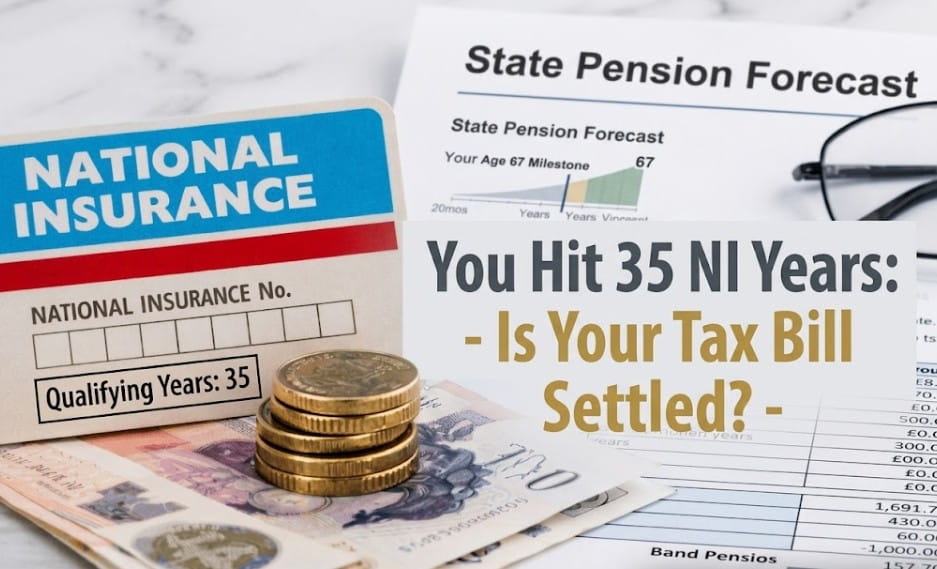
To receive the full new State Pension in the UK, you typically need 35 qualifying years on your record. However, hitting this 35-year mark doesn’t give you a legal free pass to stop contributing.
Many workers ask, Can I Stop Paying National Insurance after 35 Years? The answer is no; if you’re under State Pension age and earning above the primary threshold, contributions remain mandatory.
Can I Stop Paying National Insurance After 35 Years?
No. In the UK, reaching 35 qualifying years secures your full State Pension entitlement, but it does not exempt you from paying National Insurance (NI). You must continue to pay NI as long as you are below State Pension age and earning above the Primary Threshold (£242 per week for 2026/27).
Why do I have to pay National Insurance if I have already reached 35 years?
A common mistake is viewing National Insurance as a personal savings pot. In reality, it functions more like a social security tax, designed to bankroll the NHS, statutory benefits, and the current State Pension for today’s retirees.
While 35 years of contributions generally secures the full new State Pension rate, set at £241.30 per week for the 2026/27 tax year, the liability to pay only expires once the individual reaches their official State Pension age.

The Legal Requirement
Legally, reaching 35 qualifying years does not grant a tax exemption. If you are under State Pension age and earn above the relevant thresholds, contributions remain mandatory.
National Insurance liability is dictated by age and earnings, not your total contribution history. Key legal mandates for the 2026/27 tax year include:
Mandatory Age Span: Liability begins at age 16 and only expires once you reach your official State Pension age (currently rising toward 67).
Earnings Triggers:
- Employees (Class 1): 8% on weekly earnings above £242.
- Self-Employed (Class 4): 6% on annual profits above £12,570.
Social Security Model: The law defines NI as a tax to fund current services (like the NHS) rather than a personal savings pot; therefore, maxing out your pension does not end your tax duty.
Termination Dates:
- Employees: Contributions cease exactly on your State Pension birthday.
- Self-Employed: Class 4 liability ends on the 6th of April following your State Pension birthday.
Employer Compliance: Employers must deduct NI by law. You can only stop these deductions by providing proof of age, not a record of years served.
The 2026/27 State Pension Age Shift
For the 2026/27 tax year, the State Pension age is shifting. Those born after 6 March 1961 will not reach their pension age until they are 67. Until you reach that milestone, HMRC still expects its cut of your wages or profits.
It’s also worth keeping an eye on your savings interest, given the current freeze on tax bands, more retirees are being caught out by HMRC’s latest warnings regarding tax on bank interest.
Why 35 years is a Pension Goal but not a Tax Limit?
We often see professionals hitting their 35th qualifying year in their early 50s and assuming their NI bill is settled. Unfortunately, that’s not the case. While the 35-year rule dictates how much pension you’ll get, it has no impact on your legal requirement to pay tax on what you earn today.
Once you hit 35 years, any further contributions are excess in the sense that they won’t increase your weekly pension payout (unless you have a complex pre-2016 record), but they remain a legal requirement.
35 Years vs. State Pension Age
Understanding the distinction between hitting your pension goal and reaching your legal stop date is vital for retirement planning.
While 35 years secures your payout amount, only reaching your official pension age ends your mandatory National Insurance contributions.
| Feature | 35 Qualifying Years | State Pension Age |
| Pension Impact | Secures the full new State Pension rate. | The date you can start claiming your money. |
| NI Liability | Does not stop your NI tax bill. | Stops NI liability for employees instantly. |
| 2026/27 Threshold | N/A | Variable (rising to 67 for many). |
| Impact on Pay | No change to take-home pay. | Increases take-home pay (no more NI). |
Do I have to keep paying NI if I still work?
Yes, if you are employed or self-employed and earn above the Primary Threshold (£12,570 per year for 2026/27), you must continue to pay National Insurance.
This applies even if you have 40 or 50 years of contributions. The only way to stop paying while under the State Pension age is if your earnings fall below the Lower Earnings Limit.
Understanding Class 1 and Class 4 Obligations
- For Employees (Class 1): Your employer will continue to deduct NI from your salary at a rate of 8% on earnings between the Primary Threshold and the Upper Earnings Limit (£50,270).
- For the Self-Employed (Class 4): The rate for 2026/27 is 6% on profits between £12,570 and £50,270.
When considering Can I Stop Paying National Insurance After 35 Years, remember that NI is a mandatory tax on earnings; liability only expires when you reach State Pension age, regardless of your qualifying years.
The Stop Dates for Different Workers:
- Employees: You stop paying NI the moment you reach State Pension age. If you work past this age, you should show your employer proof of age (like a birth certificate) to ensure they stop deductions.
- Self-Employed: You stop paying Class 4 NI at the end of the tax year in which you reach State Pension age. This means you might pay for a few extra months compared to an employee.

How many years of National Insurance do I need for a full pension?
To receive the full new State Pension in 2026/27, you generally need 35 qualifying years. However, this is not a universal rule for everyone.
If you were contracted out of the Additional State Pension before 2016, as is common for NHS workers, teachers, and civil servants, you might actually need more than 35 years to reach the maximum payout due to a rebate adjustment.
The 10-Year Minimum Rule
You must have at least 10 qualifying years on your National Insurance record to receive any amount of the UK State Pension.
If you are concerned because I have never paid national insurance, will I get a pension? If your record shows between 10 and 34 years, the DWP simply awards a pro-rata amount of the full £241.30 weekly rate.
What happens if you pay more than 35 years of National Insurance?
Paying for more than 35 years of National Insurance is common for those who start work at 18 and continue until 67. Unfortunately, these extra years do not stack to give you a higher pension.
Once you reach the maximum state pension amount, any further years of NI are simply tax revenue for the government.
The Protected Payment Exception
Looking at how HMRC calculates older records, those with high earnings under the old State Second Pension (S2P) often have what’s known as a Protected Payment. This effectively acts as a top-up, allowing you to receive more than the standard full pension rate.
This extra amount is called a Protected Payment and is paid on top of the full rate, even if you don’t add more years.
Can I stop paying NI at 55 or 60?
If you choose to retire early (for example, at 55) and stop working entirely, you will stop paying mandatory Class 1 or Class 4 National Insurance because you no longer have earned income. However, you must be careful about your total qualifying years.
Steps to Managing Early Retirement:
- Check your forecast: Use the GOV.UK: Check your State Pension tool.
- Verify your total: If you have 35 years at age 55, you can stop working, and your pension is safe.
- Identify gaps: If you only have 30 years at age 55, you will be 5 years short.
- Consider Voluntary NI: You can choose to pay Class 3 voluntary contributions (approx. £907.40 per year in 2026/27) to fill the remaining 5 years while you are not working.
- Evaluate private pensions: You do not pay National Insurance on income drawn from a private or company pension.
Legal Ways to Stop or Reduce NI Before State Pension Age
While you cannot simply opt out because you have 35 years, you can reduce the impact:
- Salary Sacrifice: Some employers allow you to sacrifice salary into your pension, which reduces the NI both you and your employer pay.
- Stop Working: NI is only triggered by earned income. Rental income, dividend income, and private pension drawdowns do not trigger NI.

2026/27 NI Rates and Thresholds
Understanding the current numbers and staying compliant with the tax office is vital for accurate retirement planning.
If you receive unexpected correspondence regarding your interest earnings, refer to the guide to HMRC savings account tax letters to clarify your position. The following table outlines the rates for the current tax year.
| NI Class | Who pays it? | 2026/27 Threshold | 2026/27 Rate |
| Class 1 (Primary) | Employees | £242 per week (£12,570/yr) | 8% (up to £967/wk) |
| Class 1 (Secondary) | Employers | £96 per week (£5,000/yr) | 15% (on all earnings above) |
| Class 4 | Self-Employed | £12,570 per year | 6% (up to £50,270) |
| Class 3 | Voluntary | Flat Rate | £17.45 per week |
Strategic Pension Questions and 2026 Realities
The 2026/27 financial year introduces specific complexities regarding retirement timing and tax thresholds that require careful navigation.
Is it better to take a pension at 60 or 65?
In the UK, you cannot take your State Pension at 60 or 65 anymore; the minimum age is currently 66 and rising. However, if you have a private pension, you can often access it from age 55 (rising to 57 in 2028).
Taking it early usually results in lower monthly payments. Deferring your State Pension by just one year can increase your payments by roughly 5.8% for life.
The 5-Year Rule and Pension Loss
There is no 5-year rule that allows the government to take away your pension. However, if you live abroad, your payments may stay frozen.
For those planning to spend their retirement travelling or living overseas, securing comprehensive travel insurance is just as critical as understanding your pension indexing rights.
Passing on your pension to children
Unlike a private pension (which can often be inherited as a lump sum), the State Pension is generally not inheritable by children.
A surviving spouse or civil partner may be able to inherit a portion of your pension or a protected payment, but this is subject to strict eligibility rules regarding their own NI record.
Final Summary and Next Steps
Effectively, managing National Insurance after 35 years means balancing mandatory tax liabilities against maximum benefit eligibility for UK taxpayers in 2026.
Immediate Actions:
- Log in to your Personal Tax Account on GOV.UK to see your exact number of qualifying years.
- Identify your State Pension Age specifically, as it varies based on your birth month.
- Consult a financial advisor if you are considering stopping work early to ensure you don’t leave your record with expensive gaps.
Fact Check: This guide is based on the latest 2026/27 thresholds confirmed by HMRC and the Department for Work and Pensions (DWP).
FAQ
Do I stop paying National Insurance at 60?
No. You only stop paying National Insurance when you reach your official State Pension age (currently 66 or 67), provided you are still working. Your 60th birthday has no impact on NI liability.
Can I stop paying National Insurance if I work for the NHS?
No. NHS employees are subject to the same Class 1 National Insurance rules as any other employee. Reaching 35 years of service does not exempt you from NI while still employed.
What is the biggest mistake regarding retirement?
The biggest mistake is assuming 35 years of NI is enough without checking for contracted-out deductions. Many people reach 35 years but still have a COPE (Contracted Out Pension Equivalent) reduction, meaning they need more years.
Can I withdraw 100% of my pension?
You can withdraw 100% of a private pension, but 75% of it will be taxed as income. The State Pension cannot be withdrawn as a lump sum; it is only paid as a weekly benefit.
Do I get an extra pension when I reach 80?
Yes, there is an Age Addition of 25p per week once you reach 80. While it sounds small, it is a guaranteed uplift for those on the basic State Pension.
At what age do you stop paying Income Tax in the UK?
You never stop paying Income Tax based on age. If your total income (including pensions) exceeds the Personal Allowance (£12,570), you must pay Income Tax, even if you are 100 years old.
How to get a £50,000 yearly pension?
Reaching a £50,000 annual retirement income requires significant private pension savings, such as SIPPs or Workplace Pensions, to bridge the gap. Effectively, managing National Insurance after 35 years means balancing mandatory tax liabilities against maximum benefit eligibility for UK taxpayers in 2026.