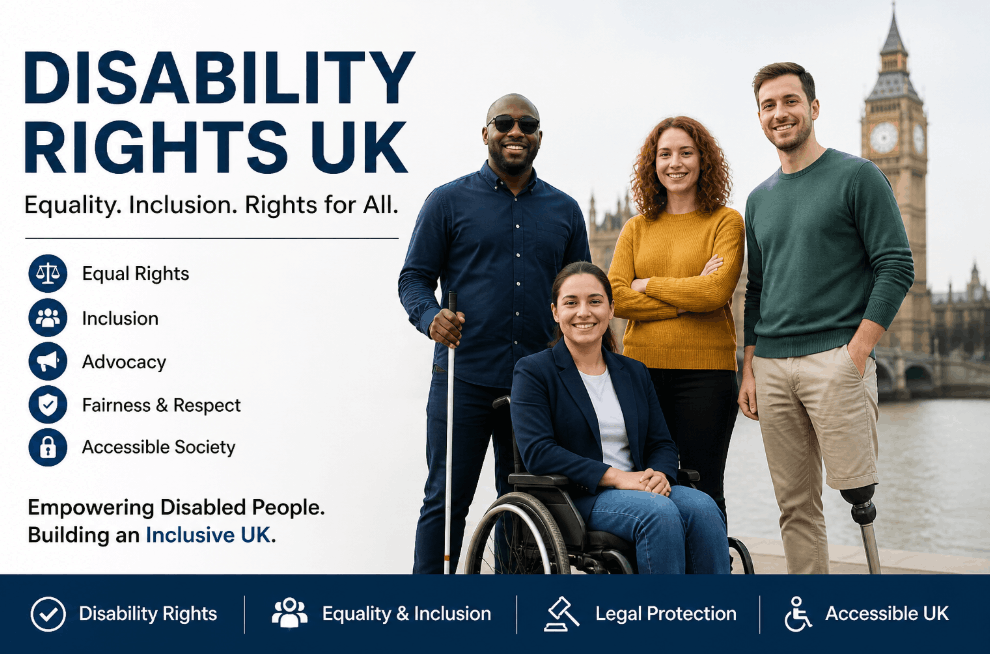
Disability rights in the UK ensure that individuals with physical or mental impairments receive equal treatment and protection from discrimination in the workplace, education, and daily life.
Primarily governed by the Equality Act 2010, these rights mandate that employers and service providers make reasonable adjustments to remove barriers, ensuring full participation and accessibility across all sectors of British society.
The legal framework surrounding disability rights UK serves as the foundation for inclusivity, evolving significantly in 2026 to address modern workplace dynamics and welfare reforms.
Understanding these protections is essential for both individuals navigating their daily lives and businesses aiming to foster a compliant, supportive environment.
The Core Pillars of UK Disability Law
The legal definition of disability in the UK is broad, covering any physical or mental impairment that has a substantial and long-term negative effect on your ability to do normal daily activities.
Substantial means more than minor or trivial, and long-term generally refers to a condition that has lasted or is expected to last for 12 months or more.
What are the fundamental disability rights in the UK?
Disability rights in the UK are legal protections that prevent unfair treatment across several key areas, including employment, education, transport, and access to goods or services.
Under the Equality Act 2010, it is illegal to discriminate against someone because they have a disability, are associated with a disabled person, or are perceived to have a disability.
Key Legal Protections:
- Direct Discrimination: Treating someone less favourably because of their disability.
- Indirect Discrimination: Putting rules or arrangements in place that apply to everyone but put disabled people at a disadvantage.
- Harassment: Unwanted behaviour related to a disability that violates dignity or creates a hostile environment.
- Victimisation: Treating someone badly because they complained about discrimination or supported someone else’s claim.
| Right Category | Legal Basis | Primary Objective |
| Workplace Equality | Equality Act 2010 | Ensuring fair recruitment, pay, and promotion opportunities. |
| Reasonable Adjustments | Statutory Duty | Removing physical or procedural barriers to access. |
| Public Sector Duty | Section 149 (Equality Act) | Requiring public bodies to actively promote disability equality. |
| Benefit Protection | Right to Try 2026 | Safeguarding financial support during employment transitions. |

What is the new Right to Try 2026 legislation?
The Right to Try legislation, introduced in April 2026, is a landmark DWP reform designed to encourage disabled individuals to enter the workforce without the immediate fear of losing their benefits.
This law provides a safety net period where health-related elements of Universal Credit or PIP remain protected even if a claimant takes on a trial employment role.
Amidst ongoing discussions regarding disability benefits cuts, this protection offers much-needed peace of mind for those re-entering the workforce.
In practice, this means that if a disabled individual finds that a specific role is not sustainable due to their condition within the first twelve months, they can revert to their previous benefit status without a mandatory reassessment.
This addresses a long-standing pain point where the risk of losing financial stability prevented many from exploring career opportunities.
Steps to Utilising the Right to Try:
- Notify the DWP of the intent to start a trial period under the 2026 rules.
- Ensure the employer is aware of the Access to Work support available during the trial.
- Record any challenges faced during the initial six months of employment.
- Access quarterly check-ins with a Work Coach to monitor health impacts.
- Review the sustainability of the role at the nine-month mark.
- Formally transition to permanent status or trigger the Safety Net Return if the role is unmanageable.
What are reasonable adjustments in the workplace for 2026?
Reasonable adjustments are changes made by an employer to ensure a disabled person can perform their job and access the workplace as effectively as non-disabled colleagues.
For 2026, these adjustments have expanded to include digital accessibility standards (WCAG 2.2) and highly flexible hybrid working models to accommodate fluctuating health conditions.
A common pattern is for adjustments to be viewed as expensive physical renovations, but most are procedural.
For example, a local business might adjust a start time from 9:00 AM to 10:00 AM to allow an employee to travel when public transport is less crowded, which is a zero-cost adjustment that significantly improves retention.
- Physical Changes: Installing ramps, ergonomic chairs, or modified keyboards.
- Procedural Changes: Allowing for extra breaks, flexible working hours, or remote work.
- Information Changes: Providing documents in large print, Braille, or compatible with screen readers.
- Support Services: Funding for sign language interpreters or job coaches via the Access to Work grant.

Is disability pay gap reporting now mandatory?
As of 2026, the UK government has introduced mandatory disability pay gap reporting for all organisations with 250 or more employees.
This move mirrors the gender pay gap reporting requirements, aiming to bring transparency to the disability price tag, the extra costs disabled people face, which often average over £1,000 per month.
For local businesses, while not always mandatory, voluntary reporting is becoming a key EEAT signal. Demonstrating transparency in how disabled staff are compensated compared to their peers builds significant trust with consumers and potential talent.
Data from early 2026 reports suggest that companies with transparent disability policies see a 15% higher retention rate among their total workforce.
How does the Equality Act protect you in shops and transport?
The Equality Act 2010 dictates that service providers, including shops, restaurants, and transport operators, must not provide a lower standard of service to disabled customers.
This includes anticipatory duties, meaning businesses should think ahead about what disabled customers might need, rather than waiting for someone to encounter a barrier.
When reviewing decisions made by transport providers, the 2026 standards now emphasise digital-first accessibility.
This includes ensuring that booking apps are fully navigable by voice control and that real-time information regarding elevator outages or ramp availability is updated instantly.
How can you challenge disability discrimination?
If a disabled person feels they have been treated unfairly, the first step is usually an informal discussion with the employer or service provider.
However, if the issue remains unresolved, there is a formal legal path to redress. Under current UK law, most discrimination claims must be brought to an Employment Tribunal or County Court within six months (minus one day) of the incident.
- Step 1: Informal Resolution. Raise the issue directly to see if a simple adjustment can solve the problem.
- Step 2: Formal Grievance. Submit a written complaint following the company’s internal grievance procedure.
- Step 3: ACAS Early Conciliation. A mandatory step before a tribunal, where an independent body tries to help both parties reach an agreement.
- Step 4: Employment Tribunal. Filing a claim if conciliation fails; this is where legal evidence of discrimination is presented.
- Step 5: Remedy and Compensation. If successful, the tribunal may award compensation for financial loss and injury to feelings.

Summary of Next Steps
Navigating disability rights in the UK requires a balance of understanding the established Equality Act 2010 and the newer 2026 welfare incentives. If you are an individual, ensure you document your needs early.
It is also worth exploring specific support streams, such as the pension age disability payment, to ensure you are receiving the full assistance available to you.
If you are a business owner, review your WCAG 2.2 compliance and Right to Try awareness to stay ahead of the curve. Access to Work remains the most under-utilised resource for funding workplace transitions. Apply early to secure support.
FAQ about disability rights UK
Do I have to disclose my disability to my employer?
No, you are not legally required to disclose a disability. However, an employer is only required to make reasonable adjustments if they know, or could reasonably be expected to know, that you have a disability.
What is the Right to Try law 2026?
It is a 2026 DWP policy allowing disabled claimants to take a job for up to 12 months, with the guarantee they can return to their original benefit level if the work isn’t sustainable.
Does the Equality Act cover mental health?
Yes. Mental health conditions like depression, anxiety, or bipolar disorder are covered if they have a long-term, substantial effect on your daily activities.
How long do I have to make a discrimination claim?
In employment cases, you usually have three months minus one day to start the ACAS process. In service provision cases (like shops), you have six months.
Can an employer refuse a reasonable adjustment?
An employer can only refuse if the adjustment is unreasonable. Factors include the cost, the size of the business, and how effective the change would be in helping you.
What is Access to Work?
It is a government grant that pays for practical support, such as specialist equipment or travel costs, to help disabled people stay in work.
Are all websites required to be accessible?
Yes, under the Equality Act, service providers must ensure their websites do not discriminate. Most now follow WCAG 2.2 standards to meet this legal obligation.