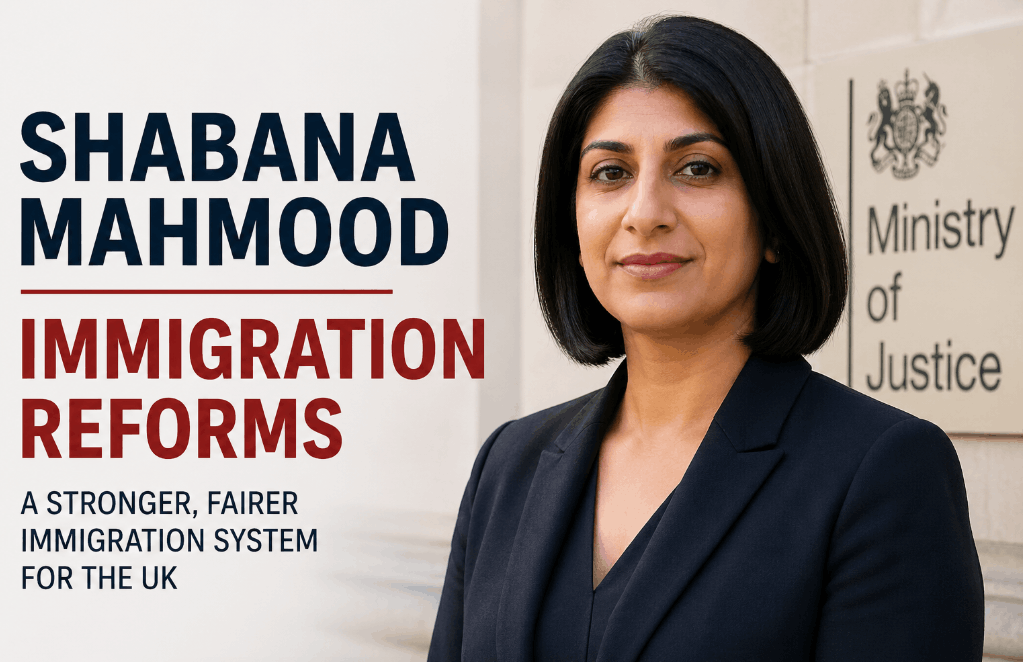
The Shabana Mahmood immigration reforms introduced in March 2026 represent a fundamental shift in UK border policy, moving from a rapid settlement model to a principle of Earned Settlement.
These changes prioritise long-term integration through extended residency requirements, heightened English language standards, and the implementation of a Visa Brake to manage net migration levels effectively.
What are the Shabana Mahmood immigration reforms?
The Shabana Mahmood immigration reforms are a comprehensive legislative overhaul designed to reduce net migration by extending the standard pathway to Indefinite Leave to Remain from five years to ten for most routes.
The reforms introduce the Visa Brake mechanism, increase financial self-sufficiency thresholds, and mandate a B2 level of English for those seeking permanent residency in the United Kingdom.
The core philosophy of earned settlement
The 2026 reforms depart from previous iterations of the Points-Based System by categorising migration as a tiered journey rather than a guaranteed transaction.
Under the new Contract on Migration framework, the Home Office views settlement as a privilege earned through a decade-long economic contribution and social adherence.
In practice, this means that most individuals arriving on Skilled Worker or Family visas must now demonstrate a consistent history of UK residency without relying on public funds for double the duration previously required.

How does the 10 year settlement rule work?
A central pillar of the Shabana Mahmood immigration reforms is the standardisation of the 10-year route to Indefinite Leave to Remain (ILR).
Previously, many work and family streams allowed for settlement after 60 months; however, the new rules default these pathways to a 120-month qualifying period.
| Feature | Previous Rules (Pre-2026) | New Reform Rules (Post-March 2026) |
| Standard Settlement Period | 5 Years | 10 Years |
| English Language Requirement | B1 (Intermediate) | B2 (Upper-Intermediate) |
| Criminality Threshold | 12-month custodial sentence | Zero tolerance for any custodial sentence |
| Refugee Review Period | 5 Years | 30 Months |
| Public Funds Access | No Recourse (usually 5 years) | No Recourse (full 10 years) |
This extension aims to ensure that those who settle have established deep-rooted ties to the local economy.
For instance, a software engineer who arrived in London in early 2026 would now need to maintain valid leave until 2036 before applying for permanent status, unless they qualify for specific high-value exemptions.
Which groups are affected by the Visa Brake?
The Visa Brake is a new executive power allowing the Home Secretary to suspend visa processing for specific nationalities or sectors when migration targets are exceeded or when diplomatic cooperation on returns is deemed insufficient.
Steps to navigate the 2026 Visa Brake process:
- Check the Quarterly Migration Gazette for the current Brake Status of your country of origin.
- Identify if your specific SOC (Standard Occupational Classification) code is exempt from the temporary pause.
- Review the Core Protection list to see if your visa type is shielded from humanitarian suspensions.
- Ensure all biometric appointments are completed before a scheduled Brake activation date.
- Consult the Home Office Paused Route guidance if an application is currently pending.
- Seek alternative sponsorship if your primary industry is capped under the new regional quotas.
- Verify if the Brake applies to dependants or only to lead applicants for that cycle.
For those whose travel or residency plans are disrupted by these sudden legislative pauses, ensuring your travel documents are valid is critical.
If you find yourself needing to travel urgently amidst these administrative changes, you may need to secure an emergency passport same day UK to avoid further delays.
When reviewing decisions made under this mechanism, it is evident that the Home Office prioritises sectors with acute labor shortages, such as the NHS, while pausing low-threshold hospitality and retail routes during peak migration periods.

What are the new requirements for Skilled Worker visas?
Under the Shabana Mahmood immigration reforms, the Skilled Worker route has undergone significant tightening regarding salary compliance and payroll auditing.
The government has moved away from annual salary averaging, requiring employers to meet the minimum salary threshold in every single pay period.
- Strict Salary Compliance: Employers must now prove that the pro-rata salary meets the threshold every month, preventing salary padding during bonus seasons.
- Enhanced English Proficiency: All applicants must now achieve a CEFR Level B2 in speaking, listening, reading, and writing to qualify for initial entry.
- Sponsor Responsibility: Businesses must now report any unpaid leave exceeding five working days, which may trigger a review of the migrant’s visa status.
A common pattern is that smaller firms are struggling with the increased administrative burden of these real-time compliance checks.
For example, a mid-sized marketing firm in Manchester recently faced a licence suspension because they failed to adjust a sponsored employee’s pay during a brief period of reduced hours.
How has refugee status changed under the 2026 reforms?
The reforms have introduced Core Protection status, which replaces the traditional five-year refugee leave with a rolling 30-month permission to stay.
This allows the Home Office to conduct more frequent Safe Return reviews to determine if the situation in the country of origin has improved.
Comparison of Humanitarian Routes
| Protection Type | Duration of Leave | Settlement Eligibility | Work Rights |
| Core Protection | 30 Months (Renewable) | After 10 Years | Full Access |
| Temporary Humanitarian | 12 Months | No | Restricted |
| Resettlement Schemes | 5 Years | After 5 Years | Full Access |
This change means that individuals under UK protection face a higher degree of uncertainty.
They are now required to submit updated evidence of their ongoing need for protection every two and a half years, rather than waiting for a single settlement application at the five-year mark.
What impact do the reforms have on family migration?
The financial requirement for spouse and partner visas has been further aligned with the median UK household income.
Furthermore, the 10-year settlement rule applies here too, meaning couples must maintain their subsisting relationship evidence for a decade before the foreign partner can claim ILR.
- Higher Income Thresholds: The minimum income requirement is now pegged to the 50th percentile of UK earnings.
- Integration Checks: Couples must undergo an Integration Interview at the five-year mark to demonstrate community involvement.
- English Progression: Partners must move from A1 to B2 level English over the course of their ten-year journey.
Demonstrating this involvement often requires official verification or references from established members of your local community.
Applicants frequently worry about the availability of professional contacts for such formalities, much like the common concern of what if i don’t know anyone to countersign my passport when preparing essential identity documents.
Consider the case of a British citizen married to a Canadian national. Under the 2026 rules, they would need to apply for three separate visa extensions (at 30, 60, and 90 months) before reaching the settlement stage at 120 months.

Final Summary
The Shabana Mahmood immigration reforms have redefined the UK’s approach to border control, moving away from rapid permanency in favour of a long-term, integration-focused 10-year model.
For visa holders, the priority must be maintaining B2-level English proficiency, ensuring strict salary compliance, and meticulously documenting their decade-long journey to settlement.
To stay compliant, individuals should review their specific visa conditions via the official GOV.UK portal and monitor quarterly updates regarding the Visa Brake status.
FAQ about Shabana Mahmood immigration reforms
When do the 2026 immigration changes take effect?
The majority of the reforms, including the 10-year settlement rule and the B2 English requirement, came into force on 11 March 2026. Certain salary compliance rules for existing sponsors were phased in over the following 90 days.
Does the 10-year rule apply to people already in the UK?
No, the Home Office has confirmed a grandfathering clause. Individuals who held a valid visa on the 5-year route prior to March 2026 remain eligible for settlement under the old timeline, provided their leave remains continuous.
What is the Visa Brake exactly?
The Visa Brake is a legal mechanism that allows the government to instantly cap or halt visa issuance for specific routes or countries if net migration exceeds the annual target set by Parliament.
Can I still switch visas within the UK?
Switching is still permitted between most work routes, but the 10-year settlement clock may reset if the new visa category has significantly different qualifying criteria under the 2026 framework.
Is the life in the UK test still required?
Yes, the Life in the UK test remains mandatory for settlement, but it has been updated to include sections on the 2026 Migration Contract and responsibilities regarding Earned Settlement.
Are there any fast-track routes to settlement left?
Yes, the Global Talent visa and specific High Value NHS clinical roles maintain a 3-year or 5-year path to settlement to ensure the UK remains competitive for top-tier international expertise.
What happens if I lose my job on a 10-year route?
You generally have 60 days to find a new sponsor. Under the 2026 rules, the Home Office is more stringent; failing to secure a new role within this window typically leads to curtailment.