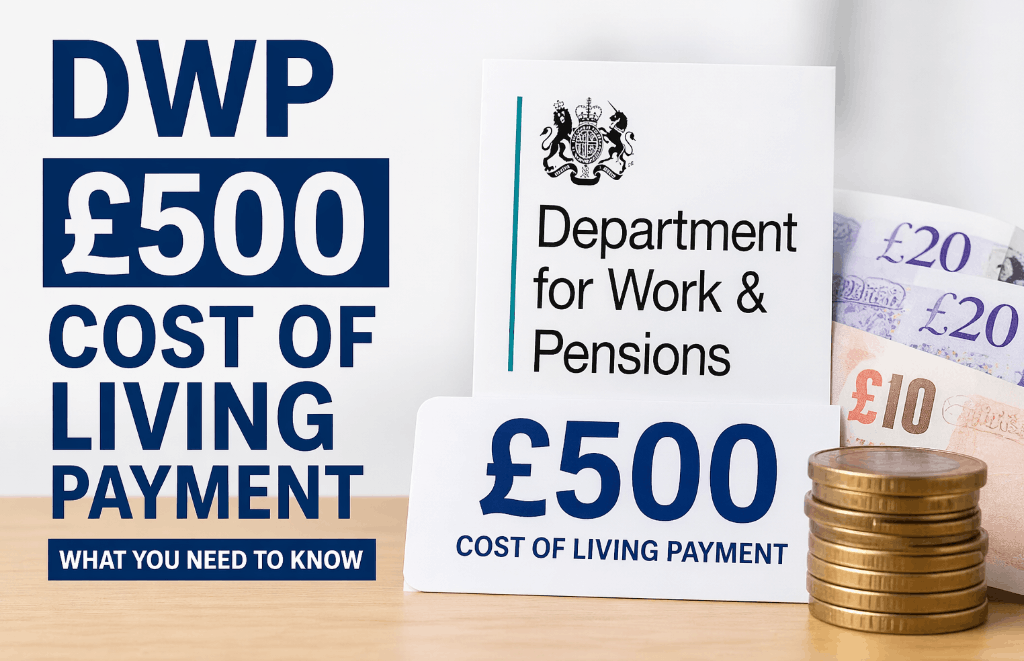
The DWP £500 cost of living payment for 2026 is primarily delivered through the Crisis and Resilience Fund (CRF), which replaced the former Household Support Fund.
While not a universal automatic payment, eligible households can secure grants often totalling £500 based on local council assessment of financial hardship, energy costs, and essential living needs.
Is there a DWP £500 cost of living payment for 2026?
The DWP £500 cost of living payment refers to the targeted financial support available through the £1.1 billion Crisis and Resilience Fund (CRF) and local authority grants.
Unlike previous flat-rate national payments, this support is distributed by local councils to residents facing immediate financial pressure regarding food, energy bills, and essential household expenditure.
The landscape of UK welfare support underwent a significant shift in April 2026.
While the broad, automatic “Cost of Living Payments” seen in previous years have concluded, many residents still look back at the criteria for the DWP £299 cost of living payment to gauge their current eligibility. The government has now transitioned to a localized resilience model to manage these needs.
This means that while the DWP provides the overarching funding, the specific sum of £500 is often the benchmark figure used by local authorities for emergency intervention grants.

How do you qualify for the 2026 Crisis and Resilience Fund?
Eligibility for the new Crisis and Resilience Fund (CRF) is more stringent than previous iterations.
In practice, local authorities prioritise households that are not just low income but are experiencing a specific financial shock or gap in their monthly budget that cannot be met by standard Universal Credit or Pension Credit payments.
| Benefit Category | Eligibility Status | Support Level |
| Universal Credit | High Priority | Variable (Up to £500+) |
| Pension Credit | High Priority | Fixed + Emergency Grants |
| PIP / DLA | Medium Priority | Disability-related premiums |
| Working Tax Credit | Assessment Required | Discretionary grants |
| No Benefits (Low Wage) | Assessment Required | Crisis-only support |
When reviewing decisions made at the local level, councils typically look for evidence that a household has less than a month’s worth of essential expenses in savings.
Understanding how to maximise your base income is vital, and some claimants have found significant relief by identifying a Universal Credit loophole £1500 that helps bridge the gap during difficult months.
For example, a family in Birmingham might receive a £500 voucher for energy arrears while addressing these broader income adjustments.
How to apply for the £500 emergency support via your council?
To access the DWP £500 cost of living payment through the CRF, you must initiate an application through your local authority’s Financial Support or Local Welfare Provision portal.
- Visit the official website for your local council to locate the Crisis and Resilience Fund section.
- Gather your latest three months of bank statements to prove financial hardship.
- Obtain proof of your current DWP benefit entitlement, such as a Universal Credit statement.
- Complete the online application form, detailing your specific need for the £500 grant.
- Upload evidence of unforeseen costs, such as a broken boiler or an unexpected utility debt.
- Submit the application and await a phone or email assessment from a council officer.
- Provide any additional identity verification if requested by the local authority.
- Receive the decision, which is usually delivered within 5 to 10 working days for urgent cases.

What other DWP payments are rising in 2026?
Beyond the discretionary £500 payments, standard DWP benefits saw a scheduled uplift in April 2026 to match the Consumer Price Index (CPI).
This uprating ensures that the core support system keeps pace with the cost of essential goods, even as specific lump-sum bonuses become more targeted.
- Universal Credit Standard Allowance: Increased for both single claimants and couples.
- Personal Independence Payment (PIP): Both the daily living and mobility components rose to reflect higher care costs.
- State Pension: Adjusted under the Triple Lock mechanism, providing a significant boost to weekly income for retirees.
A common pattern is that these inflationary increases reduce the need for emergency grants, but for many, the gap between income and the Energy Price Cap remains a significant hurdle.
Why are some residents receiving a £500 pensioner support grant?
For those of state pension age, the DWP £500 cost of living payment context often combines the Winter Fuel Payment with specific local Pensioner Hardship funds.
Following the 2025 policy changes, the Winter Fuel Payment is now means-tested, meaning only those on Pension Credit or other qualifying benefits receive it.
It is also worth verifying your full historical entitlement, as many retirees are currently discovering eligibility for DWP state pension back payments, which can provide a much larger financial cushion than a one-off grant.
This makes checking your records as important as applying for current local hardship funds.
Comparing 2026 Support Schemes
| Scheme Name | Typical Amount | How it is Paid |
| Crisis & Resilience Fund | £250 – £600 | Local Council Application |
| Warm Home Discount | £150 | Automatic Credit to Utility Bill |
| Cold Weather Payment | £25 per week | Automatic during 0°C periods |
| Pensioner Cost of Living | £200 – £300 | Integrated with Winter Fuel |
Impact of the National Living Wage
As of April 2026, the National Living Wage rose to £12.71 per hour. This increase is a core part of the government’s resilience strategy, designed to move people away from emergency DWP grants and toward self-sufficiency through higher earnings.
However, for those unable to work due to disability or caring responsibilities, the reliance on the CRF remains high.
What are the key deadlines for the £500 payment?
The funding for the Crisis and Resilience Fund is allocated in two distinct blocks for the 2026/27 financial year.
- First Tranche: April 2026 to September 2026.
- Second Tranche: October 2026 to March 2027.
It is advisable to apply early in the tranche, as councils often close applications once their specific budget for that period has been exhausted.
An anonymised example from a London borough in early 2026 showed that the Summer Crisis fund was fully committed within four months due to high demand for school holiday food support.

Summary of Next Steps
To secure the DWP £500 cost of living payment support, you should first verify your eligibility for Pension Credit or Universal Credit, as this significantly simplifies the council application process.
Visit your local authority’s website today to check the status of their Crisis and Resilience Fund.
If you are in immediate distress, contact Citizens’ Advice for a referral to a local food bank or fuel voucher scheme while your DWP application is being processed.
FAQ about DWP £500 Cost of Living Payment
Is the £500 payment automatic?
No. Unlike the 2023/24 payments, the 2026 support is discretionary and requires an application to your local council under the Crisis and Resilience Fund framework.
Do I need to be on Universal Credit to qualify?
While most recipients are on means-tested benefits, councils can award grants to those not on benefits if they can prove they are in a financial crisis.
Can I get the payment more than once?
Generally, no. Most councils limit CRF or £500 support grants to once every 6 to 12 months, unless there is a significant change in circumstances.
Will this payment affect my other benefits?
No. Grants from the Crisis and Resilience Fund or the former Household Support Fund are not treated as income and do not reduce your Universal Credit.
What can I use the £500 grant for?
The funds are usually restricted to essentials, including energy debts, water bills, food, essential clothing, and emergency white goods like a fridge or cooker.
Is there a separate payment for PIP claimants?
There is no standalone disability cost of living payment in 2026. PIP claimants must apply for the CRF or check for local disability-specific grants.
How long does the application take?
Most councils aim to process emergency applications within 5 working days, though non-urgent requests for white goods may take up to 20 working days.