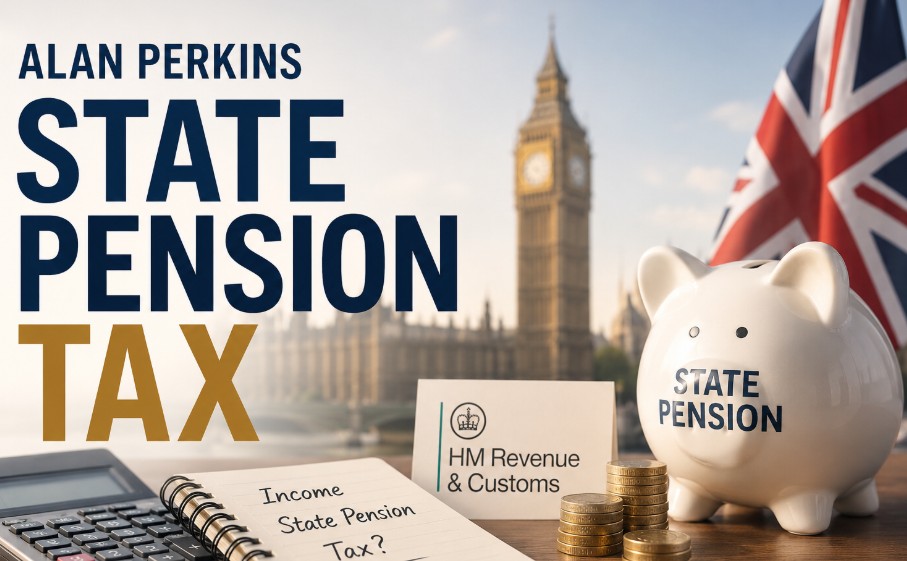
The Alan Perkins state pension tax situation serves as a critical case study for UK retirees, illustrating how the State Pension can trigger unexpected HMRC tax demands. The State Pension tax trap occurs when a pensioner’s combined annual income exceeds the Personal Allowance (£12,570 for 2026/27).
While the State Pension is paid gross, it remains taxable income; if your total income exceeds the Personal Allowance, you will owe tax, often resulting in a retroactive Simple Assessment bill.
What is the Alan Perkins state pension tax trap?
The Alan Perkins state pension tax trap is the unwelcome financial shock many retirees face when an out-of-the-blue tax bill lands on their doormat. At its heart, the problem is simple: the State Pension is a taxable benefit, but it’s paid gross, meaning no tax is taken out before it hits your bank account.
Because many retirees have other income sources, such as private pensions, that already use up their Personal Allowance, the State Pension is often left untaxed during the year.
HMRC may not realise until the end of the tax year that your combined income has exceeded your tax-free allowance, resulting in a retroactive Simple Assessment bill for the tax that should have been paid throughout the year.
Why does the Alan Perkins state pension tax trap exist?
The issue arises because the State Pension is taxable income that does not have tax deducted at source. HMRC systems often cannot automatically reconcile the tax due on the State Pension with the tax already paid on private pensions or other income until the tax year has concluded.
Pensioners often wrongly assume that because the State Pension is a government benefit, it is exempt from tax.
When combined with other income sources that have already utilised the tax-free personal allowance, the State Pension becomes the extra income that triggers a tax liability.
The reality of pension taxation
The UK tax system operates on a cumulative basis. Your total annual income, combining State Pension, private pensions, savings interest, and other earnings, determines your tax liability, regardless of whether individual income streams are below the threshold.
Many retirees fail to update HMRC when their private pension increases due to cost-of-living adjustments, or when their tax code changes.
These small, unnoticed shifts lead to an underpayment that is only discovered when HMRC conducts its year-end review.
Why do some retirees receive a surprise HMRC tax bill?
Retirees receive surprise bills due to three primary factors: cumulative taxation on total annual income, the lack of PAYE deductions on the State Pension, and annual fluctuations in private pension payments that result in an outdated tax code.
- Cumulative Taxation: HMRC calculates tax based on your total annual income, not just individual pension payments. If your private pension and State Pension combined exceed the £12,570 Personal Allowance, you owe tax on the surplus.
- Lack of PAYE Deduction: Since the State Pension has no tax deducted from it, the burden falls on the tax codes assigned to your private pension providers. If these codes are outdated or fail to account for the full amount of your State Pension, you will underpay tax.
- Changing Income: If your private pension increases or if there are adjustments to your payment rates, such as those reflected in the new State Pension August, your tax code may require an update. If your code is not adjusted to account for these changes, the amount being deducted via PAYE may become insufficient, leading to a year-end shortfall.
Is the UK State Pension taxable?
Yes, the State Pension is treated as taxable income under UK law. While it does not have tax deducted before it reaches your bank account, the total amount received annually contributes toward your overall taxable income.
If this sum, added to any private pensions or savings interest, pushes you over the £12,570 threshold, the surplus is taxed at the basic rate or higher, depending on your total income bracket.
| Income Source | Taxable? | Tax Collected At Source? |
| State Pension | Yes | No |
| Private Pension | Yes | Yes (PAYE) |
| Savings Interest | Yes | No (via PSA) |
| Dividend Income | Yes | No |
How to manage or minimise your pension tax liability?
While you cannot legally stop paying tax on a pension if your total income exceeds the Personal Allowance, you can minimise or manage your liability:
- Utilise Tax-Free Allowances: Ensure you are using your full Personal Allowance (£12,570 for 2026/27).
- Use Tax-Advantaged Accounts: Income from ISAs is tax-free. If you have significant savings, moving them into an ISA can generate interest that doesn’t count toward your taxable income threshold.
- Manage Withdrawals: If you have a flexible private pension (drawdown), try to keep your total annual income below the threshold where you would pay higher-rate tax, or plan withdrawals to stay within your available Personal Allowance.
- Adjust Your Tax Code: If you are worried about large, surprise bills, contact HMRC. You can request they adjust your tax code for the following year to collect any estimated tax owed on your State Pension in smaller, manageable monthly instalments through your private pension(s).
How to check your PAYE coding notice?
To avoid receiving an unexpected tax demand, you must ensure your PAYE coding notice is accurate. This code tells HMRC how much tax to collect from your other income sources to cover the tax owed on your State Pension.
- Log in to your Personal Tax Account on the GOV.UK website.
- Navigate to the Pay As You Earn (PAYE) section to view your current tax code.
- Verify that your State Pension amount is correctly recorded.
- Check if your personal allowance is being reduced by other benefits.
- Cross-reference the tax code with your most recent pension statement.
- Report any discrepancies, such as outdated income figures, immediately.
- Save a copy of your updated notice for your financial records.

The tax threshold for pensioners
The maximum a pensioner can earn before paying tax is determined by the Personal Allowance, currently set at £12,570.
If you are unsure about your current entitlement, it is helpful to check what the state pension amount is to understand your baseline income. Once your total annual income exceeds the allowance, you enter the tax net.
For the 2026/27 tax year, staying aware of these thresholds is essential for effective financial planning, especially as you track DWP state pension changes next year that may impact your overall planning. With frozen tax bands, more retirees are gradually being pulled into paying tax on their pension income.
- Monitor combined income: Ensure the sum of all pension payments does not quietly breach the allowance.
- Utilise your tax-free allowance: Ensure your private pension provider is aware of your full allowance status.
- Keep records: Maintain annual statements to reconcile your income against your HMRC record.
Navigating the Simple Assessment process
If HMRC sends you a Simple Assessment letter, it is a notification of tax owed that was not collected via PAYE.
It is important to treat this as a formal notice. If you believe the calculation is incorrect, you have 60 days to query it.
Many find that once they provide updated details on their private pension or other income sources, the calculation can be corrected, sometimes reducing or even eliminating the tax bill if personal allowances were misapplied.
Disclaimer: This information is for educational purposes and does not constitute financial or tax advice. Always consult with a qualified professional or check your specific circumstances via the official GOV.UK website.
Final Summary and Next Steps
The Alan Perkins state pension tax case highlights the importance of proactive tax management. Retirees should regularly review their Personal Tax Account, verify their PAYE coding notices, and understand that the State Pension is part of their total taxable income.
If you find your income exceeds the £12,570 Personal Allowance, prepare for tax liability by setting aside funds or adjusting your tax code.
FAQ
Is pension income considered earned income?
No, pension income is classified as taxable income, but it is not considered “earned income” for National Insurance purposes. You do not pay National Insurance contributions on pension payments, even if you are still working alongside receiving your pension.
What is the maximum a pensioner can earn before paying taxes?
The standard Personal Allowance is £12,570. If your total annual income from all sources, State Pension, private pensions, and interest, is below this amount, you do not pay any Income Tax.
Can I take 25 per cent of my pension tax-free?
Yes, you can typically take up to 25% of your private or workplace pension pot as a tax-free lump sum once you reach the age of 55 (rising to 57 in 2028). This does not apply to the State Pension.
Will my state pension be reduced if I have a private pension?
No, your entitlement to the State Pension is based on your National Insurance record. Having a private pension does not reduce your State Pension, though it will increase your total taxable income.
What should I do if I receive a tax bill from HMRC?
Do not ignore it. Log into your Personal Tax Account to verify the details. If the figures are accurate, arrange payment. If they are incorrect, use the online dispute service or contact HMRC to request a review of your tax code.
Is there any tax on pension money?
Yes, most pension income, including the State Pension, is subject to Income Tax. The only exception is typically the 25% tax-free lump sum from private pensions and certain tax-exempt pension schemes.
How much tax is taken off my pension?
Tax on private pensions is usually deducted via the PAYE system. The rate depends on your total annual income, typically charged at the basic rate of 20% for most pensioners, unless your income pushes you into the higher tax brackets.
What is the lowest State Pension per month?
The amount depends on your National Insurance contributions. Those with fewer years may receive a lower weekly payment, which is then calculated monthly, though it remains taxable as part of your total annual income.