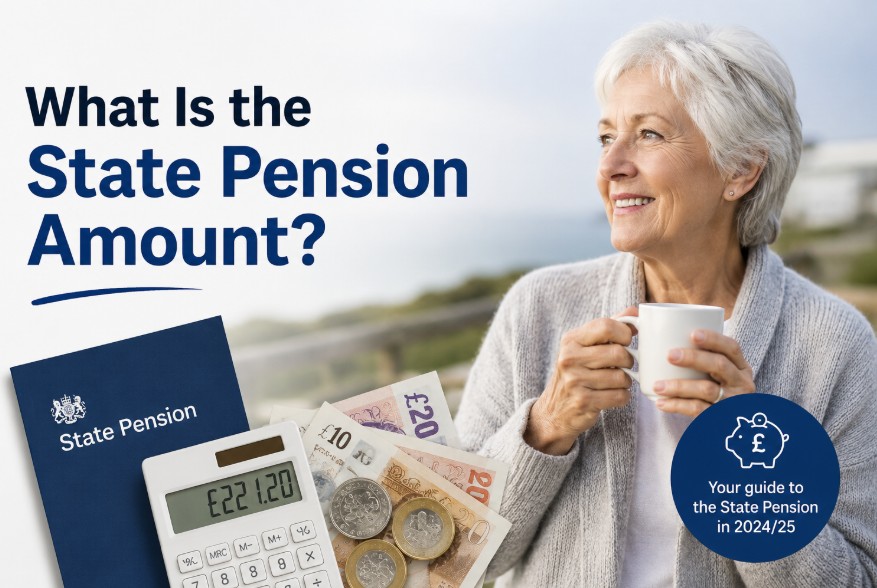
The full New State Pension amount is £241.30 per week for the 2026/27 tax year, while the full Basic State Pension rate is £184.90 per week. Your exact payment depends on whether you retired before or after April 2016 and the total number of qualifying years on your National Insurance record.
What Is the State Pension?
The UK State Pension is a regular, taxable payment from the government that individuals can claim upon reaching the official State Pension age. It serves as a state-funded financial safety net based on your lifelong National Insurance contribution record rather than a personal investment pot.
The State Pension is designed to act as a financial safety net rather than a full replacement for your working income.
Unlike workplace or private pensions, where you accumulate a physical cash pot of investment funds, the State Pension is funded on a pay-as-you-go basis.
This means today’s workers pay National Insurance (NI) contributions, which the government uses to fund payments to today’s pensioners. What you build up over your working life is not a pot of money, but a record of qualifying years.
There are currently two systems active in the UK:
- The New State Pension: For men born on or after 6 April 1951 and women born on or after 6 April 1953.
- The Basic State Pension (Old System): For individuals who reached retirement age before 6 April 2016.
What Is the State Pension Amount?
For the 2026/27 tax year, the full New State Pension is £241.30 per week (£12,547.60 annually), and the full Basic State Pension is £184.90 per week (£9,614.80 annually). These amounts are distributed in strict four-weekly cycles rather than calendar months.
The amount of money you actually receive depends heavily on which system you fall into, your total qualifying years, and whether you are owed any official DWP State Pension back payments due to processing delays or past calculation errors.
The Department for Work and Pensions (DWP) pays the State Pension every 4 weeks (in arrears) rather than by the calendar month.
For personal household budgeting, here is how the full, maximum rates break down across weekly, monthly, and annual cycles for the 2026/27 tax year:
| Pension Type | Weekly Rate | 4-Weekly Cycle (Actual Payment) | Calendar Month Equivalent | Annual Income |
| Full New State Pension (Post-April 2016) | £241.30 | £965.20 | ~£1,045.63 | £12,547.60 |
| Full Basic State Pension (Pre-April 2016) | £184.90 | £739.60 | ~£801.23 | £9,614.80 |
Note on Indexation: Both figures are legally protected by the Triple Lock mechanism. This means they increase every April by whichever is the highest of three economic measures: average wage growth, price inflation (CPI), or a baseline of 2.5%. For 2026/27, a 4.8% increase was applied based on average wage growth metrics.
What Is the State Pension Amount UK Per Month?
The monthly equivalent of the full New State Pension is approximately £1,045.63 per month. However, because the DWP distributes payments in four-weekly blocks of £965.20, pensioners receive 13 payments per year, meaning some calendar months will feature two payment dates.
For personal budgeting purposes, calculating a calendar month figure requires multiplying the weekly rate by the 52 weeks of the year and dividing by 12.
Key Rules of the Payment Cycle
- Payment Cycles: Most pensioners receive their funds in four-weekly blocks.
- Tax Implications: State Pension payments count as taxable income. If your total annual income exceeds the Personal Allowance threshold, you may incur an Income Tax liability.
- Direct Deposit: Payments are deposited directly into your nominated bank or building society account.
How Much State Pension Will I Get at 66?
At age 66, you will receive a pro-rata share of the £241.30 weekly maximum based on your National Insurance record. You receive the full amount if you have 35 qualifying years, a proportional amount for 10 to 34 years, and £0 if you have fewer than 10 years.
To proactively plan your retirement budget, you should accurately calculate how much State Pension you will get at 66 based strictly on the number of qualifying years currently accrued on your personal NI record.
Steps to Check Your Actual Forecast
To accurately find out what your specific payout will look like at age 66, follow these precise steps:
- Log in to the GOV.UK Check your State Pension portal using your Government Gateway credentials.
- Review your National Insurance record to identify any missing years.
- Check the forecast section to see your estimated weekly, monthly, and annual pension.
- Assess whether you have any gaps in your record due to unemployment or caregiving.
- Consider if voluntary National Insurance contributions would increase your future entitlement.
- Consult the HMRC website to understand the cost-benefit of filling gaps for past years.
- Confirm your projected payment date based on your date of birth.

Why Your New State Pension Might Be Less Than £241.30?
Your New State Pension will be less than £241.30 if you have fewer than 35 qualifying National Insurance years or if you were contracted out of the Additional State Pension before 6 April 2016 via an old workplace scheme.
Many people are shocked to find that even with 35 qualifying years on their record, their official forecast is lower than the headline full rate.
Beyond historical contracting out, sudden shortfalls can often be traced back to the statutory UK State Pension reduction rules, which modified how historical workplace earnings interact with newer state calculations.
If you were contracted out, you or your employer paid lower National Insurance contributions or redirected funds into a private scheme instead.
The government applies a starting amount deduction to account for this, meaning your baseline state pension is lower, though you should receive a higher private/workplace payout to balance it out.
How Much Is the State Pension for a Couple?
There is no combined or double State Pension rate for a couple in the UK. Each individual is assessed strictly on their own National Insurance record, meaning a married couple with maximum qualifying records can receive up to £482.60 per week combined.
Because the modern UK pension framework evaluates individuals uniquely, couples must track their balances separately.
- Individual Assessment: A married couple may receive two separate pension payments if both partners have sufficient qualifying years.
- Dependent Spouses: If one partner has a weak NI record, they might not receive the full amount, but they may be eligible for Pension Credit or other means-tested benefits.
- Historical Variations: Individuals who reached State Pension age before 2016 may have had rights to a pension based on their spouse’s record, a rule that does not apply to the new system. This legacy discrepancy has triggered ongoing corrective action, resulting in significant State Pension back payments for women who were historically underpaid by the old DWP system.
If you are concerned about your entitlement, you can read more about DWP State Pension Changes Next Year to see if you may be affected by these calculation errors.
Can You Get More Than the Full New State Pension?
Yes, you can receive more than the standard £241.30 per week if you defer claiming your State Pension by at least 9 weeks, or if you built up an Inherited State Pension or Protected Payment during the pre-2016 system rules.
Achieving the basic maximum requires 35 years of paid or credited National Insurance contributions. It is impossible to exceed this amount through standard NI contributions alone; additional retirement income must be sourced from workplace or personal pensions, or via the special methods below.
What Qualifies You for the State Pension?
Qualification for the UK State Pension requires a minimum of 10 qualifying National Insurance years for any partial payout, and a minimum of 35 qualifying years to claim the full £241.30 per week rate.
British citizenship alone does not qualify you. Entitlement is built entirely through National Insurance (NI) qualifying years.
A qualifying year is a tax year during which you either paid NI contributions or received designated credits.
To receive any pension at all, you must cross a specific time threshold:
- The 10-Year Minimum Rule: You must have a minimum of 10 qualifying years on your NI record to get any payout whatsoever. If you have 9 years or less, you get nothing.
- The Pro-Rata Scaling: If you have between 10 and 34 qualifying years, you get a proportional share of the pension.
- The 35-Year Rule: To claim the full maximum New State Pension of £241.30 per week, you need 35 qualifying years.
You can accumulate these qualifying years through:
- Working: Paying Class 1 or Class 2 NI contributions through employment or self-employment.
- National Insurance Credits: Being credited automatically if you are claiming Child Benefit (for a child under 12), Universal Credit, Jobseeker’s Allowance, or Carer’s Allowance.
When Can You Claim the State Pension?
The current official State Pension age to claim your benefits is 66 years old for both men and women. This age threshold is legislated to rise gradually to 67 between May 2026 and March 2028.
You cannot claim your State Pension early, regardless of whether you choose to stop working or if you have already hit your 35-year contribution limit.
- The Current Retirement Age: The official State Pension age is currently 66 for both men and women.
- Future Increases: By law, the State Pension age is scheduled to phase upward to 67 between May 2026 and March 2028. Further increases pushing the retirement age to 68 are planned for subsequent decades.

How to Boost Your State Pension?
If you check your forecast and realize you aren’t on track to receive the full amount, you have several reliable strategies to increase your final payout:
- Buy Voluntary NI Contributions (Filling Gaps): If you have gaps in your work history due to living abroad, unemployment, or taking time out to raise a family, you can explicitly buy voluntary Class 3 NI contributions. Generally, you can look back and fill gaps over the previous 6 tax years, making this an incredibly high-return financial decision for individuals approaching retirement age.
- Check for Missing NI Credits: Ensure you have claimed all the credits you are entitled to. For instance, grandparents who look after grandchildren under the age of 12 while the parents work can claim Specified Adult Childcare Credits to boost their own retirement records.
- Defer Your Pension: You are under no legal obligation to claim your pension the moment you turn 66. If you choose to delay claiming, your eventual payout increases by 1% for every 9 weeks you defer (amounting to roughly 5.8% for each full year). Deferring for just one year adds an extra £14.00 per week to your 2026/27 payout.
How to Claim the State Pension?
To claim the State Pension, you must apply online at GOV.UK/claim-state-pension, call the Pension Service helpline at 0800 731 7898, or complete a physical PR1 claim form via mail. It does not start automatically at age 66.
The government will not automatically start sending you payments; you must actively initiate the claim sequence.
- The Invitation Letter: Approximately 2 to 4 months before you turn 66, the DWP should send an invitation letter containing a unique security code.
- The Claim Paths: Once you have your invitation code, you can officially log your claim through three distinct routes:
- Online (Fastest): Visit the official portal at GOV.UK/claim-state-pension.
- Phone: Call the Pension Service helpline directly at 0800 731 7898.
- Post: Request a physical PR1 claim form, fill it out, and mail it back.
- Information Required: To complete the claim, you will need your National Insurance number, your current address, your bank details, and the date of your marriage or civil partnership (if applicable).
Summary and Next Steps
Understanding your retirement income requires navigating the specific requirements of your National Insurance record. Start by reviewing your forecast on the official government portal to see exactly how many qualifying years you have accrued.
If you identify gaps, investigate whether you can purchase voluntary Class 3 or Class 2 National Insurance contributions to bolster your final payout.
For those with complex financial situations, including various workplace pensions or significant savings, seeking independent financial advice remains a prudent step to ensure your retirement strategy aligns with your long-term goals.
FAQ
Is the State Pension taxable?
Yes, the State Pension is considered taxable income. If your total annual income, including the pension, exceeds your Personal Allowance, HMRC will collect the tax due, usually through an adjustment to your tax code.
Can I retire at 60 and still get full State Pension?
No. The current State Pension age is 66. You cannot claim the State Pension before reaching this age, regardless of when you stop working or if you have already completed 35 years of contributions.
What happens if I have less than 35 years of National Insurance?
If you have at least 10 years, you will receive a partial State Pension proportional to your contributions. Those with fewer than 10 years of qualifying NI records receive no State Pension entitlement.
Can I transfer my UK pension abroad?
Yes, you can receive your UK State Pension abroad. However, the amount only increases annually if you live in the EEA, Switzerland, or countries with a social security agreement with the UK.
What is the new pension age in the UK?
The current State Pension age is 66 for both men and women. Future increases are legislated to rise to 67 between 2026 and 2028, with further increases expected in the following decades.
Do all British citizens get a pension?
No. Eligibility is not determined by citizenship, but by the accumulation of National Insurance contributions. You must have lived and worked in the UK (or received NI credits) to build an entitlement.
How much pension will I get after 30 years if I retire?
Under the new State Pension system, 30 years of contributions would result in a pension roughly 85% of the full weekly rate, provided you have met the minimum threshold of 10 qualifying years.
How do I use a UK State Pension calculator?
You should only use the official Check your State Pension service on GOV.UK. Third-party calculators are often inaccurate; always verify your forecast against the data held directly by the Department for Work and Pensions.