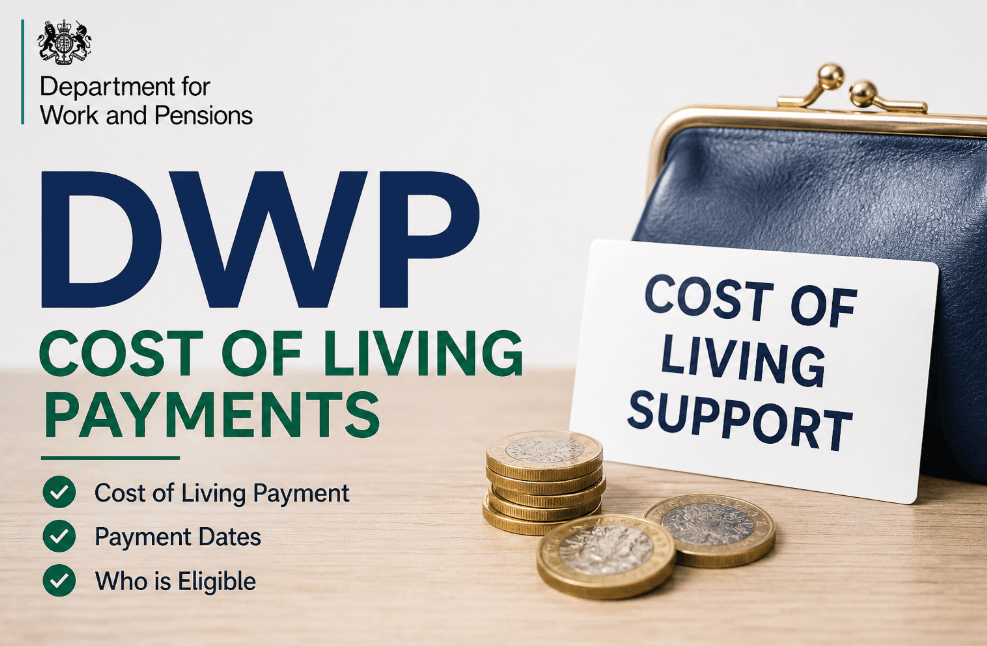
As of 2026, the Department for Work and Pensions (DWP) has transitioned from fixed-rate lump sum DWP cost of living payments to a system of increased monthly benefit rates and localised support.
While the previous £900 and £299 installments have concluded, eligible households now access financial relief through a 3.8% uprating of standard benefits and the newly established Crisis and Resilience Fund administered by local councils.
Will there be DWP cost of living payments in 2026?
Direct cost of living payments, as seen in previous years, have been replaced by a permanent increase in social security rates and targeted local authority funding.
For the 2026/27 tax year, the government has focused on “uprating” benefits like Universal Credit and the State Pension to align with inflation, ensuring that support is integrated into regular monthly payments rather than one-off grants.
The strategy marks a shift toward sustainable financial resilience. Instead of waiting for specific DWP announcement dates, claimants now see the “cost of living” adjustment reflected in their standard allowance.
This shift ensures that assistance is more predictable and less reliant on emergency legislation. For instance, recent adjustments have seen the DWP to provide £225 cost of living payments to alleviate financial strain for specific groups transitioning into the new system.
Additionally, the Crisis and Resilience Fund (which succeeded the Household Support Fund in April 2026) provides a safety net for those facing immediate emergencies with food, energy, or essential housing costs.
The Core Transition: From Lump Sums to Uprating
In practice, this means that while you won’t see a single “£300 payment” hit your bank account in May 2026, your total annual income from benefits should be higher than in previous years.
For example, a single claimant over 25 on Universal Credit will see their standard allowance rise significantly compared to the 2024 levels. This “hidden” cost of living support is designed to provide more predictable monthly budgeting for low-income households across the UK.

How much is the 2026 benefit uprating?
The 2026 benefit uprating is the primary method the DWP uses to manage the cost of living for millions. Most means-tested benefits have risen by 3.8%, based on the Consumer Price Index (CPI) from late 2025.
This ensures that the purchasing power of your benefits does not fall behind the cost of supermarket staples and household utilities.
| Benefit Type | 2025 Monthly Rate (Est) | 2026 Monthly Rate (New) | Annual Increase |
| Universal Credit (Single, 25+) | £393.45 | £408.40 | £179.40 |
| Universal Credit (Couple, 25+) | £617.60 | £641.06 | £281.52 |
| State Pension (Full New) | £963.00 | £1,009.22 | £554.64 |
| Pension Credit (Single) | £944.66 | £980.56 | £430.80 |
Note: Figures are rounded and depend on specific circumstances including housing and child elements.
What is the Crisis and Resilience Fund?
The Crisis and Resilience Fund is a critical resource for UK residents who find that their standard DWP cost of living payments and monthly benefits do not cover essential emergencies. Launched in April 2026, this fund is decentralised, meaning the DWP provides the budget, but your local council decides who receives the money and how it is distributed.
- Visit your local council’s official website.
- Search for the “Crisis and Resilience Fund” or “Local Welfare Provision” section.
- Check the specific eligibility criteria, which often focus on “immediate financial distress.”
- Gather evidence of your situation, such as a final energy notice or proof of low income.
- Complete the online application form or call the council’s dedicated helpline.
- Wait for an assessment; many councils provide vouchers or direct bank transfers within 5–10 working days.
When reviewing decisions made by local councils, it is clear that priority is often given to households with children, pensioners, or individuals with significant disabilities who are not eligible for other forms of credit.
Who is eligible for DWP support this year?
Eligibility for the 2026 financial support package is largely determined by your status as a “qualifying claimant” of means-tested benefits.
While receiving these funds, claimants should remain aware of the latest compliance measures regarding their assets and savings. Updated protocols for DWP bank account monitoring ensure that support is reaching those who meet the strict capital limit requirements.
Unlike the broad stroke payments of the past, the current system targets specific vulnerabilities.
- Low-Income Families: Those receiving Universal Credit, Income-based JSA, or Income-related ESA.
- Pensioners: Individuals receiving the State Pension who also qualify for Pension Credit (this is vital for unlocking extra winter support).
- Disabled Claimants: Recipients of PIP, DLA, or Attendance Allowance who face higher daily living costs.
- Carers: Those receiving Carer’s Allowance, who benefit from the 3.8% uprating to help balance their reduced earning capacity.
A common pattern is for households to miss out on “Cost of Living” support simply because they haven’t claimed Pension Credit.
Even if you only qualify for a few pounds of Pension Credit per week, it acts as a “passport” to thousands of pounds in additional support, including free TV licenses for those over 75 and reduced Council Tax.
How to report a missing DWP cost of living payment?
If you believe you were entitled to a payment from the 2023/24 or 2024/25 cycles but never received it, you can still take action. While the 2026 focus is on uprating, the DWP maintains a portal for “missing payments” from previous qualifying periods.
Steps to Recover Past Payments
If you were on a qualifying benefit like Tax Credits during the relevant “window” but your bank balance didn’t reflect the payment, do not assume it is lost. You should first check your “Payment Statements” in your Universal Credit journal.
If the entry is missing, use the “Reporting a Missing Payment” link on the GOV.UK website. You will need your National Insurance number and the dates you believe you were eligible.
Additional help with energy bills and housing
Beyond the DWP cost of living payments framework, other schemes remain active in 2026 to assist with specific high-cost areas.
The Winter Fuel Payment continues for eligible pensioners, and the Warm Home Discount provides a one-off £150 rebate on electricity bills for those in the “core group” or “broader group” of low-income households.
- Energy Rebates: Automatic £150 credits applied to your energy account between October and March.
- Water Sure: A scheme for those on benefits who use a lot of water due to medical conditions or large families.
- Discretionary Housing Payments (DHPs): Extra money from the council if your Universal Credit doesn’t cover your full rent.
Consider the case of “Sarah,” a part-time worker in Manchester. While she didn’t receive a specific 2026 cost of living lump sum, she applied for a DHP through her council when her rent increased, which covered the £80 monthly gap that her Universal Credit housing element missed.

Summary of Next Steps
To maximise your financial position in 2026, ensure you are receiving every element of benefit you are entitled to.
It is also worth investigating specific claiming strategies that could significantly boost your monthly income. Some households have successfully utilised a Universal Credit Loophole £1500 to secure additional backdated funds they were previously unaware of.
Use an online benefit calculator to check for “unclaimed” support like Pension Credit or Council Tax Support.
If you hit a sudden financial emergency, contact your local council immediately to ask about the Crisis and Resilience Fund. Staying proactive is the best way to navigate the end of lump-sum payments and the start of the new uprated system.
FAQ about DWP cost of living payments
Are there any £299 payments in 2026?
No. The £299 payment was part of the 2023/24 schedule. In 2026, support is provided via increased benefit rates and the Crisis and Resilience Fund.
Is the £900 cost of living payment coming back?
There are currently no plans to reinstate the £900 lump sum. The DWP has shifted to a 3.8% permanent increase in monthly benefit allowances instead.
How do I apply for the 2026 cost of living increase?
You do not need to apply. The 3.8% uprating is applied automatically to your Universal Credit, PIP, or State Pension payments from April 2026.
Does the Crisis and Resilience Fund pay cash?
Most councils provide support via supermarket vouchers, energy top-up codes, or direct payments to landlords, though some offer bank transfers for emergency needs.
Why is my Universal Credit higher in May 2026?
Your May payment reflects the annual uprating. Because benefits are paid in arrears, the April rate increase typically shows up in bank accounts by May.
Can I get a payment if I am on PIP but not Universal Credit?
While there isn’t a dedicated “Disability Cost of Living Payment” in 2026, your PIP rate has increased, and you can apply for local council crisis support.
What if I missed a payment from 2024?
You can report a missing payment via the official GOV.UK portal. Ensure you have your NI number and proof of benefit receipt for that period.