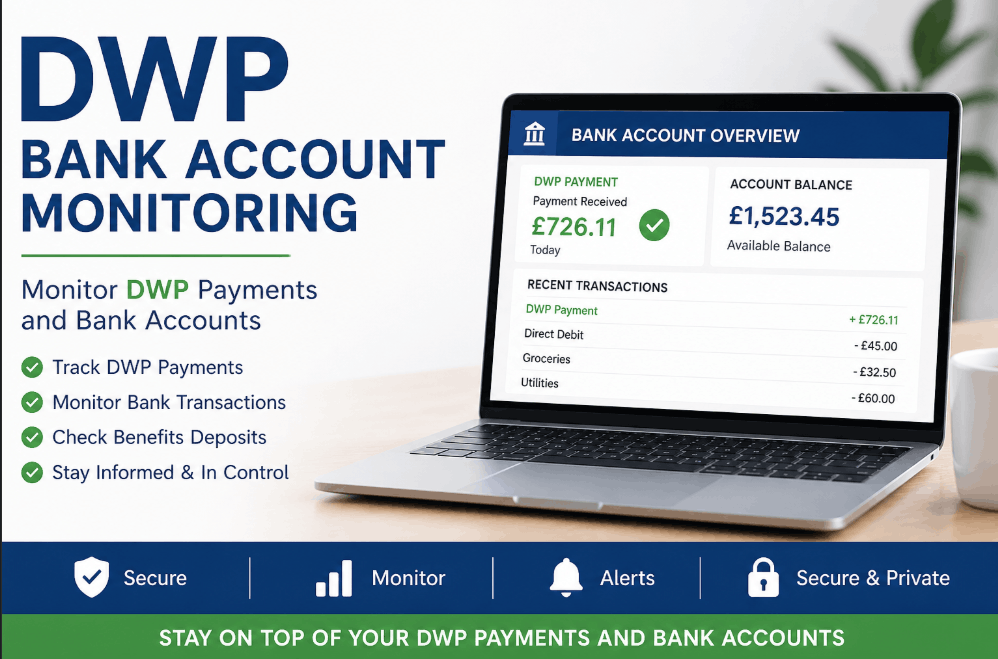
DWP bank account monitoring is the process where the Department for Work and Pensions requests data from financial institutions to identify benefit fraud and errors. Under the latest UK legislation, banks are required to share specific information regarding capital limits and abroad stays, ensuring claimants meet the eligibility criteria for means-tested benefits while maintaining strict data protection standards.
What is DWP bank account monitoring?
DWP bank account monitoring involves financial institutions scanning their systems for specific “flags” that indicate a benefit claimant may no longer meet eligibility requirements.
These flags primarily target accounts exceeding capital thresholds or those showing extended periods of overseas activity, which are then reported to the DWP via Eligibility Verification Notices (EVNs) for further investigation by human caseworkers.
The Core Truth of Modern Benefit Oversight
The fundamental reality of this system is that it does not grant the DWP “live” or “direct” login access to your personal banking app. Instead, it shifts the burden of reporting from the individual to the institution.
While the DWP has always had the power to request bank statements during an investigation, the current framework automates the identification of potential discrepancies.
This change is designed to reduce the £8 billion lost annually to fraud and error, specifically targeting unreported savings and abroad fraud.

Which benefits are affected by DWP bank account monitoring?
The new monitoring powers are primarily focused on means-tested benefits where an individual’s financial capital directly impacts their entitlement. If you receive benefits that are not based on your savings or income, your accounts are generally not subject to the same level of automated scrutiny.
| Benefit Category | Affected by Automated Monitoring? | Reason for Scrutiny |
| Universal Credit | Yes | Strict £6,000 and £16,000 capital limits. |
| Pension Credit | Yes | Verification of unreported income/assets. |
| Employment & Support Allowance (ESA) | Yes (Means-tested) | Ensuring income stays below permitted levels. |
| Personal Independence Payment (PIP) | No | Eligibility is based on health, not wealth. |
| State Pension | No | Contributory benefit; not means-tested. |
| Housing Benefit | Yes | Linked to local authority and DWP data sharing. |
While capital limits are strict, claimants often seek ways to maximize their legitimate entitlement within the rules. Understanding specific provisions, such as the Universal Credit Loophole £1500, can provide essential financial breathing room for eligible households.
Being aware of these nuances ensures you aren’t missing out on support while remaining fully compliant with DWP reporting standards.
How does the DWP bank monitoring process work?
The transition to automated flagging represents a significant shift in UK welfare administration. It is important to understand the specific steps involved in how a data flag moves from your high street bank to a DWP compliance officer’s desk.
- Legislative Trigger: The DWP issues an Eligibility Verification Notice (EVN) to a bank or building society.
- Automated Data Matching: The bank’s software scans its customer database against a list of DWP claimants.
- Exception Identification: The system identifies accounts that exceed the £16,000 capital limit or show transaction patterns suggesting 30+ consecutive days abroad.
- Data Transfer: The bank sends a limited data packet to the DWP, confirming the claimant’s identity and the nature of the flag.
- Initial Review: A DWP caseworker reviews the flag to see if the claimant has already declared these circumstances.
- Information Request: If a discrepancy exists, the DWP contacts the claimant to request official bank statements.
- Compliance Interview: A formal interview may be scheduled to discuss the findings and adjust benefit payments if necessary.
In practice, a common pattern is for a flag to be raised because of a disregarded payment. For example, a claimant might receive a backdated insurance payout that pushes their balance over £16,000.
While the system flags this as a violation, a human caseworker should recognize the payment as disregarded capital once the claimant provides evidence.

What triggers a DWP bank account check?
While the monitoring is widespread, the DWP does not investigate every claimant. Investigations are exception-based, meaning a specific data point must deviate from the rules of the benefit being claimed.
Capital Threshold Violations
Most means-tested benefits in the UK have a lower limit of £6,000 and an “upper limit” of £16,000. If your balance consistently stays above these markers without being declared, the bank’s automated system will notify the DWP.
This includes money held in ISAs, joint accounts, or even secondary savings accounts.
The 30-Day Abroad Rule
Universal Credit rules typically require claimants to be in the UK to receive payment, with limited exceptions. If bank records show consistent card transactions in a foreign country for more than 28 or 30 days, it triggers a residency flag.
A believable, anonymised example involves a claimant who stayed in Spain for six weeks to care for a relative; because they didn’t notify the DWP, the automated system flagged the overseas spending, leading to a temporary suspension of their claim.
Categorise Your Savings
Keep documentation for money that is disregarded, such as payments from the DWP cost of living boost 2025 or specific compensation sums. Correctly identifying these funds ensures that one-off government supports do not accidentally trigger a fraud flag when they appear in your balance.
What are your privacy rights under UK GDPR?
The implementation of DWP bank account monitoring has raised valid concerns regarding civil liberties. However, the DWP must operate within the framework of the Data Protection Act 2018 and UK GDPR.
- Data Minimisation: Banks are not supposed to send your full transaction history (what you bought at the supermarket) during the initial flag. They only provide the fact that a threshold has been met.
- Human Intervention: No benefit claim can be terminated solely by an automated algorithm. A human must review the case and offer the claimant a chance to explain.
- The ICO Oversight: The Information Commissioner’s Office monitors how the DWP handles this vast amount of data to prevent function creep, where data is used for purposes beyond fraud prevention.
When reviewing decisions, advocacy groups often find that the biggest risk is false positives, where a legitimate inheritance or a loan is incorrectly identified as income. Understanding your right to appeal is vital.
How to stay compliant and protect your claim?
Managing a benefit claim in 2026 requires more proactive record-keeping than in previous years. Being organized is the best defense against an automated flag.
- Report Capital Changes Immediately: If you receive a gift, inheritance, or large refund, update your journal or call the DWP within the same assessment period.
- Categorise Your Savings: Keep documentation for money that is disregarded, such as Cost of Living payments or specific compensation sums.
- Monitor Abroad Stays: If you are planning to leave the UK, even for a holiday, check your benefit’s specific rules on duration and notify your work coach.
- Keep Paper Trails: In the event of a bank error, having your own statements and letters ready can resolve a compliance check in days rather than months.

Comparison of DWP Investigation Types
| Feature | Standard Compliance Check | Fraud Investigation |
| Reason | Routine verification or minor flag. | Strong suspicion of deliberate deception. |
| Contact Method | Letter or phone call request. | Formal Interview Under Caution. |
| Data Scope | 1–3 months of bank statements. | Up to several years of financial history. |
| Potential Outcome | Payment adjustment or overpayment. | Prosecution, fines, or prison sentence. |
Final Summary and Next Steps
The landscape of UK welfare is shifting toward a more data-driven model. While DWP bank account monitoring sounds intimidating, it is primarily a tool for financial verification rather than a snooper’s charter into your daily life.
To protect yourself, ensure your Change of Circumstances are always up to date and maintain a clear folder of your financial statements. If you are contacted by the DWP, remain calm, provide the requested evidence promptly, and seek advice from Citizens Advice if you believe a mistake has been made.
FAQ about DWP bank account monitoring
Can the DWP see what I buy?
No. The monitoring identifies if your total balance is over a limit or if you are spending abroad. It does not provide the DWP with a line-by-line list of your shopping habits unless a formal fraud investigation is opened.
Which banks are sharing data with the DWP?
All major UK high street banks (e.g., Barclays, HSBC, NatWest) and digital-only banks (e.g., Monzo, Starling) are legally required to comply with Eligibility Verification Notices issued by the government.
Will the DWP check my partner’s bank account?
If you are claiming as a couple (e.g., for Universal Credit), both partners’ finances are treated as a single household unit. Therefore, both accounts are subject to monitoring to ensure the combined capital is accurate.
Can a bank refuse to share my data with the DWP?
No. Under the Public Authorities (Fraud, Error and Recovery) Act, financial institutions are legally mandated to share this data. Refusing to comply could lead to significant legal penalties for the bank.
Does bank monitoring apply to the Disability Living Allowance?
Generally, no. Disability Living Allowance (DLA), like PIP, is not means-tested. Monitoring is targeted at benefits where your savings level is a condition of receiving the money.
What happens if the DWP finds an error?
If the monitoring reveals an undeclared balance, you will usually be asked to pay back the overpaid amount. If the omission was accidental, it is treated as an error. If it was intentional, it may be treated as fraud.
How far back can the DWP check my bank accounts?
While automated monitoring is prospective, the DWP can investigate historical records if a significant discrepancy is found. This retrospective look also applies to government errors, such as the ongoing processing of DWP state pension back payments for those underpaid in previous years.
Whether the error is on the part of the claimant or the department, financial transparency remains the standard.