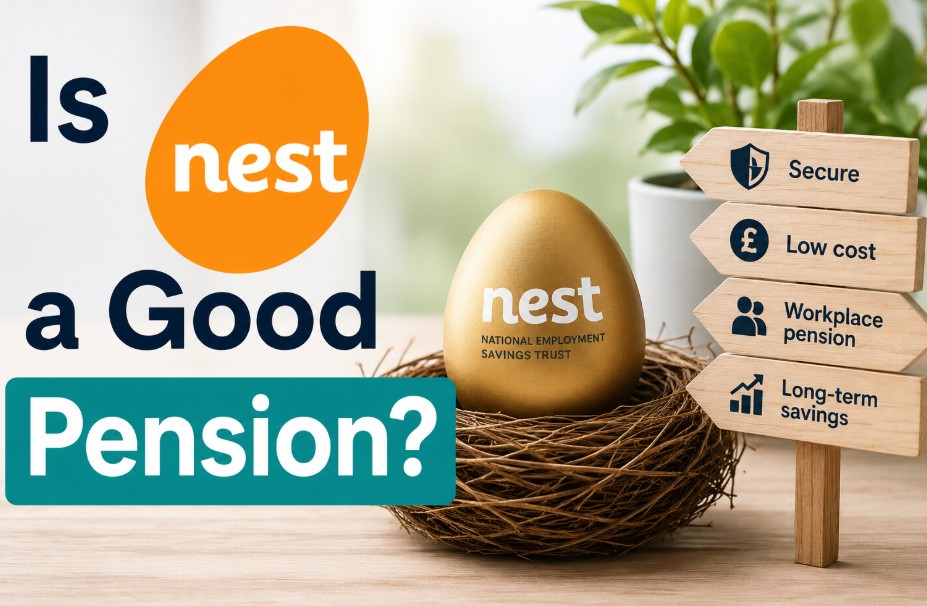
Yes, NEST is an excellent, highly secure, and compliant pension foundation for the vast majority of UK workers due to its government-backed status and mandatory employer contributions.
While it is perfect for those seeking a low-cost, set-and-forget approach, high-earners or investors seeking granular control over individual stocks may prefer a private Self-Invested Personal Pension (SIPP).
What is a NEST pension?
A NEST (National Employment Savings Trust) pension is a government-backed, defined contribution workplace pension scheme.
It is designed to provide a secure and low-cost retirement savings vehicle for millions of UK workers, operating as a reliable, set-and-forget solution for those without extensive financial market experience.
How does a NEST pension work?
NEST functions through automatic enrolment, where your employer is legally required to register eligible workers. Both you and your employer make mandatory contributions, which the government boosts with tax relief.
These funds are pooled into a Retirement Date Fund that automatically adjusts its risk level as you age.
- Automatic Enrolment: If you are an eligible jobholder (generally earning over £10,000 annually), your employer is legally required to enrol you into a workplace pension scheme, often NEST.
- Employer Contributions: Every time you contribute to your pension, your employer is required to add a percentage, effectively acting as an immediate boost to your savings.
- Tax Relief: Because your contributions are often taken from your salary before tax, the government effectively adds tax relief to your pot, increasing the amount invested.
- Investment Growth: Your contributions are pooled and invested in a default Retirement Date Fund. This fund automatically adjusts its asset allocation, moving from growth-oriented equities to lower-risk bonds, as you get closer to your target retirement age.
Is NEST a Good Pension?
Yes, NEST is considered a top-tier pension choice. Its primary strengths are its simplicity, security, and low cost. It removes the complexity of managing investments while ensuring you capture essential employer matching.
However, if you are a high-earner or require sophisticated investment strategies like individual stock picking, you may find that a private SIPP offers better control.
The Truth About NEST Pension Utility
NEST operates differently from private SIPPs because its mandate is to ensure universal workplace compliance rather than providing high-frequency trading capabilities.
| Feature | NEST Pension | Private SIPP |
| Annual Management Charge | 0.3% | Varies (often higher) |
| Contribution Charge | 1.8% | Generally none |
| Investment Control | Limited (Default funds) | High (Stocks, ETFs, Funds) |
| Account Setup | Automatic via Employer | Manual |
Analyzing the Fee Structure
The fee structure of NEST often generates debate. While the 0.3% Annual Management Charge (AMC) is competitive, members must also account for the 1.8% charge on each contribution.
- Impact on small pots: The 1.8% upfront charge can feel significant on early-career contributions.
- Long-term benefit: Over 20–30 years, the low 0.3% AMC typically outweighs the initial contribution cost, particularly for passive investors who prioritize set and forget simplicity.

What are the disadvantages of NEST pension?
The primary disadvantages of a NEST pension include a limited selection of investment funds, an upfront 1.8% contribution charge that may affect early-career savings, and customer support services that some users report have longer wait times compared to premium, private-sector pension providers.
- Limited Investment Choice: The selection of funds is smaller compared to major private investment platforms.
- Upfront Fee: The 1.8% contribution charge can feel significant when you are just starting out or making small, frequent payments.
- Customer Support: Some users report that customer service can have long wait times compared to premium private providers.
- Performance Tracking: It lacks the high-frequency trading tools or in-depth technical analysis dashboards found on commercial investment platforms.
Is it worth paying into a NEST pension?
Yes. For most people, the combination of employer contributions and tax relief provides an immediate return that is difficult to replicate in a standard savings account. Failing to contribute often means leaving free money from your employer on the table.
Is NEST a Good Pension for Self-Employed Individuals?
Yes, NEST provides a rare opportunity for self-employed individuals to access a master trust typically reserved for large-company employees.
- Flexibility: Unlike private pensions that often mandate fixed monthly direct debits, NEST allows for ad-hoc, flexible contributions, which is ideal for those with irregular business income.
- No Exit Fees: You can pause or adjust payments based on your cash flow without facing punitive penalties.
How much will a NEST pension pay?
There is no fixed payout for a NEST pension, as it depends on your total contributions, market performance, and your retirement age.
You can estimate your future income by using the NEST online portal’s projection calculator or by reviewing your annual statements to forecast your potential pot value.
- Using the NEST Calculator: Log in to your online member portal to use their built-in projections.
- Checking Your Statements: These provide a projection of your potential income at your chosen retirement age.
- Considering Outside Factors: Your final income will also be influenced by other pots you may have, your State Pension entitlement, eligibility for the Pension Age Disability Payment, and your chosen withdrawal method (such as taking a tax-free lump sum or purchasing an annuity).

Is NEST Pension Performing Well?
Pension performance is intrinsically linked to the investment fund you choose. Most members are in the NEST Retirement Date Fund, which prioritizes long-term growth and manages risk automatically.
Factors Influencing Your Pot Value
Your pot value is primarily influenced by your chosen asset allocation, the length of time you have been saving, and general market conditions. The fund’s automated de-risking strategy helps protect your savings from market volatility as you get closer to your target retirement date.
- Asset Allocation: Your fund shifts from high-growth equities to lower-risk bonds as you age.
- Market Volatility: Like all market-linked investments, temporary downturns can occur. This is a standard part of long-term investing.
- Risk Profiles: If the default fund feels too conservative, NEST offers alternatives, such as a Sharia fund or a Higher Risk fund.
Why is my NEST pension losing money?
If your NEST pension balance drops, it is usually a reflection of temporary global market volatility affecting the underlying equities in your fund.
This is standard in long-term investing; check your statement to determine if this is a market-wide trend or an issue specific to your chosen investment fund.
How does NEST pension work when you retire?
From age 55 (57 from 2028), you can access your NEST savings. The process involves reviewing your pot size, verifying your eligibility, choosing a withdrawal method, such as a tax-free lump sum or an annuity, and submitting your request via the online portal to receive your funds securely.
Steps to Accessing Your NEST Pension
- Review your current pot size: Log in to your member dashboard to confirm your total accrued value.
- Verify your retirement age: Ensure you meet the minimum age requirements set by current UK legislation.
- Choose your withdrawal method: Decide between a lump sum, a series of smaller withdrawals, or purchasing an annuity.
- Consider financial advice: Before making large withdrawals, consult with a qualified advisor to understand tax implications.
- Submit your request: Use the online portal to notify NEST of your intent to start drawing funds.
- Confirm bank details: Ensure your nominated UK bank account is linked for secure transfers and complies with current DWP Pension Banking Rules.
- Receive confirmation: Wait for NEST to verify your eligibility and process the initial payment.
How to get a NEST pension?
If you are an employee, you are likely to be enrolled automatically by your employer if you meet eligibility criteria.
If you are self-employed, you can join NEST directly by registering for an account on the official NEST Pensions website to start making flexible, ad-hoc contributions.
- Through Employment: If your employer uses NEST, you will be enrolled automatically if you meet the eligibility criteria. You can confirm this with your HR department.
- Self-Employed: You can join NEST directly as a self-employed individual. Visit the NEST Pensions website to register for an account, which will allow you to make flexible, ad-hoc contributions to suit your business’s cash flow.
How to register for a NEST pension?
The registration process depends on your employment status. If you are an employee, you are typically enrolled automatically by your employer.
If you are self-employed or a single-person director, you can register directly via the official NEST website by completing an eligibility check and providing your National Insurance number.
If you are an employee
In most cases, you do not need to register yourself.
- Automatic Enrolment: Your employer is legally required to enrol you if you meet the eligibility criteria (generally earning over £10,000 annually).
- Welcome Pack: Once enrolled, NEST will send a welcome letter by post containing your NEST ID.
- Account Activation: Visit the NEST website, select I already have a Nest pension, and follow the steps to set up your online access using your NEST ID and personal details.
If you are self-employed
You can join NEST directly if you are self-employed or a single-person director with no other employees.
- Check Eligibility: Visit the NEST Registration page to confirm you reside in the UK, make National Insurance contributions, and are aged between 16 and 75.
- Provide Details: You will need your National Insurance (NI) number, personal contact details, and a UK-registered personal bank account for Direct Debits or debit card payments.
- Complete Sign-up: Follow the online prompts to create your login credentials (username and password).
- Manage Contributions: Once registered, you can log in to your dashboard to set up regular monthly contributions or make one-off payments (minimum £10).
Note: NEST is a workplace pension scheme. If you are a director of a company that employs other people, you must register as an employer to fulfil your legal duties before you can enrol yourself and your staff

Comparing NEST and The People’s Pension
While both NEST and The People’s Pension are popular workplace master trusts designed for auto-enrolment, they differ significantly in their governance, fee structures, and investment flexibility.
The table below outlines the core differences to help you decide which scheme better aligns with your retirement goals.
| Feature | NEST Pension | The People’s Pension |
| Governance | Government-backed Master Trust | Private Sector Master Trust |
| Annual Management Charge (AMC) | 0.3% | Varies (typically tiered) |
| Contribution Charge | 1.8% | Generally none |
| Investment Options | Limited (Default-focused) | Higher flexibility in fund choice |
| Primary Target | Universal workplace compliance | Flexible corporate & private sector |
| Best For | Set-and-forget savers | Savers seeking more fund variety |
Note: Fee structures for private master trusts like The People’s Pension can vary based on individual employer agreements. Always check your specific pension statement or your employer’s HR documentation to confirm the exact charges applied to your pot.
Final Summary
Determining if NEST is a good pension requires balancing its low annual fees and government-backed security against the upfront contribution charge and limited investment customization.
For the majority of UK workers, NEST is an excellent, reliable, and compliant foundation for retirement. However, high-earners or those seeking sophisticated investment portfolios may eventually find that transitioning to a private SIPP provides better flexibility.
Assess your retirement horizon and contribution capacity to decide if your current path remains optimal.
Verified against the Pensions Regulator and official NEST Pensions guidance.
FAQ about Is NEST a good pension?
Is NEST a private pension?
No, NEST is a workplace master trust pension. While it functions similarly to a private pension, it was created by the UK government to facilitate auto-enrolment for all employees.
Is Nest pension safe?
Yes. NEST is highly regulated by the Pensions Regulator. Your funds are held in trust, separate from both your employer and the government, providing a high level of security.
What are common problems with Nest?
Common complaints often relate to customer service wait times and the complexity of understanding the 1.8% contribution fee versus the 0.3% annual management charge.
Can I transfer my NEST pension to another provider?
Yes, you can transfer your NEST pot to another registered pension scheme, such as a SIPP, provided the receiving scheme accepts transfers from master trusts.
Is NEST better than an NHS pension?
These are fundamentally different. An NHS pension is a defined benefit (DB) scheme, which is generally considered superior due to its guaranteed, inflation-linked income, whereas NEST is a defined contribution (DC) scheme.
Is it worth paying into a Nest pension?
For most, yes. The combination of mandatory employer contributions and tax relief makes it an efficient way to save for retirement compared to keeping cash in a standard savings account.
Why is my Nest pension balance not increasing?
If your balance is stagnant, it may be due to low contribution levels or the specific investment strategy of your chosen fund not aligning with your growth expectations.
How do I check my Nest pension performance?
Log in to your online member account to view your transaction history, current fund valuation, and detailed performance reports for your specific retirement date fund.