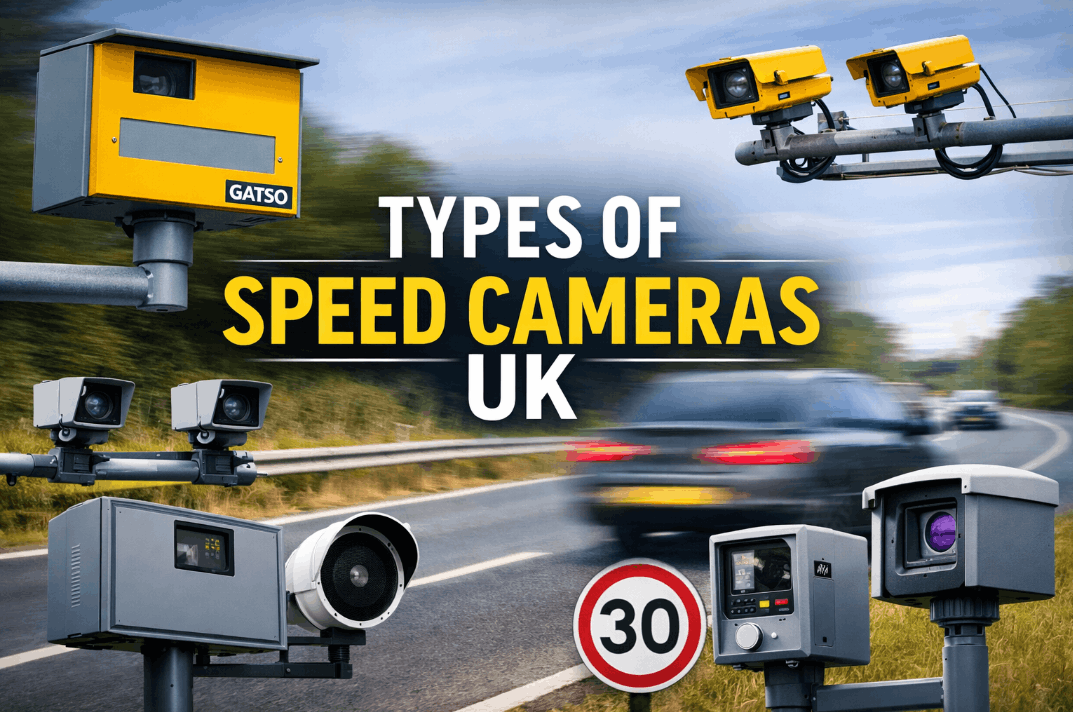
The different types of speed cameras UK motorists encounter range from traditional fixed yellow boxes to advanced 4D radar and AI-powered surveillance systems.
These devices monitor vehicle velocity using radar, laser, or sensor-based technology to ensure road safety compliance. Modern enforcement now includes bi-directional tracking and multi-offence detection for seatbelt and mobile phone violations.
British roads utilise a combination of fixed, average, and mobile enforcement technology. The various types of speed cameras UK authorities deploy include rear-facing Gatso units, forward-facing Truvelo cameras, and HADECS 3 stealth units found on smart motorways.
Average speed systems like SPECS monitor long stretches of road, while mobile laser vans and new AI-integrated 4D radar units provide flexible enforcement across the national road network.
These systems are frequently deployed during major roadworks; understanding what would you expect to find at a contraflow system on a motorway allows you to navigate the narrow lanes and reduced limits enforced by these high-precision units.
The Shift Toward Intelligent Infrastructure
The transition from traditional ‘wet film’ units to fully digital, internet-connected systems has fundamentally accelerated the enforcement timeline.
Historically, cameras had to be manually emptied of physical film; today, violations are transmitted instantly to central police ticket offices.
This digital shift allows for higher operational uptime and the ability to update software remotely to meet new legislative standards.
| Camera System | Technology Used | Detection Range | Primary Purpose |
| Gatso | Radar / Flash | Fixed Point | Speed enforcement (Rear) |
| Truvelo | Piezo / Infrared | Fixed Point | Speed & Driver ID (Front) |
| SPECS | ANPR / Digital | Multi-mile | Average Speed Monitoring |
| Redspeed | 4D Radar / AI | Lane-wide | Speed, Phone, & Seatbelts |
| HADECS 3 | Radar / Digital | Variable | Smart Motorway Compliance |
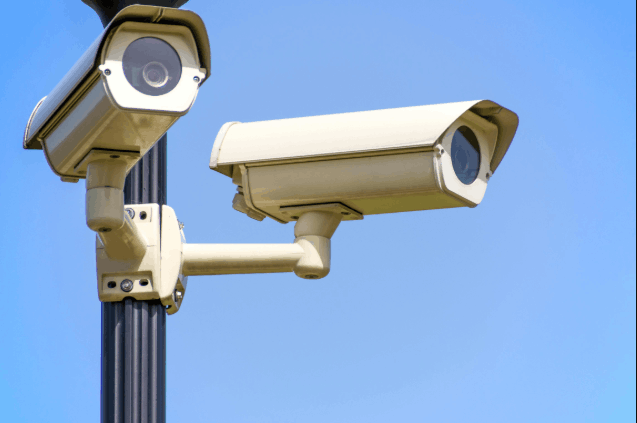
The 15 Types of Speed Cameras UK Drivers Face
1. Digital Gatso
The ubiquitous yellow box remains a staple of British roads, though it has evolved from 1990s film to 2026 digital precision. These units use rear-facing radar to detect your speed as you pass over white check marks.
If triggered, the camera takes two photos, using the distance travelled between them as secondary proof. They are the most common fixed units in the UK.
Pros
- Highly visible, serving as a massive psychological deterrent in accident hotspots.
- Rear-facing design means they never dazzle drivers with a bright white flash.
Cons
- Cannot identify the driver’s face, which leads to legal Section 172 disputes.
- Motorists often yo-yo drive, braking hard before and speeding up immediately after.
2. Truvelo Combi
Unlike the Gatso, the Truvelo Combi looks you right in the eye. It uses piezo sensors embedded in the road surface to calculate speed with pinpoint accuracy.
When a violation is detected, it snaps a front-facing photo of the vehicle. It uses a special magenta or infrared filter on its flash to prevent blinding the motorist during the capture.
Pros
- Captures the driver’s face, providing irrefutable evidence for the police.
- Use of infrared technology makes the flash nearly invisible to the human eye.
Cons
- Front-facing capture means motorcyclists (who have no front plate) are often immune.
- Since there is no obvious flash, drivers often don’t know they’ve been caught.
3. Truvelo D-Cam
The D-Cam is the slim, versatile successor to the Combi. These units can be mounted on poles or gantries and are capable of monitoring three lanes of traffic simultaneously.
They can be set to front or rear-facing and use laser technology or road sensors. They are becoming the standard replacement for ageing Gatso boxes in many UK counties.
Pros
- Digital connectivity allows for instant violation transmission to central police offices.
- Multi-lane capability means one unit can monitor an entire dual carriageway.
Cons
- Their smaller, slimmer profile makes them harder to spot than traditional boxes.
- High installation cost due to the advanced 4K digital imaging required.
4. HADECS 3 (Smart Motorway)
The Highway Agency Digital Enforcement and Compliance System (HADECS) is the stealth king of the motorway. Mounted on the side of gantries rather than overhead, these tiny grey units are easy to miss.
They are linked directly to variable speed limit signs, meaning they adjust their trigger threshold the moment the signs change during heavy traffic or incidents.
Pros
- Effectively manages traffic flow and protects recovery crews on smart motorways.
- Completely automated; they require no human operator to function 24/7.
Cons
- Their grey stealth colour is controversial as they don’t provide a clear visual warning.
- Can trigger during the grace period when a variable limit is transitioning down.
5. SPECS (Average Speed)
SPECS systems don’t care how fast you pass the camera; they care how fast you drove the last two miles. Using ANPR technology, these yellow cameras (found on poles or bridges) time you between two points and calculate your mean speed.
If you cover the distance too quickly, a Notice of Intended Prosecution is automatically generated and sent.
Pros
- Proven to smooth traffic flow and eliminate dangerous panic braking near cameras.
- Highly effective in roadworks for protecting vulnerable workers from high-speed collisions.
Cons
- Motorists feel constantly watched over long stretches, increasing driver fatigue.
- Lane-changing was once a way to cheat them, but modern systems overlap lanes.
6. VECTOR SR
The VECTOR SR is the ultimate all-rounder. Produced by Jenoptik, this unit doesn’t need road loops or a flash. It uses 3D tracking radar to monitor speed in both directions across multiple lanes.
It is often used as a combined Speed and Red Light camera, making it one of the most efficient tools in the police arsenal today.
Pros
- Passively safe and compact, it can be mounted on existing street furniture easily.
- Does not require a flash, meaning it works 24/7 without notifying the driver.
Cons
- Its discreet CCTV-like appearance makes it nearly impossible for drivers to identify.
- High complexity means calibration errors can occasionally lead to legal challenges.
7. Redspeed Sentio (4D AI)
Representing the vanguard of 2026 enforcement, the Redspeed Sentio is an all-in-one ‘intelligent’ unit. Using 4D radar and AI, the Sentio doesn’t just look for speed; it scans the driver’s hands for mobile phones and the torso for seatbelts.
It can even check if your MOT or Insurance has expired via a real-time link to the DVLA database, monitoring up to six lanes from one unit.
Pros
- Multi-offence detection reduces the need for physical police patrols.
- Extremely accurate 4D tracking eliminates false triggers caused by nearby vehicles.
Cons
- Raising major privacy and mass surveillance debates among civil liberty groups.
- Initial deployment costs are significantly higher than traditional speed-only cameras.
8. Acusensus Heads Up
Specialized in behavioural enforcement, the Acusensus system is usually found on trailers or high gantries. It looks down into the cabin of the vehicle using high-angle lenses.
AI software flags images where a driver appears to be holding a mobile phone or not wearing a seatbelt, which are then sent to a human officer for final verification and prosecution.
Pros
- Targets distracted driving, which is a leading cause of UK road fatalities.
- Mobile trailer design allows police to move the unit to different hotspots weekly.
Cons
- Does not always provide a visible speed deterrent, focusing instead on internal offences.
- Relies on AI guessing, which requires a secondary human check to avoid errors.
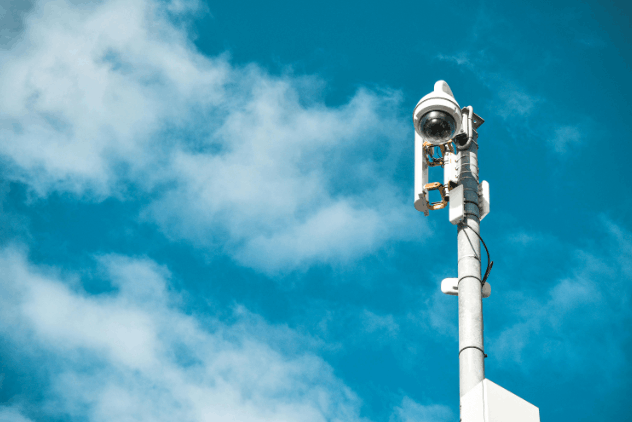
9. Mobile Laser Vans
The classic white van with a window in the back. These are operated by the Safety Camera Partnership and use laser guns (Lidar) to target vehicles.
They can be parked on bridges or verges and are often deployed based on community complaints about speeding in residential areas. They capture high-quality video and still images of the offence.
Pros
- Can be deployed anywhere, anytime, making them highly unpredictable for speeders.
- Lasers have a massive range, often catching drivers from over 1,000 metres away.
Cons
- Requires a trained human operator, making them more expensive to run than fixed boxes.
- Vulnerable to flash warnings from other motorists who see the van first.
10. Siemens SafeZone
SafeZone is the urban version of average speed enforcement. These small, unobtrusive cameras are perfect for 20mph zones, residential estates, and school areas.
They use ANPR to ensure that drivers maintain a safe, consistent speed throughout a neighbourhood rather than just slowing down for a single speed bump or a traditional fixed yellow camera box.
Pros
- Much more popular with local residents as they feel less aggressive than Gatsos.
- Significantly reduces CO2 and noise pollution by encouraging smooth, steady driving.
Cons
- Often lacks the instant deterrent of a flash, so speeders may continue through.
- Setup requires multiple camera sites, which can be expensive for small local councils.
11. SpeedSpike
SpeedSpike is a low-cost, networked average speed system. Unlike SPECS, which is usually for motorways, SpeedSpike can link up to 1,000 cameras into a web.
This allows a whole town to be monitored simultaneously. If you enter at one side of a city and exit the other too fast, the system knows, regardless of which route you took.
Pros
- Extremely flexible; cameras can be moved between pre-installed base stations easily.
- Works in all weather conditions and is incredibly difficult for motorists to evade.
Cons
- Creates a Big Brother atmosphere in towns where every movement is tracked.
- Relies heavily on high-speed data networks; if the link drops, enforcement fails.
12. REDFLEX speed
REDFLEX units are high-capacity radar cameras often found on busy dual-carriageways. They use a dual-radar system to differentiate between vehicles in heavy traffic.
One radar tracks the speed, while the other identifies the specific lane. They are capable of photographing six different vehicles at the same time, making them lethal in high-volume traffic areas like London.
Pros
- Exceptional at identifying the correct offending vehicle in a crowded multi-lane pack.
- High-resolution 11MP images provide great clarity for identifying number plates.
Cons
- Can be sensitive to environmental interference like heavy rain or snow.
- The complex multi-radar setup requires frequent, professional calibration to remain legal.
13. Traffic Light Cameras (Gatso RLC)
These are the Red Light guardians. Triggered by sensors under the road, they activate only when a car crosses the line after the light has turned red.
However, most modern versions now act as Speed on Green cameras, meaning they will also ticket you for speeding through the junction even if the light is perfectly green.
Pros
- Effectively prevents T-bone collisions at junctions, which are often fatal.
- Doubles as a speed camera, providing two types of enforcement from one box.
Cons
- Can penalise drivers who pull forward to allow an emergency vehicle through.
- Ground sensors are prone to wear and tear from heavy lorries over time.
14. Long Ranger Mobile
Operating with extreme precision at distance, the Long Ranger is the premier tool for long-distance mobile enforcement. Used by police officers on overpasses, it consists of a high-powered video camera linked to a laser.
It can capture the driver’s face, seatbelt status, and mobile phone usage from over a mile away. By the time you see the officer, your offence has already been recorded in HD video.
Pros
- Incredible range allows police to monitor traffic without being a visible distraction.
- Video evidence is much harder to contest in court than a single static photo.
Cons
- Extremely expensive equipment that requires specialized training for the police officer.
- Drivers often feel this is entrapment due to the extreme distance involved.
15. DS2 Unattended Mobile
The DS2 is a semi-permanent speed trap. It consists of three thin strips or light beams across the road connected to a hidden camera.
It can be left at the side of a road for days without an officer present. When a car breaks the beams too quickly, the camera snaps the plate. It is a favourite for rural B-roads.
Pros
- Allows for enforcement on narrow country roads where a van cannot safely park.
- Extremely difficult to detect as there is no radar signal for detectors to pick up.
Cons
- Because it is unmanned, these units are frequent targets for theft or vandalism.
- Setup is time-consuming as the beams must be perfectly aligned across the tarmac.
Why does the government install speed cameras?
The primary motivation for installing speed cameras is the reduction of road traffic fatalities and serious injuries.
Local Safety Camera Partnerships and National Highways use historical collision data to identify blackspots where excessive speed is a recurring factor in accidents.
Many of these units are positioned near pedestrian hubs; for a driver, knowing exactly why is a toucan crossing different from a puffin crossing is vital for anticipating pedestrian and cyclist movements within camera-controlled urban zones.
By placing visible deterrents, authorities aim to encourage speed compliance rather than simply generating revenue.
Analysis of Speed Camera Enforcement: Benefits vs. Drawbacks
The table below outlines the balance between public safety objectives and the operational concerns frequently raised by UK motorists.
| Feature | Advantages (Safety & Efficiency) | Disadvantages (Driver Concerns) |
| Accident Reduction | Statistically proven to reduce fatal and serious collisions at identified blackspots by up to 25%. | Can cause panic braking, where drivers slam on brakes upon spotting a camera, potentially causing rear-end shunts. |
| Consistency | Cameras apply the law 24/7 without bias; they do not have off days and treat every motorist equally. | Lacks the human touch or discretion a police officer might show (e.g., in an emergency or for minor technicalities). |
| Operational Costs | Frees up police resources to focus on violent crime or complex investigations rather than manual speed traps. | High initial taxpayer cost; some units cost over £100,000 to install and maintain with secure data links. |
| Traffic Flow | Average speed cameras (SPECS) have been shown to improve traffic smoothing and reduce stop-start congestion. | Fixed cameras can lead to yo-yo driving, where motorists speed up immediately after passing the enforcement zone. |
| Multi-Detection | Modern AI units can detect non-speeding offences, such as mobile phone use and lack of seatbelts. | Increases the feeling of mass surveillance and Big Brother among the law-abiding driving population. |
| Environmental | Encouraging lower, consistent speeds reduces fuel consumption and lowers CO2 and NOx emissions. | The production and energy consumption of thousands of digital units have a minor but notable carbon footprint. |
How do different types of speed cameras UK technology differ?
The technical capabilities of these devices have diverged significantly over the last decade. While older units relied on simple radar, the current 2026 standard involves complex environmental resilience.
4D radar has become the gold standard; unlike older radar that could be confused by multiple vehicles, 4D systems track the distance, angle, height, and velocity of every object in their field of vision.
- Environmental Resilience: Most UK units are IP68-rated, meaning they are completely dust-tight and water-resistant against heavy rain and coastal corrosion.
- Night Vision: Modern systems use infrared (IR) illuminators that provide clear images in total darkness without a visible flash.
- Power Supply: Newer mobile trailers often use solar panels and hydrogen fuel cells for long-term off-grid deployment.
What is the cost and installation process?
Installing a single speed camera involves the camera head, pole, secure housing, power, and high-speed data links to the police network.
A standard fixed unit typically costs between £20,000 and £40,000 to purchase, but total taxpayer cost often exceeds £100,000 per site when factoring in civil engineering and signage.
What happens if you are caught speeding?
The legal process following a camera trigger is rigid and time-sensitive. Failure to follow the steps can result in much harsher penalties than the initial speeding offence.
- Camera Trigger: The device records the speed and number plate.
- First NIP: The Notice of Intended Prosecution is sent to the registered keeper within 14 days.
- Section 172: You must name the driver within 28 days of receiving the notice.
- Offer of Course: If eligible, you may receive an offer for a Speed Awareness Course.
- Conditional Offer: Alternatively, you receive a £100 fine and 3 penalty points.
- Court Summons: If the speed was excessive (Band C) or you ignore the NIP, the matter goes to a Magistrates’ Court.
Eligibility for driver retraining is strictly limited to minor offences; motorists often question why was I not offered a speed awareness course if their recorded velocity was significantly above the threshold or if they have attended a session recently.
Can you request recordings or evidence?
Under the Data Protection Act and GDPR, you have the right to submit a Subject Access Request (SAR) to the relevant police force.
Usually, the police provide still images rather than full video sequences. If a camera is found to have a calibration error, as seen in the 2025 variable speed anomaly cases, the footage is vital for a successful appeal.
Consider the case of a courier in Birmingham who recently successfully challenged a NIP after proving the gantry signs were blank; by requesting the secondary check images, they proved the HADECS 3 unit had triggered while the variable limit was transitioning.
How to spot and identify speed cameras on the road
To find out if a camera is present, you should look for the rectangular blue or white camera logo signs. Beyond specific camera alerts, identifying what shape are traffic signs giving orders allows you to recognize mandatory speed limit changes the moment they appear on the roadside.
A common pattern is that cameras are located near schools, high-risk junctions, or roadworks. GPS-based apps and dashcams with Speed Camera Alerts are legal and use the National Speed Camera Database to warn drivers.

Protecting Your Licence: Essential Next Steps
Managing the legal risks associated with the various types of speed cameras UK police deploy requires a proactive approach. If you receive an NIP, identify the driver and return the Section 172 form within 28 days. Ignoring the notice is a separate offence that carries a mandatory 6 points, often more than the speeding offence itself.
FAQ
Do speed cameras flash at night?
Most modern digital and forward-facing cameras use infrared technology, which is invisible to the human eye. Only older Gatso units still use a bright white flash to illuminate the rear of the vehicle.
Can a speed camera make a mistake?
Yes, though it is rare. Mistakes usually occur due to improper calibration, obstructed lenses, or variable speed glitches where the camera triggers before a gantry sign has fully updated.
Do people steal or vandalise speed cameras?
Theft is rare as the units have no resale value, but vandalism is increasing. Damaging a camera is a serious criminal offence (Criminal Damage) that can lead to prison sentences and heavy fines.
Can speed cameras catch you without MOT or Insurance?
Yes. Almost all modern speed cameras are equipped with ANPR technology that automatically cross-references your number plate with the MID (Insurance) and DVLA (MOT) databases.
Is there a 10% plus 2mph rule?
This is a recommendation by the NPCC (National Police Chiefs’ Council), not a law. While many forces apply this buffer for speedometer error, they are legally permitted to prosecute for any speed over the limit.
Where is the video evidence saved?
Evidence is stored on encrypted, secure police servers. Most systems use end-to-end encryption to ensure the data cannot be tampered with between the camera site and the ticket office.
Can cameras catch you using a mobile phone?
The latest AI cameras, like the Redspeed Sentio, use high-angle lenses to look through the windscreen. They use machine learning to identify the shape of a phone in a driver’s hand.