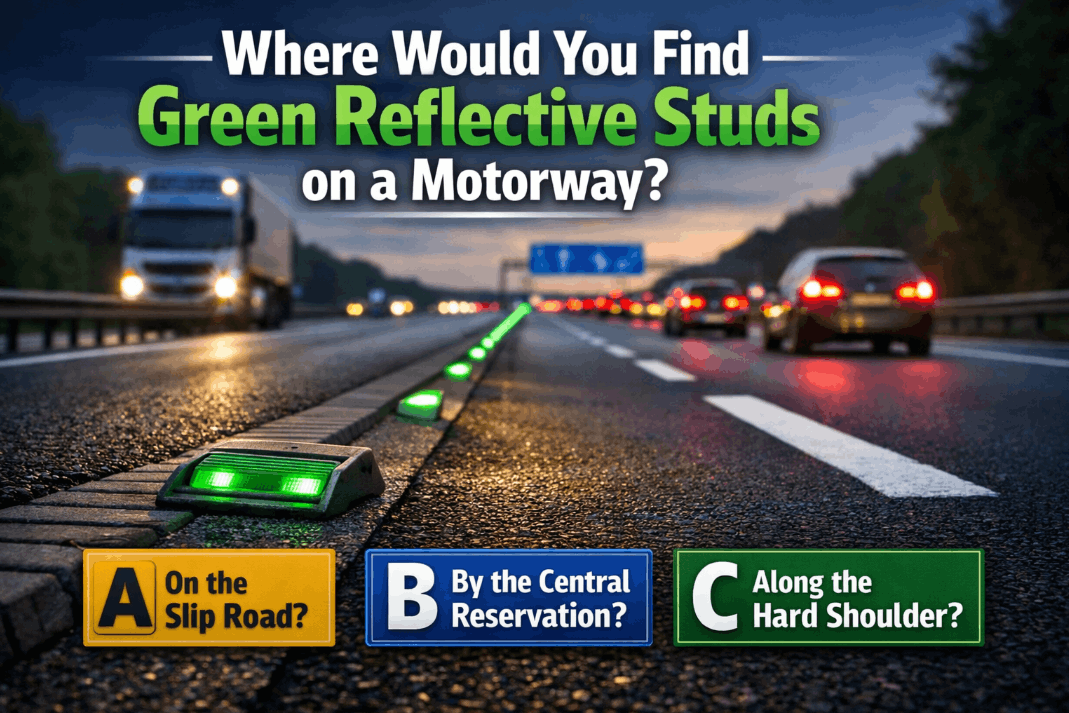
Navigating the high-speed environment of a dual carriageway requires instant recognition of road markings. If you are wondering where would you find green reflective studs on a motorway, they are located at the junctions where slip roads join or leave the main carriageway, and at the entrances to lay-bys and emergency refuge areas.
On a motorway, green reflective studs are positioned across the openings of slip roads at junctions to mark the boundary between the main carriageway and the exit or entry lane.
They also indicate the presence of lay-bys and emergency refuge areas, appearing as a break in the continuous red studs found on the left-hand edge.
Where would you find green reflective studs on a motorway
Green reflective studs act as a transition marker, indicating a break in the primary road edge to allow for vehicle entry or exit.
You will find them specifically crossing the throat of slip roads, providing a visual guide that distinguishes the through-traffic lanes from the decelerating or accelerating traffic at junctions.
Many candidates find it helpful to clarify what colour are the reflective studs between a motorway and a slip road during their revision to ensure they can distinguish junctions from standard lane markings.
The Boundary Function of Green Markers
These markers essentially function as a high-visibility buffer. When driving at 70mph in low-visibility conditions, such as heavy rain or fog, the solid line of red studs on the left-hand side provides a continuous boundary.
When this red line is interrupted by a row of green studs, it alerts the driver to a change in the road layout, such as an upcoming exit or a joining lane from a service station.
A common pattern observed by highway engineers is that green studs help prevent last-minute swerving. By highlighting the exact start of a slip road, they allow motorists to begin their lane transition with precision.
This is especially critical on modern smart motorways, where the traditional hard shoulder may be used as a running lane, making the green studs the primary indicator for emergency refuge areas.
| Stud Colour | Placement Location | Primary Driver Meaning |
| Green | Slip roads and lay-bys | Edge of main carriageway at junctions |
| White | Between traffic lanes | Lane markings and dividers |
| Red | Left-hand verge | Left-hand edge of the running lane |
| Amber | Central reservation | Right-hand edge of the carriageway |
| Blue | Emergency access | Police and recovery vehicle markers |
| Green-Yellow | Temporary roadworks | Changed lane layouts and contraflows |
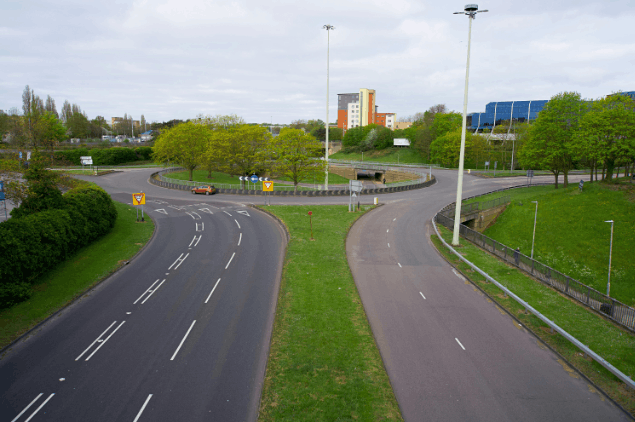
How many colours are there in reflective studs on a motorway
There are six distinct colours of reflective studs used on the National Highways network, each providing specific spatial information to the driver.
While white, red, and amber are the most common, green, blue, and fluorescent green-yellow studs play specialized roles in navigation and infrastructure management.
Consistent safety standards ensure these colours remain predictable, allowing a driver’s reaction to become almost instinctive.
For example, a driver seeing amber on their right and white on their left immediately knows they are in the fast lane (Lane 3 or 4) without needing to look for overhead signs.
Understanding exactly where are amber reflective studs found on a motorway is essential for maintaining lane discipline when driving adjacent to the central reservation.
- White studs mark the lanes or the middle of the road.
- Red studs mark the left-hand edge of the road.
- Amber studs mark the central reservation on the right.
- Green studs mark the edge of the main carriageway at lay-bys and slip roads.
- Blue studs mark the entrance to emergency vehicle off-shoots or hydrants.
- Fluorescent green-yellow studs mark temporary changes due to roadworks.
The significance of road stud navigation for UK motorists
This specific detail is a frequent focal point for two groups: learner drivers navigating the complexities of the Highway Code and experienced motorists adapting to the evolving infrastructure of the 2026 road network.
For learners, this is a frequent and often confusing question on the DVSA Theory Test, requiring a precise understanding of Highway Code Rule 132.
Gaining a comprehensive grasp of what colour are the reflective studs on a motorway is a core competency required to pass the DVSA theory exam and drive safely at night.
Experienced drivers often search for this information when they encounter 2026 smart motorway configurations.
As of this year, the removal of permanent hard shoulders on many stretches has made the green studs at Emergency Refuge Areas (ERAs) a critical safety feature.
Recovery professionals often observe that motorists in distress lose their bearings once they leave the illuminated safe zone provided by these markers.

What is the importance of green reflective studs on a motorway
The primary importance of these markers lies in reducing exit-point collisions. By providing a high-visibility contrast to the red edge studs, they allow drivers to differentiate between a dangerous verge and a safe exit path.
Without green studs, a driver might inadvertently follow the red line and miss their junction, or worse, steer into a slip road at an incorrect angle.
In heavy spray, where paint markings on the tarmac become invisible, the retroreflective properties of the green studs, often referred to as Cat’s Eyes, become the only reliable guide for lane discipline.
They ensure that the mouth of the junction is clearly illuminated by the car’s own headlights, projecting a path for merging traffic.
Who invented the reflective studs on a motorway
The reflective road stud was invented by Percy Shaw in 1933. A local council worker from Halifax, West Yorkshire, Shaw was inspired after driving home in thick fog and seeing his headlights reflected in the eyes of a cat sitting by the roadside.
He realized that a permanent, reflective marker could save thousands of lives on Britain’s poorly lit rural roads.
The Evolution of the 1933 Patent
Shaw’s original design was a marvel of engineering. It featured a rubber mop that would wipe the glass lenses clean every time a car drove over the stud.
This self-cleaning mechanism ensured that the studs remained bright even in the muddiest conditions. By the time motorways began to dominate the landscape in the late 1950s, Shaw’s Cat’s Eye was already the industry standard for night-time navigation.
When did the UK install reflective studs on a motorway
While the invention dates back to the 1930s, the widespread installation of reflective studs on motorways coincided with the opening of the Preston Bypass (now part of the M6) in 1958.
This was the UK’s first motorway, and it set the precedent for using coloured studs to manage high-speed traffic flow.
By the mid-1960s, the Ministry of Transport mandated the use of reflective studs across the entire burgeoning motorway network.
As of 2026, these studs are a mandatory requirement for all motorway-grade roads in the country, with strict maintenance schedules to ensure they meet the reflective intensity standards set by the Department for Transport.
What materials are motorway reflective studs manufactured from?
Modern road studs are manufactured using a combination of high-durability materials designed to withstand the pressure of 44-tonne HGVs.
The housing is typically made from cast iron or high-impact polymers like Acrylonitrile Butadiene Styrene (ABS).
Technical Specification of Modern Studs:
- Base: Spheroidal Graphite (SG) iron or reinforced polycarbonate.
- Reflective Element: Biconvex glass lenses or micro-prismatic plastic.
- Coating: Often treated with a non-stick polymer to prevent road salt and grime buildup.
- Internal Mechanism: A vulcanized rubber insert that allows the stud to depress under the weight of a tyre, triggering the self-cleaning action.
Who is responsible for installing motorway reflective studs?
Installation is managed by National Highways or their appointed Tier 1 contractors. These specialized road maintenance crews use heavy machinery to cut precise sockets into the asphalt or concrete road surface.
The Installation Process:
- Closure of the lane or carriageway using a mobile traffic management unit.
- Precise milling of the road surface to create a cavity for the stud base.
- Application of a hot-poured bitumen grout or high-strength epoxy resin.
- Manual placement of the stud housing into the adhesive.
- Verification of the reflective orientation to ensure light hits the lens at the correct angle.
- A cooling period of 15–30 minutes before the lane is reopened to traffic.
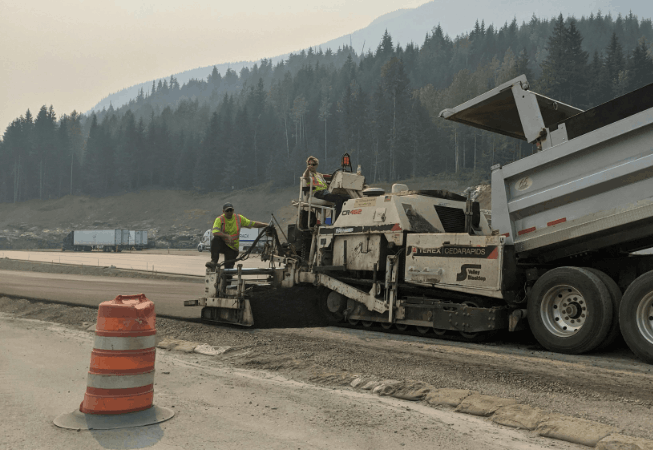
What is the life span of reflective studs on a motorway
The average lifespan of a standard reflective motorway stud is between 5 and 10 years, though this varies significantly based on traffic volume.
Studs in the slow lane (Lane 1), which experience frequent HGV traffic, may require replacement more often than those marking the central reservation.
As of 2026, many sections of the M1 and M25 have transitioned to solar-powered LED studs. These have a different maintenance profile, often lasting up to 8 years before the internal battery or LED brightness degrades below safety standards.
Factors like snow-plough damage during winter months are the leading cause of premature failure in UK road studs.
Do reflective studs on a motorway reduce accidents
The statistical impact of road studs on motorway safety is profound. Research into night-time collisions indicates that the presence of high-quality reflective markers can reduce run-off-road accidents by as much as 70% in high-risk areas.
| Condition | Without Studs | With Reflective Studs |
| Night-time Visibility | ~50–100 metres | Up to 900 metres |
| Reaction Time (70mph) | ~3 seconds | ~25+ seconds |
| Lane Discipline Error | High in fog/rain | Low (Visual guide provided) |
| Driver Fatigue Alert | Minimal | Sensory (vibration when crossed) |
By providing a tactile rumble when driven over, the studs also serve as an auditory warning to tired drivers, potentially preventing accidents caused by microsleep.
What do new drivers need to know regarding reflective studs on a motorway
If you are unfamiliar with high-speed night driving, consider these studs your primary secondary navigation system. If your GPS fails or visibility drops to near-zero, the studs can guide you safely to the next junction.
Essential Guidance for Learners
When you see where would you find green reflective studs on a motorway on your theory exam, remember the Entrance and Exit rule. Green is the only colour that signals a safe place to leave the main flow of traffic.
Furthermore, a common mistake is confusing the amber studs (right) with the red studs (left). A helpful tip used by driving instructors is: Red is near the hedge (left), Amber is near the edge (central barrier).
What is the punishment for not following the reflective studs on a motorway?
While there is no specific fine for hitting a road stud, the studs act as the legal boundary for lane discipline.
Crossing a solid line of studs where prohibited, such as entering a closed lane marked by a Red X or crossing into a hatched area, can result in a fine of £100 and 3 penalty points on your license.
In 2026, enforcement is increasingly automated. Overhead cameras on smart motorways are synchronized with lane markings.
If you cross the red studs onto a hard shoulder that is not open for traffic, or ignore the green studs to cut across a chevron area at the last second, you are liable for a Driving Without Due Care and Attention charge.
Summary
Understanding road stud colours is a vital component of UK road mastery. You will find green reflective studs at the critical transition points of the motorway, slip roads, lay-bys, and emergency zones.
By using these markers as a visual guide, you can improve your nighttime lane discipline and respond more effectively to changes in the road layout. For your next journey, practice identifying the Red-Left, Amber-Right, Green-Exit pattern to build your situational awareness.
FAQ
Where are green studs located?
Green studs are positioned across the entrance and exit of slip roads at junctions, as well as marking the boundaries of motorway lay-bys and emergency refuge areas.
What do red studs on the motorway mean?
Red studs mark the left-hand edge of the carriageway. They indicate the line between the running lane and the hard shoulder or the verge, warning drivers not to drift off the road.
Why are there amber studs on the right?
Amber studs are used to mark the edge of the central reservation. They help drivers in the right-hand lane maintain a safe distance from the central barrier or oncoming traffic lanes.
Are there blue studs on UK motorways?
Yes, blue studs are used to highlight emergency vehicle access points, such as those used by the police or fire services, and to mark the location of water hydrants.
What should I do if I see green and yellow studs?
Fluorescent green and yellow studs indicate temporary roadworks. These specific markers are exactly what would you expect to find at a contraflow system on a motorway where traffic is diverted into temporary lane configurations.
Can road studs be seen in the fog?
Yes, the Cat’s Eye design is specifically engineered to reflect light back to the driver even in heavy fog, providing a much further visible range than traditional painted lines.
How many green studs are at a junction?
The number varies, but they are spaced at 8-metre to 15-metre intervals across the opening of the slip road to create a visible gate for exiting or joining vehicles.
Do motorways have white studs?
White studs are the most common and are found between traffic lanes. They act as lane dividers, helping motorists stay centered within their chosen lane during night driving.