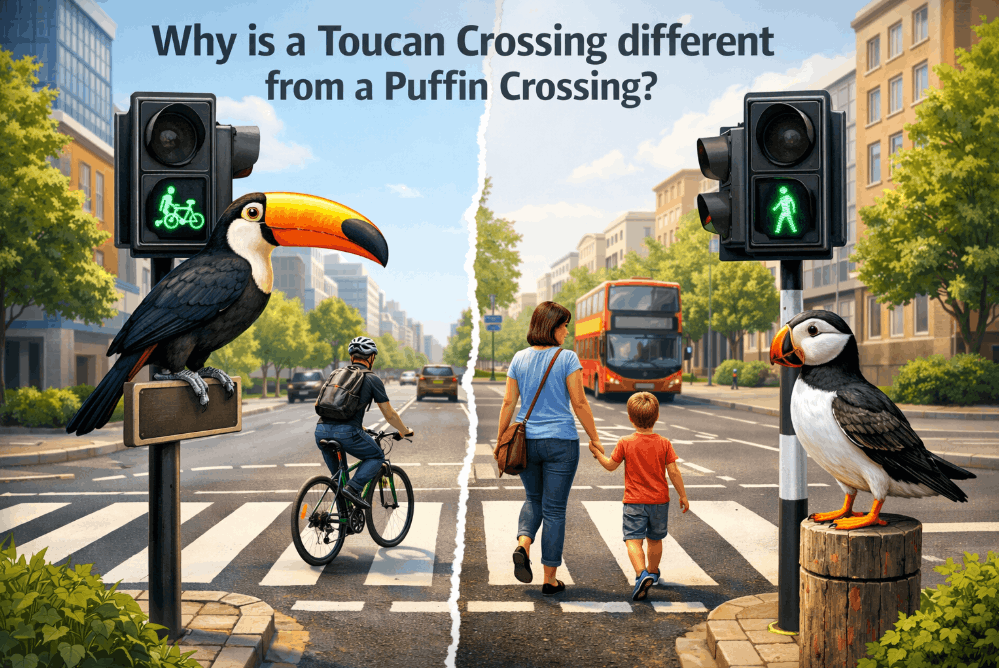
Deciphering why is a toucan crossing different from a puffin crossing is a common challenge for UK motorists, especially as sensor-led technology continues to replace older signal types.
A toucan crossing allows both pedestrians and cyclists to cross the road simultaneously without dismounting, whereas a puffin crossing is designed specifically for pedestrians.
Toucan crossings feature far-side signals with a bicycle icon, while puffin crossings use near-side “intelligent” sensors to adjust signal timings based on pedestrian movement.
The UK’s ‘zoo’ of bird-themed crossings, Pelican, Puffin, and Toucan, remains a major source of confusion for local businesses and commuters alike.
However, mastering these differences is vital for road safety, avoiding heavy fines, and passing the modern driving theory test.
Why is a toucan crossing different from a puffin crossing for road users?
The fundamental difference is that a toucan crossing is a shared-use facility where cyclists ride across, while a puffin crossing is strictly for pedestrians.
Toucan crossings are wider to accommodate cycle traffic and use far-side signals. Puffin crossings use “intelligent” sensors and near-side signals to manage pedestrian flow without disrupting traffic unnecessarily.
The shift from old timers to smart sensors
In practice, the distinction is about urban connectivity. You will rarely find a Toucan crossing in a cramped, mid-block high street location.
They are strategic tools used where cycle paths meet major roads. A common pattern we see in urban planning is the use of Toucans to bridge “missing links” in a city’s cycle network, whereas Puffins are the “workhorses” of standard pedestrian footfall areas.
What is a Toucan Crossing and why was it introduced?
A Toucan crossing is a signal-controlled crossing designed for the combined use of pedestrians and cyclists. The name is a pun, “Two-Can” cross together. Unlike other crossings, cyclists do not have to dismount their bikes to use them safely and legally.
The history and purpose of the Toucan
First introduced to UK roads in 1992, the Toucan crossing was specifically designed to bridge gaps in city cycle networks without endangering pedestrians.
It is easily identified by the bicycle symbol appearing alongside the ‘green man’ on the signal head, a visual cue that cyclists can remain mounted while crossing.
What will happen if you do not respect a Toucan Crossing?
Ignoring the signals or rules of a Toucan crossing carries significant legal weight under the Road Traffic Regulation Act. As of 2026, enforcement via traffic cameras at these crossings has become increasingly common in UK city centres to protect vulnerable road users.
Penalties for Motorists
If a motorist fails to stop when the light is red, or if they stop within the zig-zag markings, they typically face a Fixed Penalty Notice (FPN) consisting of a £100 fine and 3 penalty points.
It is also strictly illegal to overtake the lead vehicle at a crossing, a mistake often classified as dangerous driving.
Avoiding penalty points through education
In many cases, if a mistake is made at a Toucan or Puffin crossing, the police may offer the National “What’s Driving Us?” Course as an alternative to prosecution.
This is a behavioral change session for drivers who may have inadvertently neglected pedestrian rights or missed a signal change.
Completing this 3-hour course (available online or in-person) means you bypass the fine and the 3 penalty points, keeping your driving record clean while improving local road safety.
Avoiding a camera-triggered fine requires a clear understanding of modern sensor-controlled timing. These systems eliminate the old flashing amber phase, meaning drivers must wait for the full sequence.
To stay safe, it is vital to know which colour follows the green signal at a puffin crossing as moving off prematurely is a leading cause of traffic light offences.

How do the light signals differ on these crossings?
The most significant visual difference for a driver or pedestrian is the placement of the signal lights. This design choice is rooted in user psychology and safety.
| Feature | Puffin Crossing | Toucan Crossing |
|---|---|---|
| User Type | Pedestrians only | Pedestrians & Cyclists |
| Signal Placement | Near-side (On the button box) | Far-side (Across the road) |
| Light Icons | Red/Green Man | Red/Green Man + Bicycle |
| Width | Standard (approx. 2.8m) | Extra Wide (approx. 4m) |
The Near-side vs Far-side Logic
Puffin crossings use near-side signals (the lights are right next to you as you wait). This forces pedestrians to look toward the oncoming traffic to see when the light changes.
Toucan crossings use far-side signals (across the road) because cyclists, who travel faster, need a longer line of sight to the signal as they approach the junction.
Why are puffin crossings considered intelligent?
The Puffin (Pedestrian User-Friendly Intelligent) crossing is the modern replacement for the old Pelican crossing. It uses two types of sensors to make the crossing “smart.”
- Pedestrian Kerb Detectors (PKD): These monitor the waiting area. If you press the button but cross early, the sensor “cancels” the request so traffic doesn’t stop for no reason.
- Pedestrian Crossing Detectors (PCD): Infrared sensors watch the road and hold the traffic light on red until slow-moving pedestrians are safely across.
- Efficiency: This eliminates “phantom stops” where drivers are stuck at a red light with no one crossing.
- Safety: It removes the ambiguity of the flashing amber phase.
- Environmental Impact: Reduces vehicle idling and emissions in congested areas.
- Adaptive Timing: Adjusts the “green man” duration based on the volume of people crossing.
Comparing the Zoo of UK Crossings
Beyond the bird-themed variants, several other signal types form the UK’s wider crossing hierarchy:
| Crossing | Control Type | Key Feature |
|---|---|---|
| Zebra | Uncontrolled | Belisha Beacons; pedestrians have right of way. |
| Puffin | Sensor-controlled | Near-side lights; “Intelligent” sensors. |
| Toucan | Sensor-controlled | Bicycle icon; wide shared-use path. |
| Pegasus | Sensor-controlled | High-level button for horse riders. |
Summary and Key Takeaways
When determining why is a toucan crossing different from a puffin crossing, it ultimately comes down to shared access and ‘smart’ technology. A Toucan is a 4-metre-wide shared space for “two” (pedestrians and cyclists) with far-side lights.
A Puffin is a smart pedestrian-only crossing with near-side lights that uses sensors to prevent traffic delays.
Next Steps for Readers:
- Learner Drivers: Practice identifying the sensor types on your next driving lesson.
- Cyclists: Map your route to favour toucan crossings for a more seamless commute.
- Businesses: Ensure delivery drivers avoid stopping in zig-zag zones to prevent £100 fines.

Commonly asked questions about UK crossings
Do Toucan crossings have a flashing amber phase?
No. Like Puffins, Toucans go from Red to Red/Amber to Green. The sensors handle the safety delay, removing the need for a flashing amber phase.
Can a motorbike use a Toucan crossing?
No. Toucan crossings are strictly for pedestrians and non-motorised bicycles (including legal e-bikes). Motorbikes must remain on the road.
Why are there “elephant’s footprints” on Toucan crossings?
These are the large white square markings on the road. They signal to motorists that the crossing is a shared space for cyclists and pedestrians.
Is it illegal to walk on a Toucan crossing?
No, it is designed for both. However, users should stay mindful of each other within the 4-metre shared width.
Why was the Pelican crossing replaced by the Puffin?
The Pelican used a fixed timer, which was less efficient. The Puffin’s sensors make the process safer and more responsive to real-time movement.
Are all Toucan crossings far-sided?
Generally, yes. Far-side signals are standard for Toucans to ensure cyclists approaching at speed have a clear view of the signal.
How do I know if a crossing is a Puffin or a Pelican?
Look at the lights. If they are across the road and have a flashing amber phase, it’s a Pelican. If they are on the button box next to you, it’s a Puffin.
When was the Toucan crossing introduced?
The Toucan crossing was first trialled in 1992 to improve safety and connectivity for the UK’s growing cycle network.