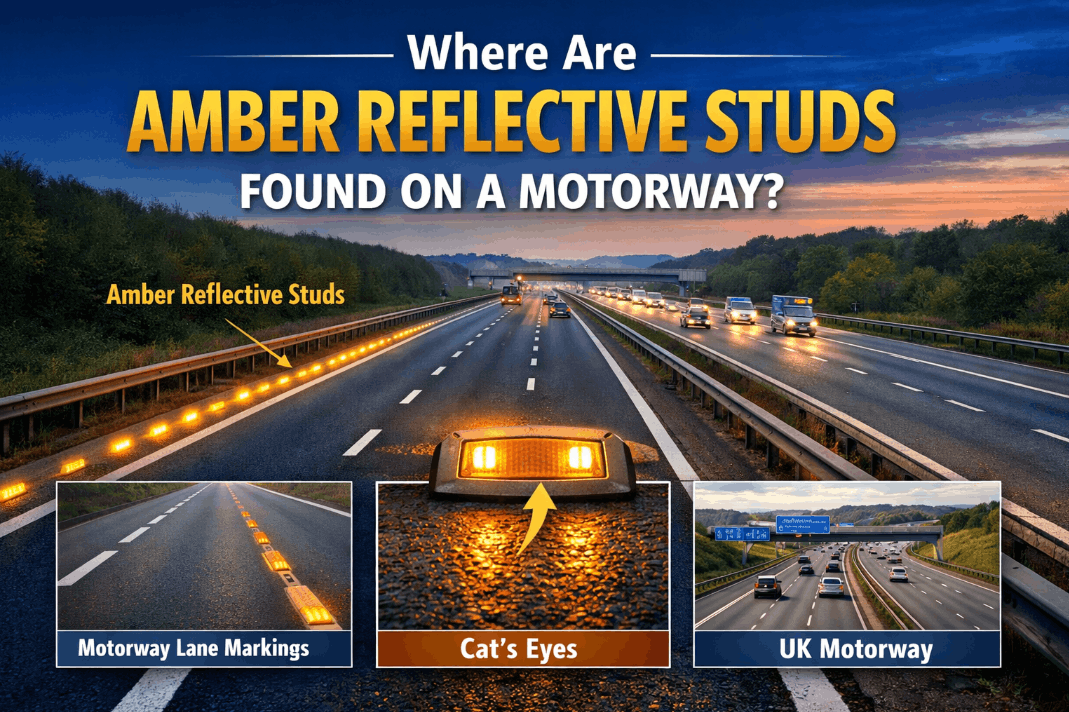
On a British motorway, maintaining lane discipline at high speeds depends heavily on a sophisticated system of colour-coded markers. Where are amber reflective studs found on a motorway?
These essential safety devices are located exclusively along the right-hand edge of the main carriageway, positioned directly adjacent to the central reservation or median barrier.
They serve as a permanent visual and tactile boundary that separates the fast-flowing traffic of the outer lane from the structural hazards of the motorway’s centre.
Where are amber reflective studs found on a motorway?
Amber reflective studs are found on the right-hand edge of the motorway, marking the specific border between the right-hand (overtaking) lane and the central reservation.
Their primary purpose is to provide a continuous, glowing line that defines the innermost limit of the drivable surface, preventing drivers from drifting into the median strip during periods of low visibility.
The Purpose of the Amber Marker
The placement of amber studs is a deliberate safety standard dictated by the Traffic Signs Regulations and General Directions (TSRGD).
By reflecting the light from a vehicle’s headlights back to the driver, these cat’s eyes delineate the danger zone, the area closest to oncoming traffic on the opposite side of the barrier.
In practice, high-speed night driving relies heavily on these markers.
For instance, a long-distance courier navigating the M6 during a winter storm may lose sight of painted white lines due to surface spray; however, the retro-reflective properties of the amber studs remain visible, providing a steady reference point for lane positioning.
Mastering this visual shorthand is a core requirement for the UK driving theory test, yet its true value lies in providing drivers with the split-second orientation needed during high-speed night-time transit.
To appreciate how these markers endure decades of heavy HGV traffic, it is helpful to examine the specific materials used in their construction:
| Component | Material | Function |
| Outer Housing | Spheroidal Graphite (SG) Cast Iron | Protects the internal unit from heavy vehicle impacts. |
| Insert | Natural/Synthetic Rubber | Allows the lenses to depress and provides the wiping action. |
| Reflectors | Biconvex Glass Lenses | Directs light back to the source (retro-reflectivity). |
| Base | Bituminous Grout | Bonds the stud securely into the road surface. |

What are amber reflective studs and what is their purpose?
Reflective road studs, technically known as retro-reflective raised pavement markers, are safety devices used to supplement painted road lines.
The amber variety specifically signifies the offside or right-hand edge of the road. Beyond simple visual guidance, these studs provide a vital tactile warning.
If a driver begins to drift due to fatigue or distraction, the physical height of the cast-iron housing creates a rumble vibration and an audible thumping sound as the tyres pass over it.
This sensory feedback is a crucial secondary purpose that prevents median-strip collisions.
When and who invented the reflective road studs used in the UK?
The ‘cat’s eye’ stands as a landmark achievement in British road safety engineering, born from the practical necessity of navigating the often-treacherous Yorkshire fog.
Percy Shaw, a road contractor from Halifax, patented the design in 1934.
Percy Shaw famously recounted that his design was inspired by a roadside encounter with a stray cat, whose glowing eyes provided the only guidance on a lightless, fog-bound road.
While invented in the 1930s, amber reflective studs became a standardised feature of the UK motorway network following the opening of the M1 in 1958.
During the WWII blackout, the value of passive, non-electric lighting became undeniable, leading to the nationwide rollout we see today.
How are motorway reflective studs manufactured and maintained?
Modern road studs are engineered to withstand the weight of 44-tonne HGVs passing over them thousands of times per day.
They are manufactured using a high-grade cast-iron shoe that is deeply embedded into the asphalt. Inside this shoe sits a flexible rubber insert containing the glass lenses.
Who maintains the amber reflective studs in the UK?
The maintenance of these studs falls under the remit of National Highways (formerly Highways England) for the strategic road network, or local authorities for A-roads.
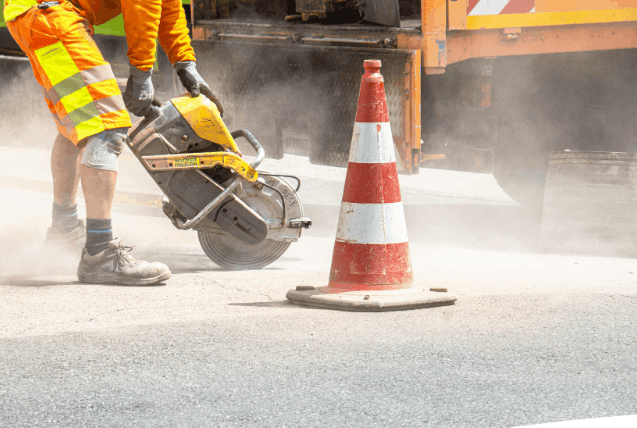
Maintenance teams use specialised stud-stripping machines to remove worn units.
The Life Time and Replacement Cycle
The typical lifetime of a reflective stud on a busy motorway is between 5 and 10 years. However, they are frequently changed in the UK during major Section 82 road resurfacing schemes.
Rather than replacing individual studs, authorities find it more cost-effective to replace entire stretches of markers when the asphalt is renewed.
Understanding the Rainbow: Motorway Stud Colours Explained
While amber serves as the primary anchor for offside lane discipline, the motorway network utilises a broader spectrum of markers to communicate changing road conditions.
For long-haul logistics and new motorists alike, a firm grasp of what colour are the reflective studs on a motorway ensures that lane boundaries remain clear even when surface spray obscures traditional road paint.
- White Studs: Found between individual lanes to mark the boundaries of the carriageway.
- Red Studs: Found on the left-hand edge of the motorway, marking the boundary between the lane and the hard shoulder.
- Green Studs: Found at slip road entrances and exits, marking the break in the red line.
- Green/Yellow Studs: Temporary markers used during roadworks to indicate a change in lane layout.
- Blue Studs: Reserved for emergency services to identify access points or observation platforms.
Understanding exactly what colour are the reflective studs between a motorway and a slip road helps motorists identify safe exit points well before they reach the physical junction.
Performance in Extreme Weather: The Snow and Theft Questions
A common concern for drivers is whether snow will deposit over the amber reflective studs and render them useless. The design of the original Percy Shaw cat’s eye actually solves this problem.
- The Sinking Mechanism: When a car (or a snowplough) drives over the stud, the rubber insert is pushed down into the housing.
- The Self-Cleaning Action: The housing contains a small amount of rainwater. As the rubber insert pops back up, it passes against a stationary rubber wiper that cleans the glass lenses.
- Snow-Plough Friendly: Because the studs sink flush with the road when pressed, snow-plough blades can pass over them without shearing them off.
Do people steal amber reflective studs?
Despite their iconic design, these units are rarely targeted by thieves due to their significant weight and the specialized equipment required to extract them from the bitumen. Removing one requires a jackhammer or heavy crowbar, making it a high-effort, low-reward crime with no significant scrap value.
Legal Obligations and Fines for Motorway Lane Discipline
Following the guidance of reflective studs is not just a suggestion; it is a legal requirement under the Highway Code.
Safe motorway passage relies on the same adherence to signal logic found elsewhere in the Highway Code; for instance, understanding which colour follows the green signal at a puffin crossing is as fundamental to urban safety as road studs are to high-speed navigation.
Rule 132 specifically mentions that reflective road studs may be used to help you see the layout of the road.
When reviewing decisions in court regarding Careless Driving (Section 3 of the Road Traffic Act 1988), judges often look at whether a driver ignored the physical and visual warnings provided by road markings.
How to Navigate Motorways Using Reflective Studs
- Keep Red to the Left: Always ensure the red studs are on your left-hand side.
- Keep Amber to the Right: Maintain the amber line to your right to avoid the central reservation.
- Cross White with Caution: Only cross white studs when changing lanes after checking mirrors.
- Watch for Green Breaks: Use green studs to identify your exit early, especially in heavy fog.
- Heed the Vibration: If you feel the rumble of a stud, immediately check your lane positioning.
- Slow for Yellow/Green: These signal temporary changes; reduce speed to the posted limit.
Failure to follow these visual cues can lead to a Fixed Penalty Notice for Inconsiderate Driving, typically resulting in a £100 fine and 3 penalty points. In more severe cases involving collisions with the central reservation, fines can be unlimited and lead to a driving ban.

Final Summary and Practical Advice
The UK’s reflective stud system remains one of the most effective examples of passive infrastructure in modern transport.
The answer to where are amber reflective studs found on a motorway is a vital piece of knowledge that ensures you never lose your orientation on the fast side of the road.
By keeping the amber line to your right and the red line to your left, you create a safe corridor for travel, even when the overhead lights are off.
Key Takeaways:
- Amber = Right-hand edge (Central Reservation).
- Maintenance: Handled by National Highways on a 5–10 year cycle.
- Safety: Provides both visual light and tactile rumble warnings.
- Legal: Ignoring these markers can lead to fines for careless driving.
FAQ
Where are amber reflective studs found on a motorway?
Amber studs are located on the right-hand edge of the motorway, marking the boundary between the outer lane and the central reservation.
What is the spacing of studs on a motorway?
On straight sections, studs are spaced at 18-metre intervals. In areas prone to fog or on sharp bends, this spacing is reduced to 9 metres for better visibility.
Can I find amber studs on a dual carriageway?
Yes, amber studs are used on dual carriageways that have a central reservation to mark the right-hand edge of the road.
What material are cat’s eyes made of?
They are primarily made of a cast-iron base, a natural rubber insert, and biconvex glass lenses for reflection.
Why are they called cat’s eyes?
They are named after the inventor’s inspiration, the way a cat’s eyes reflect light in the dark, which is the same principle of retro-reflectivity used in the glass lenses.
Do amber studs work in the daytime?
While they are designed for night visibility, the cast-iron housing and white rubber inserts are visible during the day as physical lane markers.
Are LED studs replacing amber cat’s eyes?
National Highways is trialling solar-powered LED intelligent studs, but the passive amber reflective stud remains the primary standard across the UK.