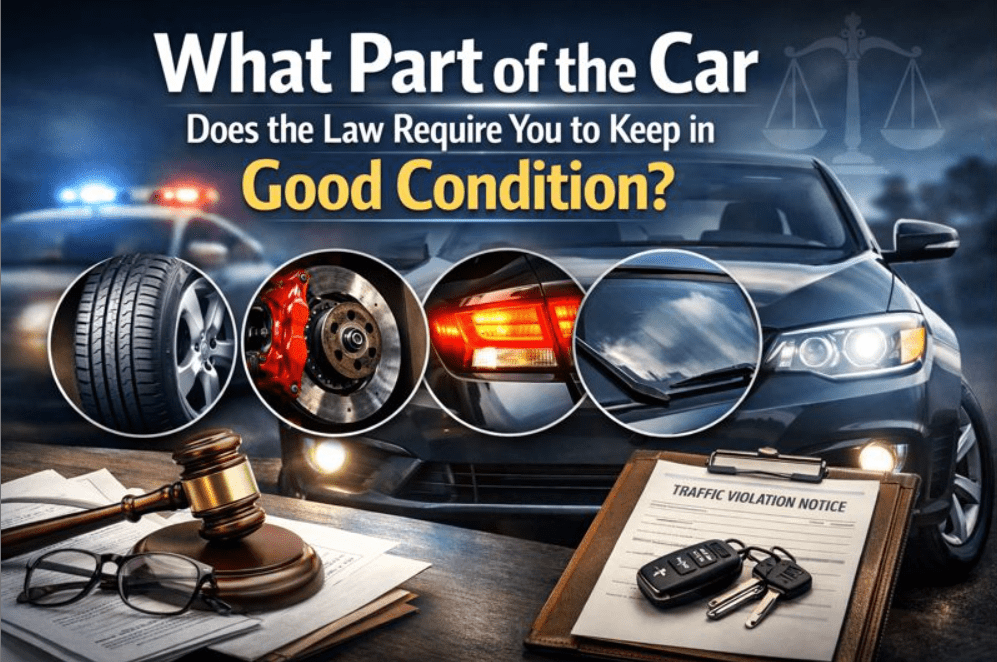
If you’ve searched what part of the car does the law require you to keep in good condition, you’re probably looking for the one correct answer (the kind you see in driving theory practice) and also a real-world explanation of what you should actually maintain.
Here’s the key idea: The exam-style answer is specific, but your real legal responsibility is broader: your car must be roadworthy.
What part of the car does the law require you to keep in good condition (UK)?
Seat belts. In the UK, the standard one correct answer to what part of the car does the law require you to keep in good condition is your seat belts; they must be fitted (where required), used correctly, and kept in working order.
Why do seat belts show up as the single answer in theory-style questions?
Seat belts are singled out because they’re a core safety requirement: if a seat belt is fitted, you’re generally expected to wear it (with limited exemptions). That’s why theory-test style questions often pin this down to a single part: seat belts.

What does keep seat belts in good condition actually mean?
Think “will it restrain you properly in a crash?”, not “does it look OK today?”
Common “not in good condition” seat belt signs
- Fraying, nicks, or fuzzy edges on the webbing.
- The belt doesn’t retract smoothly or feed out awkwardly.
- The buckle doesn’t click securely or releases unexpectedly.
- The belt looks twisted, stiff, or obviously overstretched.
If any of these show up, don’t ignore them, seat belt issues aren’t a later job.
Is it only seat belts the law cares about?
No, and this is where people get caught out. Seat belts are the classic single-answer response, but as a driver you’re responsible for keeping the vehicle roadworthy overall.
If your car is unsafe or unfit for the road, you can still be in trouble even if you weren’t thinking about seat belts at the time. Let’s explore the practical side of roadworthiness next.
What else should you keep roadworthy to stay on the right side of UK rules?
| Car area | What good condition looks like | Quick DIY check |
|---|---|---|
| Seat belts | Webbing intact, retracts properly, buckles lock/release correctly | Pull out fully + check for wear |
| Lights/indicators | Clean, clear, working, and visible | Walkaround check at dusk |
| Windscreen/windows | No dangerous cracks in key viewing areas; clear visibility | Clean inside/out; inspect driver view |
| Wipers/washers/demisters | Keeps the screen clear in rain/fog | Quick spray + wipe test |
| Brakes/steering | Safe, responsive, no pulling or serious vibration | Gentle brake test somewhere safe |
| Tyres | Legal tread + no bulges/cuts/cord showing | Tread check + sidewall scan |
| Exhaust/emissions | Not excessively smoky/noisy; no obvious leaks | Watch for smoke, listen for changes |
What’s the UK legal tyre tread depth, and why does it matter so much?
For everyday drivers, tyres are the most common “I didn’t realise that was illegal” area. The legal minimum tread depth for most cars and light vans is 1.6mm across the central three-quarters of the tyre, around the entire circumference.
Also, visible cord, bulges, or deep cuts can make a tyre unsafe even if the tread depth looks fine.
MOT vs roadworthy: what’s the difference?
An MOT is a valuable safety checkpoint, but it’s a snapshot on the day of the test. Roadworthiness is ongoing.
Here’s what you can do next: Treat your MOT as a baseline, then keep up simple checks between tests so small issues don’t become I got stopped for that? problems.
A 30-second routine that prevents most avoidable issues
- Seat belts: Pull each belt out and let it retract; check the buckle clicks.
- Lights: Indicators + brake lights (use reflections or ask someone).
- Tyres: Quick scan for bulges/cuts + tread check.
- Screenwash/wipers: Quick spray test (especially in winter).
Before a longer trip, what’s worth checking?
- Tyre pressures (on cold tyres) and tread depth.
- All exterior lights and number plates are clean and readable.
- Windscreen is clean, and your view is unobstructed.
- Any dashboard warning lights you’ve been ignoring, deal with them.
Quick seat belt condition checklist
| Seat belt issue | Why it matters | What to do |
|---|---|---|
| Fraying/cuts/serious wear | Can weaken webbing | Stop using that seat belt; book a repair/check |
| Overstretched belt | May not restrain properly | Get inspected; replacement is common |
| Buckle won’t latch reliably | The belt may not hold in impact | Don’t “make do”—fix before carrying passengers |
| The retractor doesn’t retract | The belt may be slack in a crash | Book repair; avoid using that seat if possible |
What do people discuss about this online?
Final summary
- The single-answer response to what part of the car does the law require you to keep in good condition is seat belts.
- In real life, your responsibility is bigger: your car must remain roadworthy (belts, tyres, lights, visibility systems, brakes/steering, exhaust/emissions).
- A 30-second weekly routine prevents most “easy-to-avoid” issues.
FAQ
Is the correct answer definitely “seat belts”?
For the common theory-test style question, yes: seat belts is the expected single answer.
Do I only need to maintain seat belts to be legal?
No. Seat belts are the single-answer part, but you’re responsible for keeping the whole vehicle roadworthy, especially tyres, lights, visibility systems, steering and brakes.
What’s the tyre tread depth law in the UK?
For most cars and light vans: 1.6mm across the central three-quarters of the tyre around the full circumference.
Can I still be stopped with a valid MOT?
Yes. An MOT doesn’t guarantee your car remains roadworthy every day after the test.
Author expertise note
Based on years of helping drivers translate test answers into real-world maintenance habits, the biggest wins come from quick routines: keep seat belts working properly, and don’t neglect tyres, lights, and visibility. Those are the areas most likely to turn into an avoidable stop, fail, or safety risk.