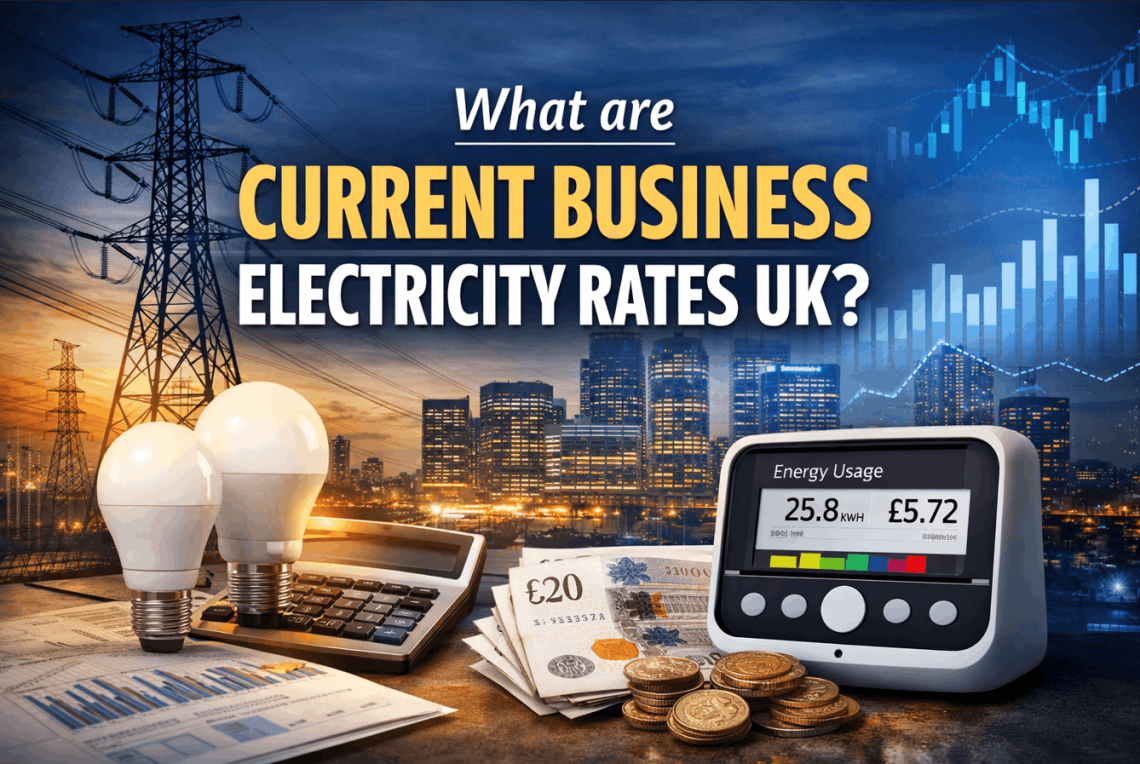
If you’re asking what are current business electricity rates UK? As of 2026, most small firms see electricity unit rates around the mid-20s p/kWh with daily standing charges often between ~40p and ~£1+, depending on usage band, meter type, contract length, region, and credit terms.
Quotes can shift quickly as wholesale prices and network charges move.
What are current business electricity rates UK?
As of 2026, business electricity rates are usually quoted as a unit rate in pence per kWh plus a daily standing charge.
Typical market averages for many small organisations sit in the mid-20s p/kWh, but the real price depends on annual consumption, meter type, contract length, payment terms, and regional network costs.
The pricing reality behind the headline numbers
There isn’t one single national rate. Suppliers price your contract around risk and cost drivers that sit behind the scenes: wholesale electricity, forecasting your usage pattern, network fees set through industry charging methodologies, and your account risk profile.
In practice, the businesses that get the sharpest rates tend to be predictable users with clean payment history, stable consumption, and clear contract terms.
Typical rate ranges you can expect in 2026
Treat these as a guide only. Your quote can land above or below the ranges shown.
| Business size band | Example annual usage | Typical unit rate in 2026 | Typical daily standing charge in 2026 | What usually drives variance |
|---|---|---|---|---|
| Microbusiness | 5,000–15,000 kWh | ~25–30p/kWh | ~40–70p/day | Low volume, higher supplier risk margin |
| Small | 15,000–25,000 kWh | ~25–27p/kWh | ~60–90p/day | Usage profile, region, contract length |
| Medium | 25,000–55,000 kWh | ~25–27p/kWh | ~£1.00–£1.60/day | Capacity and network cost exposure |
| Large | 55,000+ kWh | ~23–26p/kWh | ~£2.00+/day | Profile class, meter type, pass-through |
A common pattern is that unit rates ease slightly as usage rises, while standing charges can increase because larger sites and certain metering setups carry higher fixed-cost recovery.
Energy costs don’t sit in isolation, and renewal reactions are often shaped by wider affordability pressure, including the £450 Cost of Living Payment.
Why your business rate is not capped like household pricing?
Households on standard variable tariffs are protected by the Ofgem energy price cap, but that framework is domestic-focused. Business contracts are typically commercial agreements, priced through competitive market offers rather than a regulated cap.
There are still clear processes around contract terms, renewal windows, complaint handling, and microbusiness protections on transparency and sales practices.
A two-person design studio renewed late and slipped onto a rollover rate. Their unit price didn’t look outrageous, but the standing charge jumped, and the contract terms locked them in. A quick contract review and re-quote window would have avoided it.
Renewals often trigger a quick safety sense-check, and Which types of fire extinguisher should you use on live electrical equipment is part of that same practical risk-control mindset.
What actually makes up a business electricity quote?
Every quote is a bundle of components. Some are obvious, some are buried in “pass-through” language.
Unit rate and standing charge explained
- Unit rate (p/kWh): what you pay for each unit of electricity used.
- Standing charge (per day): fixed daily cost for keeping the supply live and covering fixed network and service elements.
Network and industry charges that move your total cost
You may see pricing described as all-inclusive or pass-through. Pass-through pricing can shift during the contract term if regulated charges change.
- DUoS (Distribution Use of System): local network cost, varies by region and time bands.
- TNUoS (Transmission Network Use of System): national grid transmission cost allocation.
- Balancing and settlement: system balancing costs and industry settlement processes.
- Capacity and reactive power (site-dependent): can matter more for larger users.
| Bill line item | What it covers | Where you typically see it | Why it matters for current rates |
|---|---|---|---|
| Unit rate | Energy commodity + supplier margin | Always | Biggest driver of day-to-day spend |
| Standing charge | Fixed cost recovery | Always | Can dominate low-usage sites |
| DUoS and related network charges | Local distribution | Sometimes bundled, sometimes pass-through | Varies by region and time-of-use |
| TNUoS | Transmission | Often bundled or pass-through | Can change with charging statements |
| Climate Change Levy | Business energy tax | Shown as a levy line | Adds a visible p/kWh increment |
| VAT | Tax on supply | Invoice total | 20% standard, 5% in limited cases |
On real bills, the biggest surprises usually come from standing charge assumptions and whether non-commodity items are bundled or passed through.
Fixed vs variable tariffs and what that means for your effective rate
The better choice usually comes down to how much price certainty you need versus how much flexibility you can tolerate.
| Contract type | Best for | Rate behaviour | Typical pitfalls |
|---|---|---|---|
| Fixed price | Budget certainty | Unit rate usually locked for term | Early exit fees, renewal timing |
| Variable out-of-contract | Short gaps only | Can move anytime | Often expensive, weak cost control |
| Flexible procurement | Larger users with energy management | Can buy in tranches | Needs governance and monitoring |
A small manufacturer chose a fixed deal at renewal because cash flow certainty mattered more than shaving a fraction off the unit rate. Their energy manager tracked consumption and avoided peak spikes, making the fixed deal perform better than expected.
How meter type changes pricing?
Metering affects both how you’re charged and how suppliers estimate risk.
Half-hourly and non-half-hourly explained
- Non-half-hourly (NHH): common for smaller sites; charges are profile-based.
- Half-hourly (HH): records usage every 30 minutes; pricing can reflect your real load shape.
How half-hourly metering changes your effective rate?
HH sites often get quotes that depend heavily on your time-of-day consumption. If you use most power in peak windows, your effective cost can rise even if the headline unit rate looks competitive.
Half-hourly pricing for smaller sites
Half-hourly pricing can reward businesses that shift load away from peaks. It can also expose you to time-banded network costs more clearly. For some sites, tightening controls on HVAC, refrigeration defrost cycles, or compressed air can reduce peak draw and improve quotes.
Do rates vary by region and why your postcode matters?
Yes. Your regional distribution network area influences network charging and supplier risk modelling.
- Distribution charging structures differ by region.
- Time bands can vary, changing the cost of peak usage.
- Local congestion and network investment needs can influence regulated cost recovery.
In day-to-day quoting, two similar sites can still see different standing charges simply because they sit in different distribution regions and carry different profile characteristics.
How to compare quotes correctly and avoid expensive mistakes?
Most cost control comes from comparing offers on the same basis, rather than chasing the lowest headline p/kWh.
The quote checklist that prevents surprises
- Your MPAN, current supplier name, and contract end date.
- Annual consumption in kWh and, if available, a recent 12-month usage breakdown.
- Meter type: HH or NHH, single rate or multi-rate.
- Any special site notes: night load, weekend trading, electric heating, EV charging, or heavy plant.
- Credit and payment preference: Direct Debit vs invoice terms.
How to compare business electricity quotes like-for-like
- Collect a recent bill and confirm MPAN and meter type.
- Note the annual kWh and whether usage is peaky or steady.
- Ask for quotes with the same contract length and start date.
- Confirm whether pricing is all-inclusive or pass-through.
- Compare unit rate, standing charge, and any additional fees line-by-line.
- Check renewal terms, notice windows, and rollover conditions.
- Validate VAT and levy assumptions before signing.
- Keep a copy of the written quote and contract summary for audit.
The same “keep everything in writing” habit that helps with quotes also helps elsewhere, including flight delay compensation, where paperwork drives outcomes.
A café compared three quotes and picked the lowest unit rate. Later, they realised the standing charge was higher and pass-through costs weren’t bundled. A re-quote using consistent “all-inclusive” terms made the real cheapest option obvious.
Estimating your monthly bill from a rate quote
A quick estimate stops you from being misled by a single headline figure.
A simple estimation method
Multiply the unit rate by expected kWh, then add the daily standing charge for the month. Then account for levies and VAT if they’re not already included.
In smaller teams, budgeting can overlap with wellbeing signposting, and questions such as how much is pip per month sometimes surface alongside everyday cost planning.
Here are typical “real-world” influences that can swing your estimate:
- Seasonal load changes (heating, lighting, longer trading hours).
- Equipment cycles (refrigeration, extraction, compressors).
- Unplanned usage (temporary heaters, refurbishment works).
Climate Change Levy and VAT in plain terms
Most business electricity bills include Climate Change Levy as a per-kWh charge, unless an exemption or relief applies (for example, via specific schemes and eligibility routes). VAT is usually 20%, though some scenarios can qualify for reduced VAT treatment.
Winter planning often mixes operating costs with seasonal support conversations, and the winter fuel payment is a common reference point when heating season bites.
A common pattern is that businesses only spot these add-ons at the invoice stage, not at the quote stage, especially when they receive a unit rate “headline” without a full pricing schedule.
Quick wins to reduce your effective electricity rate
These don’t require new hardware to start paying back.
- Tighten thermostat setpoints and add timer control discipline for heating and cooling.
- Stagger startup for high-load equipment to reduce peak demand spikes.
- Run a weekly “standby audit” to cut overnight base load.
What people talk about this online?
Is this the right time for a fixed energy deal or should I wait?
byu/Sea-Still5427 inAskUK
Britain paying highest electricity prices in the world for second year running
byu/tonato_ai inukpolitics
Business Owners: Which energy providers offer the lowest standing charges?
byu/Gloomy-Commission296 inAskUK
Final summary and next steps
Start by anchoring your expectations: in 2026, many small firms land in the mid-20s p/kWh, but the standing charge and inclusions often decide the real winner. Pull a recent bill, confirm meter type, demand a like-for-like quote set, and compare all-inclusive versus pass-through terms before you sign. Keep your written quote pack for reference.
Seasonal budgeting questions can crop up alongside renewals, and Do all pensioners get winter fuel allowance is one that often comes up in the same winter cost context.
FAQs
What is the average business electricity rate per kWh in 2026?
Many small organisations see unit rates in the mid-20s p/kWh, but your quote depends on usage volume, meter type, contract length, payment terms, and regional network costs. Treat averages as orientation, not a guaranteed tariff.
What is a normal business electricity standing charge?
Standing charges commonly range from roughly 40p/day to well over £1/day, rising for larger sites and some metering setups. It reflects fixed supply and network costs, so it can be a major driver for low-usage premises.
Why do two suppliers quote different rates for the same business?
Suppliers price risk differently. Differences usually come from wholesale hedging strategy, how they model your load profile, credit checks, contract length, inclusions versus pass-through charges, and how aggressively they want to win business in your region.
Does the Ofgem price cap apply to businesses?
No. The Ofgem price cap is designed for domestic customers on standard variable tariffs. Business electricity is usually sold on commercial contracts, so your protections come from contract terms, microbusiness rules, and complaint processes.
Is it better to fix a business electricity contract in 2026?
Fixing suits you when budget certainty matters, you have stable usage, and you want protection from market swings. Variable arrangements can suit short gaps, but out-of-contract rates often cost more and reduce control.
Do half-hourly meters increase electricity costs?
Not automatically. Half-hourly metering prices your actual usage pattern more directly. If most consumption sits in peak windows, costs can rise. If you shift load to off-peak times, it can improve value and reduce exposure.
What information do I need to get accurate quotes?
Have your MPAN, meter type, annual kWh usage, postcode, current contract end date, and payment preference ready. A recent bill helps confirm standing charge structure and whether your current deal bundles network charges.
What are pass-through charges and why do they matter?
Pass-through charges are regulated or industry costs billed in addition to the supplier’s energy price. They can change during your contract term. If you compare an all-inclusive quote to a pass-through quote, you can pick the wrong deal.
Why are my renewal rates higher than my old contract?
Renewals reflect current wholesale conditions, updated network charges, and changes in your usage profile. You may also lose older promotional pricing. Early quoting windows and a like-for-like comparison usually reduce “renewal shock”.
Author Note
Written from practical experience reviewing business energy quotes, renewal packs, and bill breakdowns for SMEs across common meter types. Focus is on clear pricing mechanics, contract terms, and cost drivers so you can compare offers confidently. This is general information, not legal advice.