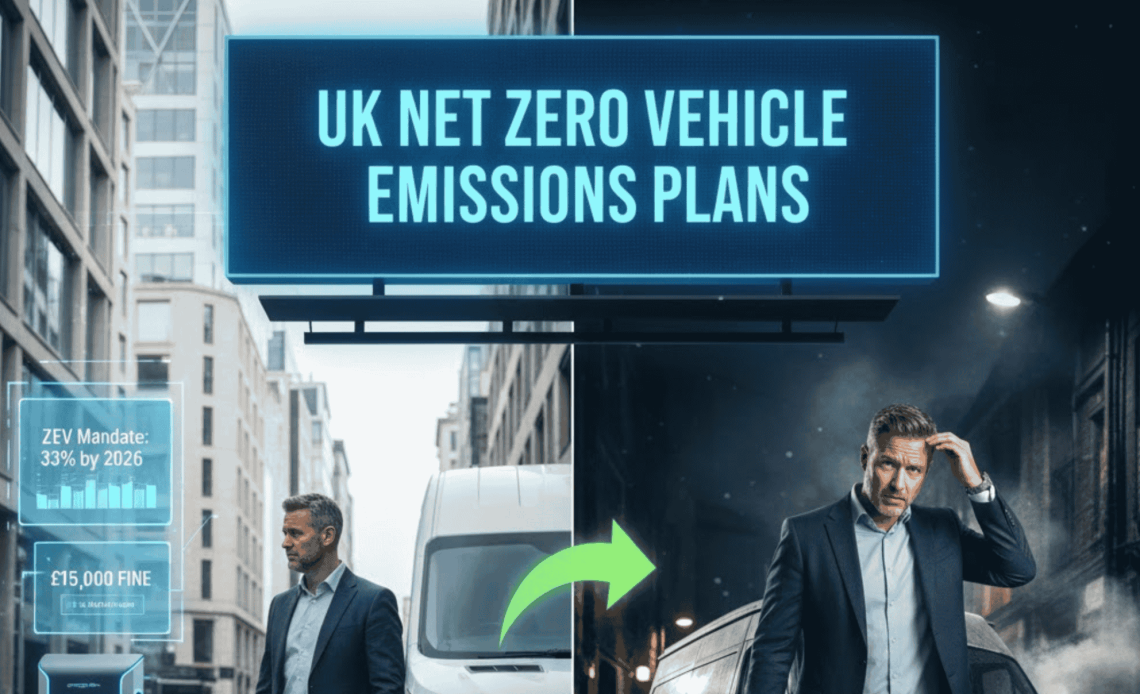
The UK’s roadmap to decarbonising transport is no longer a distant legislative dream; in 2026, it is an active, multi-billion pound regulatory machine. Following the October 2025 Carbon Budget and Growth Delivery Plan, the government has tightened the strings on vehicle manufacturers while attempting to provide “pragmatic flexibility” for the British public.
For any local business owner or fleet manager, understanding the uk net zero vehicle emissions plans is now a requirement for financial planning. The strategy is built on a complex foundation of quotas, trading credits, and strict “backstop” dates.
The ZEV Mandate: The Invisible Hand Driving the Market
While most news headlines focus on the 2030 ban, the real work is happening through the Zero Emission Vehicle (ZEV) Mandate. This policy, governed by the Vehicle Emissions Trading Schemes (VETS) Order, doesn’t tell you what to buy—it tells manufacturers what they must sell.
In 2026, car manufacturers are legally required to ensure that 33% of their new car registrations are zero-emission.
The Financial Stakes for Manufacturers
If a manufacturer sells 100,000 cars in the UK in 2026, but only 25,000 are electric (a 25% share), they miss their 33% target by 8,000 units. The penalty is severe: £15,000 per non-compliant vehicle. In this scenario, that manufacturer would face a fine of £120 million.
This shift in policy is happening in tandem with changing consumer behaviour, though adoption rates still face headwinds. Recent reports on UK drivers delaying the electric vehicle transition highlight the ongoing reluctance among a significant portion of motorists, which poses an additional challenge for manufacturers trying to meet ZEV targets.
The ZEV Mandate Trajectory (2024–2030)
| Year | New Car ZEV Target | New Van ZEV Target | Fine per Non-Compliant Unit |
| 2024 | 22% | 10% | £15,000 |
| 2025 | 28% | 16% | £15,000 |
| 2026 (Current) | 33% | 24% | £15,000 |
| 2027 | 38% | 30% | £15,000 |
| 2028 | 52% | 46% | £15,000 |
| 2029 | 66% | 58% | £15,000 |
| 2030 | 80% | 70% | £15,000 |
Why this matters for your business: To avoid these fines, manufacturers are using “VETS Credits.” Those who sell more than 33% (like Tesla) can sell their excess credits to those who sell fewer (like traditional brands). This market-based approach is why EV lease prices have remained competitive in 2026 despite high interest rates.
The 2030 Ban vs. The 2035 “Hybrid Loophole”
One of the most frequent points of confusion regarding the uk net zero vehicle emissions plans is the 2030 deadline. When the Labour government took office, they officially restored the 2030 ban on new pure petrol and diesel cars, reversing the 2035 extension.
However, a critical “safety valve” remains for those who aren’t ready for full electrification. The current 2026 rules draw a sharp line between types of engines:
1. Pure Internal Combustion (Banned 2030)
From January 1, 2030, you cannot buy a new car powered solely by petrol or diesel. This includes “Mild Hybrids” (MHEV)—cars that have a small battery but cannot be driven on electric power alone.
2. Significant Zero-Emission Capability (Allowed until 2035)
Full Hybrids (HEV), such as the Toyota Corolla, and Plug-in Hybrids (PHEV) are permitted to be sold as new vehicles until 2035. The government’s 2025 review clarified that as long as a car has a “meaningful” electric-only range, it can stay on sale for an extra five years.
3. The 100% Zero-Emission Backstop (2035)
From 2035, the “loophole” closes. Every single new car and van sold in the UK must be a zero-emission vehicle (ZEV), primarily meaning Battery Electric (BEV) or Hydrogen Fuel Cell (FCEV).
Decarbonising the “Hard-to-Abate”: Vans and HGVs
For local businesses, vans and heavy goods vehicles (HGVs) represent the biggest challenge. While electric cars are now common, the HGV market is just starting its transition.
The UK’s strategy for heavy vehicles is more aggressive than most realize:
-
Under 26 Tonnes: No new non-zero-emission trucks can be sold from 2035.
-
Over 26 Tonnes: A total ban on new non-zero-emission sales from 2040.
In 2026, we are seeing the first large-scale results of the Zero-Emission Road Freight Demonstrator (ZERFD). This project is proving that for local “hub-and-spoke” deliveries, electric is already viable, but for long-haul “trunking,” hydrogen is becoming the government’s preferred solution to meet the 2040 backstop.
Infrastructure: Reaching the 300,000 Target
A plan is only as good as its infrastructure. The UK net zero vehicle emissions plans include a commitment to reach 300,000 public chargers by 2030.
As of early 2026, the UK has passed the 90,000 mark. While this is behind the “straight line” trajectory needed, the quality of charging is improving. The government’s Public Charge Point Regulations 2023 now mandate:
-
Contactless payment on all chargers over 8kW.
-
99% reliability standards for rapid networks.
-
Open data sharing, so your sat-nav knows if a charger is broken before you arrive.
FAQ about “UK net zero vehicle emissions plans”
What happens to my current petrol car after 2030?
Nothing. The ban is on the sale of new vehicles. You can continue to drive, buy, and sell used petrol and diesel cars indefinitely. However, expect higher fuel taxes and more Clean Air Zones (CAZ) as the 2050 Net Zero target approaches.
For those continuing to drive traditional vehicles beyond 2030, it’s worth remembering that vehicle maintenance will remain strictly regulated. Knowing what part of the car does the law require you to keep in good condition is essential—not just for safety but also for compliance, especially as emission-related inspections become more stringent in low-emission zones.
Is the UK still offering grants for electric vehicles in 2026?
The “Plug-in Car Grant” for private buyers has largely been replaced by tax incentives. However, the Electric Vehicle Chargepoint Grant is still available for residents in flats or rental properties, providing up to £350 toward a home charger. For businesses, the Workplace Charging Scheme still offers significant subsidies.
Accessibility also remains a core concern during this transition. Many individuals relying on disability benefits have turned to electric options via the PIP mobility car list, which outlines EVs available under the Motability scheme—offering greater inclusivity as we move toward 2030.
Can a local business ignore these plans until 2030?
Technically yes, but strategically no. Many Tier 1 contractors and government bodies now require Scope 3 emissions reporting. If your business uses diesel vans, you may find yourself “bid-blocked” from major contracts that prioritise green supply chains.
Conclusion: Why 2026 is the Year of Transition
The uk net zero vehicle emissions plans are no longer a “green luxury”—they are the framework for the future of British commerce. By using a mix of manufacturer quotas (ZEV Mandate) and consumer deadlines (2030/2035), the government has created a market where the internal combustion engine is being priced out.
For a local business, the goal shouldn’t be to beat the ban, but to stay ahead of the regulations. Those who transition early benefit from lower “per-mile” running costs and high ESG (Environmental, Social, and Governance) scores, which are becoming a new currency in the UK business world.