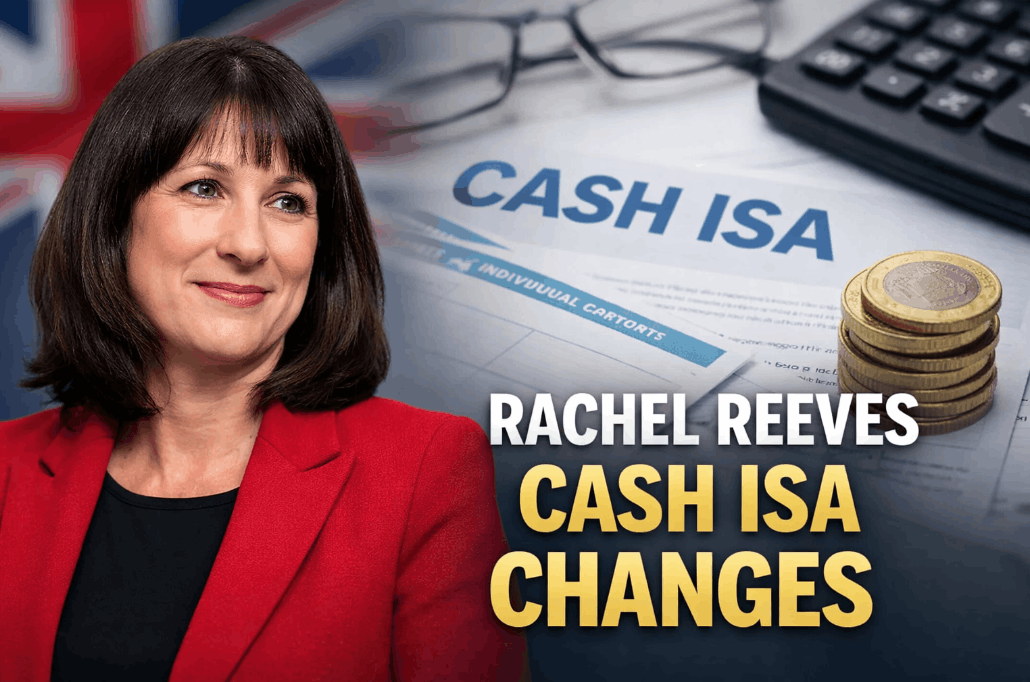
The Rachel Reeves cash ISA changes represent a fundamental shift in UK savings policy, moving from a universal £20,000 annual limit to a tiered system based on age.
Starting in the 2027/28 tax year, the allowance for under-65s drops to £12,000, while those over 65 retain the full £20,000. These reforms, established as part of the 2025/26 budget cycle, aim to redirect capital toward the UK stock market.
The primary change to UK savings involves a significant reduction in the Cash ISA allowance for individuals under the age of 65.
From 6 April 2027, this group will see their annual deposit limit cut from £20,000 to £12,000. Savers aged 65 and over are exempt from this reduction, maintaining the existing £20,000 threshold to protect retirement liquid assets.
What are the new Rachel Reeves cash ISA changes for 2026 and 2027?
The Government has restructured the ISA landscape to encourage long-term equity investment over cash hoarding. While the 2026/27 tax year remains a transition window with the £20,000 limit intact for everyone, the subsequent year introduces a strict age-based divide.
This policy shift is coupled with a 2% surcharge on unearned income, making the tax-free wrapper of an ISA more valuable even as the entry limits tighten.

The Legislative Shift Toward UK Equities
Treasury’s latest policy shifts suggest a deliberate move toward market stimulation. The British ISA concept has evolved into a nudge.
By lowering the ceiling on cash, the Chancellor is effectively pushing high-net-worth individuals toward Stocks & Shares ISAs, which retain a higher total contribution ceiling.
I am already speaking with savers who feel penalised for prioritising the security of cash over the fluctuations of the stock market.
This fiscal tightening mirrors other recent adjustments, such as the Rachel Reeves inheritance tax changes, forcing many to look at their wealth through a much longer-term lens.
The following breakdown illustrates how the allowances diverge between the current transition year and the full implementation in 2027.
| Feature | 2026/27 Tax Year | 2027/28 Tax Year (Proposed) |
| Cash ISA Limit (Under 65) | £20,000 | £12,000 |
| Cash ISA Limit (Over 65) | £20,000 | £20,000 |
| Stocks & Shares Limit | £20,000 | £20,000 |
| Total ISA Ceiling | £20,000 | £20,000 (Aggregate) |
| Transfer Stocks to Cash? | Allowed | Banned |
Why is the HMRC savings warning critical for taxpayers right now?
HMRC is now cautioning savers about accidental tax liabilities triggered by the combination of higher rates and frozen thresholds.
With interest rates remaining higher than the decade average, many savers are breaching their Personal Savings Allowance (PSA), currently £1,000 for basic rate taxpayers and £500 for higher rate taxpayers.
The HMRC warning savings message focuses on the 2% tax hike on unearned income effective from April 2026.
This means interest earned outside an ISA will be taxed at higher effective rates (e.g., 22% or 42%). For a basic rate taxpayer with £25,000 in a high-yield savings account at 5%, the annual interest of £1,250 already exceeds the PSA, triggering a tax bill on the remaining £250.
The Rise of Simple Assessment Letters
A common pattern in 2026 is the surge in P800 Simple Assessment forms. HMRC is now using real-time data from banks to calculate tax due on interest, often deducting it directly from your 2027/28 tax code.
If your interest earnings push you into the bracket for a formal tax return, you will need to register with HMRC; for those starting from scratch how do I get a UTR number is the first logistical hurdle to clear.
I recently assisted a client who was surprised to find their take-home pay reduced because their emergency fund, held in a standard easy-access account, had generated £1,100 in interest, triggering a bill for the £100 excess.

How will the UK cash ISA allowance reduction affect your 2027 strategy?
The UK cash ISA allowance reduction creates a use it or lose it scenario for the 2026/27 tax year.
Because the £12,000 limit for under-65s is a hard cap on new contributions, any unused portion of the current £20,000 allowance cannot be carried forward.
- Maximise the 2026/27 Window: Ensure you deposit the full £20,000 before 5 April 2027 if liquidity allows.
- Review Age Milestones: If you turn 65 during the 2027/28 tax year, your allowance is pro-rated from your birthday.
- Audit Fixed-Rate Maturities: If a 3-year fixed ISA opened in 2024 matures in late 2027, you must ensure the reinvestment doesn’t breach the new £12k limit.
- Utilise Spouse Allowances: Move cash to a spouse who may have a separate £12,000 (or £20,000) limit.
- Switch to Gilts: Consider short-term UK Government bonds (Gilts), which are currently exempt from Capital Gains Tax.
- The Bed and ISA Method: Sell assets in General Investment Accounts to move £3,000 of gains into an ISA before the CGT allowance resets.
- Address the Cash Drag: If you hold cash within a Stocks & Shares ISA, check if it is now subject to the uninvested cash tax surcharge.
Are Rachel Reeves cash ISAs still the best option for emergency funds?
Even with the lower cash ISA limit, these accounts remain the gold standard for emergency funds due to their tax-exempt status.
However, the 2027 rules introduce a one-way street policy. Under the new reforms, savers are banned from transferring funds from a Stocks & Shares ISA back into a Cash ISA.
This means if you move money into the stock market to chase higher returns, you cannot park it back in a tax-free cash environment if the market turns volatile, unless you have remaining 2027 allowance.
This Lock-in effect makes the initial choice between cash and shares far more consequential than in previous years.
The 65th Birthday Pro-Rata Glitch
There is significant confusion regarding savers who turn 65 mid-year. Based on current HMRC guidance, your allowance is determined by your age on the date of the contribution.
Age-based thresholds are a growing point of contention in UK policy, a sentiment echoed by the ongoing Rachel Reeves WASPI compensation campaign regarding historical pension shifts for women.
If you are 64 on April 6th but turn 65 in October, any contributions made before October are capped at the £12,000 rate, while the remaining £8,000 becomes available only after your birthday.
How to navigate the HMRC warning savings and the 2% hike
Adapting to these Rachel Reeves cash ISA changes demands a more hands-on approach to tax year-end planning. To avoid the unearned income surcharge, savers should look at the hierarchy of tax efficiency.
Your first step should be to fully utilise the Cash ISA allowance, followed by exploring tax-free prizes via Premium Bonds or boosting pension contributions to reclaim your personal savings allowance.
Comparison of Savings Vehicles (Post-2027 Reform)
| Account Type | Tax Treatment | 2027 Restrictions |
| Cash ISA | 100% Tax-Free | £12k Limit (Under 65) |
| Stocks & Shares ISA | 100% Tax-Free | No transfer back to Cash |
| Premium Bonds | Prize-based (Tax-Free) | £50,000 total holding limit |
| Standard Savings | Taxed above PSA | Subject to 2% Surcharge |
Final Summary and Next Steps
The Rachel Reeves cash ISA changes signal the end of the simple £20k savings era. To protect your wealth, you should maximise your 2026/27 allowance before the April 2027 deadline.
Review your current accounts now to ensure you don’t face an unexpected tax bill when the new surcharges take effect. If you are under 65, start diversifying into tax-free Gilts or JISAs to offset the £8,000 reduction in your annual cash limit.

FAQ about Rachel Reeves cash ISA change
Will my existing ISA balance be affected?
No. The £12,000 limit only applies to new contributions made from 6 April 2027 onwards. Any funds already inside your ISA wrapper from previous years remain tax-free regardless of the amount.
Can I still have multiple Cash ISAs?
Yes, the one ISA of each type per year rule was abolished in 2024. You can spread your £12,000 (or £20,000) across multiple providers, provided the total does not exceed your annual limit.
Does this affect Junior ISAs?
Junior ISAs (JISAs) currently maintain their separate £9,000 limit. There are no confirmed plans to reduce the JISA allowance, making them a viable safe haven for family wealth.
What is the HMRC warning about Cash Drag?
HMRC has clarified that interest earned on uninvested cash held within a Stocks & Shares ISA may be subject to a small tax levy if it exceeds certain internal thresholds, intended to discourage using S&S ISAs as proxy bank accounts.
Can I transfer a Cash ISA to a Stocks & Shares ISA?
Yes, transfers from Cash to Stocks & Shares remain permitted. The restriction only applies to moving funds in the opposite direction (Stocks to Cash) to prevent safe-haven cycling.
What happens if I over-subscribe?
If you exceed the £12,000 limit, HMRC will typically contact you at the end of the tax year. You will likely lose the tax-free status on the excess funds and may face a small administrative penalty.
Is the Personal Savings Allowance being scrapped?
No, the PSA remains at £1,000 (Basic) and £500 (Higher). However, because it is not being increased in line with inflation or interest rates, more people are being caught by the tax net.