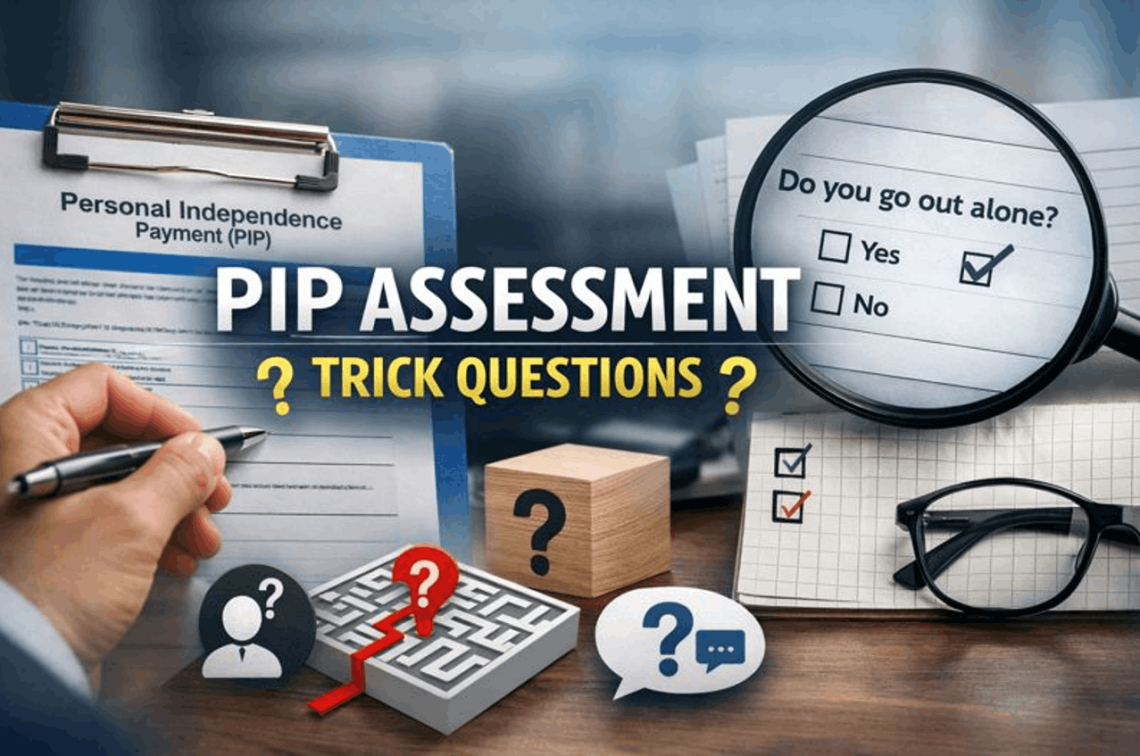
PIP assessment trick questions come up because the assessment is built around functional activities and reliability, not diagnosis. Many questions sound like everyday chat, but they are used to decide whether you can do an activity safely, repeatedly, to an acceptable standard, and in a reasonable time.
PIP assessment trick questions are usually ordinary questions used to test descriptors and reliability against what you wrote on your PIP2 form and what your evidence shows.
They are often repeated in different wording to check consistency. Clear answers focus on what happens most days, the help you need, and what goes wrong during or after the task.
PIP assessment trick questions what they are testing
PIP assessment trick questions are commonly simple prompts that feed into the Daily Living and Mobility activities in the assessment criteria.
They are not a puzzle to “beat”. They are a way for the health professional to gather details that can be mapped to descriptors in the report used by the DWP decision maker.
Sometimes the problem isn’t your answer, but how it’s summarised in the report. It’s worth knowing the common ways reports can drift from what was actually said, including the patterns behind DWP PIP benefit errors.
PIP assessment trick questions are everyday questions used to assess how you function under the PIP activities and descriptors.
They often check reliability and consistency by approaching the same task from different angles. A clear answer explains what happens most days, whether you can do it safely and repeatedly, and what support or aids are needed.

What makes an answer scoreable rather than vague?
Short answers like yes or I manage often get recorded as can do unaided, even when you meant I push through or I avoid it unless I have to. The assessment is about need, not pride, coping style, or how well you mask symptoms.
The key reality behind the questions
Assessments work by turning your day-to-day life into descriptors. It helps to describe tasks in descriptor terms: what you can do, how often, what help you need, and whether you can do it reliably.
In practice, most scoring disputes come down to missing reliability detail rather than anyone being dishonest or “caught out”
Why do assessors ask the same thing in different ways?
Repetition is usually a consistency check between your spoken answers, your PIP2 form, and any supporting evidence.
It also helps the assessor place your difficulty into the right activity, such as preparing food, washing and bathing, dressing, communicating, engaging with other people, planning journeys, or moving around.
It often follows a familiar pattern:
- A broad opener early on, such as a request to describe a normal day.
- Later on, more specific questions that check the same point from another angle.
If you notice repeats, it can help to stick to one internal framework: most days, support needed, risks, and after-effects. That keeps your account consistent even if the wording changes.
What does reliably mean in PIP and why it changes your answers?
Reliability is the difference between “possible once” and “possible as a normal way of living”. Many people lose clarity here because they answer for their best day or for a one-off effort.
| Reliability test | What it means in plain language | What to say out loud |
|---|---|---|
| Safely | No serious risk of harm during or after | Mention falls risk, accidents, panic, confusion, and near-misses |
| Acceptable standard | The outcome is good enough, not just attempted | Explain if hygiene slips, steps are missed, or instructions are misunderstood |
| Repeatedly | You can do it as often as needed | Describe fatigue, pain flares, shutdown, and recovery time |
| Reasonable time | Not taking far longer than someone without your condition | Give a simple time comparison and where you have to stop |
A steady approach is to include one reliability point in most answers, such as whether you can do it repeatedly or safely without supervision.
How are PIP descriptors linked to everyday questions?
The assessment criteria are organised by activities. That means casual topics often have a scoring purpose.
Common friendly chat topics that still map to descriptors include journeys, cooking, medication routines, shopping, and hobbies. They can be relevant because they reveal stamina, planning, safety, supervision needs, prompting needs, or after-effects.
When reviewing decisions, a common pattern is that a single capability is treated as proof of broader capability. Clear answers prevent that overreach by separating what you can do in one narrow situation from what you can do reliably day to day.

Which questions catch people out most often?
Some questions produce thin answers even from honest people, because the question sounds simpler than the descriptor underneath it.
Preparing food
If you say I can cook, it may be recorded as independent even if you can only heat a ready meal and struggle with knives, pans, standing, timing, or safety.
Add one concrete detail that makes the functional limit clear, such as: supervision for safety, needing to sit down between steps, or pain and fatigue that stop you finishing.
Washing and bathing
A yes can hide balance problems, fatigue, pain, tremors, or needing help with hair, lower body, or getting in and out. If you use a shower chair, grab rail, bath board, or you steady yourself on surfaces, that’s part of the functional picture.
Dressing and undressing
This often hinges on time, fine motor skills, fastenings, and whether you need prompting because of anxiety, low mood, or cognitive overload.
Managing therapy and monitoring a health condition
People often say I take my tablets and leave out missed doses without reminders, supervision for safety, or side effects. It also helps to remember that “therapy” can include practical tools and routines you manage at home, not only clinic appointments.
How do you answer trick questions without sounding rehearsed?
Keep it short first, then make it specific. Answer the question, then add the detail the descriptors require.
Give a short direct answer, then add what the scoring needs: what happens most days, whether you can do it safely and repeatedly, and what support is required. Avoid I manage on its own. Include one concrete detail about time, distance, prompting, supervision, aids, or after-effects.
One method that works across daily living and mobility
- Decide whether the question is mainly about Daily Living or Mobility.
- Answer for most days, not your best day.
- Say whether you can do it safely, and what goes wrong if you try.
- Say whether you can do it repeatedly, and what the after-effects are.
- Mention any aid, adaptation, or workaround you rely on.
- Say whether you need prompting, supervision, or physical help.
- Add one recent example that matches your usual pattern.
When yes is true but only sometimes how to say it accurately?
“Yes, but” is often the most truthful structure. It keeps you honest while preventing your answer being reduced to a simple “can do”.
Short add-ons can keep a yes answer accurate:
- Yes, once, but not repeatedly.
- Yes, but only with an aid, and it takes much longer.
- Yes, but only if someone prompts me or stays nearby.
- Yes, but the after-effects stop me doing other basics later.
In one common scenario: A claimant with neuropathic pain says they can shower. The report reads “independent”. What changed the later explanation was describing the shower seat, the extra time, and that lifting arms to wash hair triggers pain and tingling, so it often does not get done to an acceptable standard.

How PIP assessment trick questions appear in phone assessments?
Phone assessments remove visual context, so wording carries more weight. People can sound composed while still functioning poorly day to day, and that can be misread as “no issues”.
A few setup choices reduce misunderstandings: having your PIP2 form in front of you, keeping notes to prompt key points, and asking for clarification when a question is broad or unclear.
Here are phrases that reduce accidental minimising:
- I attempt it, but it isn’t reliable.
- I need prompting even when I do it.
- I avoid it because it isn’t safe.
- I can do it once, then I pay for it afterwards.
In one common scenario, someone answers “I go out” because they attend a monthly appointment. Adding the missing detail changes the meaning: they only go with a relative, need reassurance on the route, and experience psychological distress on unfamiliar journeys.
How do you handle questions that feel like evidence checks?
Some questions are used to cross-check your overall functional picture. They can feel unrelated, but they often connect to activities and reliability.
| Question type | What it may be checking | What makes your answer safer |
|---|---|---|
| How did you get here | Journey planning, anxiety, mobility, support | Say who came with you, what help was needed, and what it cost you afterwards |
| Do you drive | Concentration, fatigue, upper limb function, cognition | Explain frequency, adaptations, limits, and what you avoid |
| What hobbies do you have | Stamina, focus, social engagement | Clarify adjustments, short duration, and recovery time |
| Do you work | Routine tolerance, support, reasonable adjustments | Describe accommodations, reduced hours, and what fails without support |
A practical safeguard is to separate “I can do this one narrow thing” from “I can do the wider activity reliably”.
What should you say about good days and bad days?
Variability matters because PIP is generally assessed on how you function most of the time. The clearest approach is to quantify the pattern and explain what changes.
A simple way to describe it is:
- How many days a week are worse?
- What becomes impossible or unsafe on those days?
- What remains limited even on better days?
In one common scenario, a person with chronic fatigue says their good day includes cooking. Clarifying that “cooking” means heating a ready meal, sitting down between steps, and then needing hours of rest reframes the answer around a reasonable time and repeated activity.
In practice, consistent descriptions of frequency and after-effects are more persuasive than dramatic language.
What evidence strengthens answers about daily living and mobility?
Evidence is most useful when it ties directly to activities and reliability. Headlines and uncertainty can make the process feel more pressured than it needs to. That’s why it’s best to keep your evidence tightly linked to descriptors, whatever the wider debate around PIP cuts.
Diagnosis-only evidence is usually weaker than evidence that shows what happens when you try to do tasks.
Useful evidence types often include OT assessments, physiotherapy summaries, care plans, medication lists with documented side effects, appointment schedules for therapy, and symptom diaries that show frequency and recovery time.
If you use aids or adaptations, describe them clearly. Even informal workarounds matter if they show that you cannot do the task reliably without support.

What can you do after the assessment if the report is inaccurate?
If the decision does not reflect your functional reality, focus on descriptors and reliability rather than arguing about tone or intent.
Once the decision arrives, people often want to understand what happens next in practical terms. This is also where timelines like the first PIP payment become relevant. If anything looks inconsistent, request the report and act on it early.
| Option | What it is for | Best used when | What it changes |
|---|---|---|---|
| Request the assessment report | Getting the written record used in the decision | You suspect omissions or wording issues | Helps you target errors precisely |
| Mandatory Reconsideration | Asking the DWP to look again | The points awarded do not match the descriptors | Can change the decision when the reasons are descriptor-based |
| Complaint to the provider | Service concerns about process or conduct | The experience was unacceptable | Addresses service issues, not points by itself |
| Appeal to tribunal | Independent review via HMCTS | MR does not resolve the scoring | Often focuses on descriptors, evidence, and reliability |
As of 2026, assessments may be delivered by phone, video, or face to face depending on your case and provider, so it helps to prepare in a format that works in any channel.
What mistakes cause the biggest scoring problems?
Most scoring problems come from missing detail rather than incorrect detail.
Common pitfalls include answering for your best day, leaving out after-effects, and describing what you currently do rather than what you need.
Better replacements for vague phrases:
- Swap “I manage” for “I can sometimes do it once, but not reliably.”
- Swap “I’m fine” for “I can sound fine but still struggle to function.”
- Swap “I don’t get help” for “I need help but don’t have it.”
How to prevent PIP assessment trick questions being misread?
PIP assessment trick questions that are most likely to be misread
If you want one practical focus area, it is this: questions that invite a simple “yes” are the ones most likely to be misinterpreted in the report. Cooking, washing, dressing, going out, and walking distance are the repeat offenders.
To reduce misreading, keep answers anchored to the same four points: most days, support needed, safety, and after-effects.
In practice, people who prepare two or three recent examples that match their usual week tend to give clearer, more consistent answers.
What people talk about this online?
How PIP scammers have screwed the genuinely disabled over
byu/True_Paper_3830 inukpolitics
Final summary with next steps
PIP assessment trick questions are usually everyday prompts that translate your life into descriptors and reliability.
Keep answers short but complete: most days, support needed, safety, and after-effects. Avoid optimistic “yes” answers that hide the real limits.
If the decision does not match your functional reality, challenge it using descriptor-based reasons anchored to what happens when you attempt the activities.
Next steps
- Re-read your PIP2 form and mark the activities where reliability breaks down.
- Prepare two or three recent, typical examples for daily living and mobility.
- During the assessment, use the seven-step method to prevent yes answers being overinterpreted.
- After the decision, request the report if anything seems off, then write MR reasons that map directly to descriptors.
Frequently asked questions
Are there trick questions in a PIP assessment?
Most questions are not designed to trick you, but they can feel that way because they are used to score descriptors. Topics may be repeated in different wording to check consistency with your PIP2 form. Clear answers include reliability, help needed, aids used, and after-effects.
Can you take notes into a PIP assessment?
Yes, you can use notes to keep answers accurate. Notes help you remember support needs, after-effects, and how often problems occur. Keep them brief so you can still respond naturally. If someone is with you, they can help prompt you to mention key points.
Can you record a PIP assessment?
Recording may be possible, but it is usually subject to provider processes and practical requirements. If recording matters, raise it when the appointment is arranged rather than on the day. If you cannot record, detailed notes and having someone present can still improve accuracy.
What does safely repeatedly and reasonable time mean in PIP?
These are reliability checks. Safely means without serious risk of harm. Repeatedly means as often as you would normally need to do the activity. Reasonable time means not taking far longer than someone without your condition. If any of these fail, say so plainly.
What should you do if you forgot something during the assessment?
You can add it as soon as you remember, even later in the call. Keep it factual and link it to the relevant activity and reliability. If the decision later seems wrong, request the assessment report and include the missing detail in your MR reasons.
Does driving mean you will fail PIP mobility?
Not automatically. Driving can be limited, adapted, infrequent, or only possible on familiar routes. It may say little about planning and following journeys or walking distance. Explain frequency, conditions you avoid, recovery time, and any support or adaptations you rely on.
How far should you say you can walk?
Answer based on what you can do reliably. If you are unsure, avoid pressured guessing. Describe the point where you must stop, how long it takes, what pain or breathlessness occurs, and how long you need to recover. Consistency matters more than a perfect number.
What evidence helps most for PIP?
Evidence that matches activities and reliability is strongest. OT reports, physiotherapy notes, care plans, medication side effects, and consistent symptom diaries often map well. Evidence that only lists diagnoses usually needs a functional explanation alongside it.
What if the assessor says you seem fine?
Sounding calm does not equal functioning well. Bring it back to daily living impact and reliability: what you cannot do safely or repeatedly, what help you need, and what happens afterwards. Keep it factual and consistent with your form and evidence.
Author expertise note
Written from experience reviewing how PIP answers are translated into reports and how small wording choices affect descriptor outcomes. The focus is on reliability, support needs, and consistency with the PIP2 form and evidence, using realistic scenarios seen in preparation and decision reviews. Not legal advice.