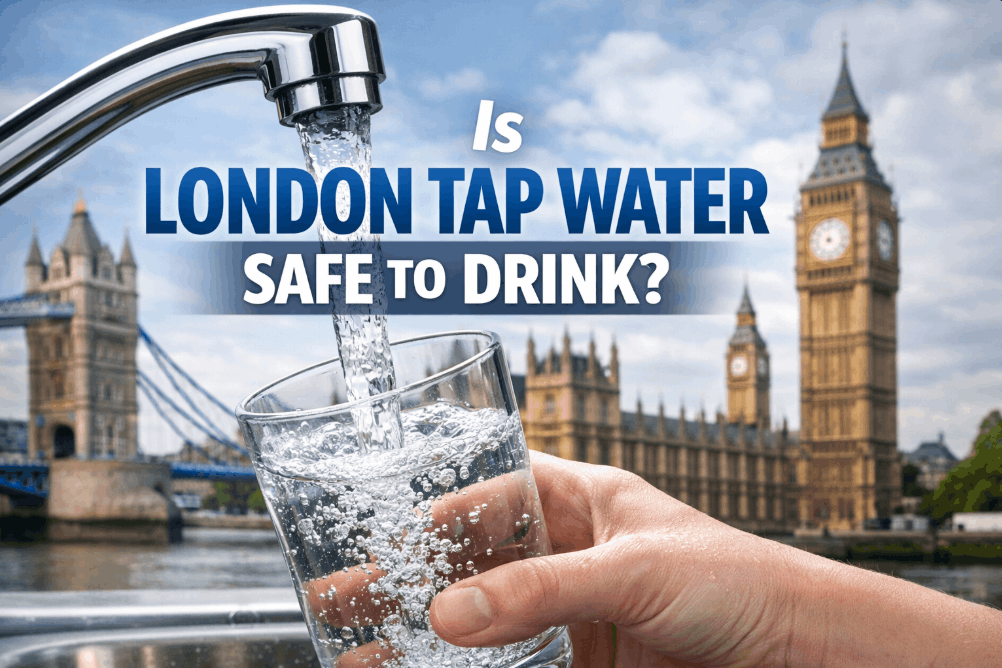
Is London tap water safe to drink? Yes, London tap water is world-class and perfectly safe to consume, meeting over 99.9% of the stringent safety standards set by the Drinking Water Inspectorate (DWI).
While the water is classified as “very hard” due to high mineral content from natural chalk aquifers, it undergoes a multi-stage purification process involving ozonisation and carbon filtration to ensure it is free from harmful bacteria and contaminants.
Is London tap water safe to drink for everyone?
As of 2026, London’s tap water remains among the most strictly monitored in the world, with over 500,000 tests performed annually to guarantee its safety.
While the high calcium and magnesium levels are safe for human consumption, the distinct “chlorine” taste and presence of limescale are the most common reasons users choose additional filtration for palatability.
The Reality of Modern Water Safety in the Capital
In practice, the safety of your water often depends as much on your building’s internal plumbing as it does on the municipal supply.
While Thames Water ensures the supply is clean when it leaves the treatment works, older Victorian properties in areas like Kensington or Hackney may still contain legacy lead piping.
Furthermore, the 2026 environmental focus has shifted toward forever chemicals (PFAS), which are monitored but increasingly influence the choice of high-end domestic filters.
| Feature | London Tap Water Profile (2026) |
| Safety Rating | High (DWI Compliant) |
| Water Type | Very Hard (Chalk-derived) |
| Management | Thames Water & Affinity Water |
| Primary Treatment | UV Exposure, Rapid Gravity Filtration, Chlorination |
| Availability | 24/7 (Except during emergency repairs) |
Does London tap water available in public places?
Yes, London tap water is highly accessible in public spaces through a vast network of over 100 dedicated drinking fountains and more than 4,000 Refill stations.
These facilities are part of a major initiative by the Mayor of London and Thames Water to reduce single-use plastic, allowing anyone to refill their own bottle with top-quality, chilled water for free while on the move.
How to Find Water on the Go
- The Blue Droplet: Look for the distinctive blue “waterdrop” fountains in major hubs like King’s Cross, Liverpool Street, and the South Bank.
- Refill London App: Download the Refill Return app (updated Feb 2026) to see a real-time map of cafes, restaurants, and shops like Costa and Starbucks that offer free tap water.
- TfL Stations: Most major London Overground and Tube stations now feature modern, contactless bottle-filling stations.
Who manages and maintains London’s water supply?
The responsibility for London’s water is split between several entities to ensure a system of checks and balances.
Thames Water is the primary private company responsible for the infrastructure, maintenance, and delivery of water to the majority of Londoners. However, Affinity Water also supplies parts of North and West London.
To ensure these companies don’t cut corners, the Drinking Water Inspectorate (DWI) acts as the independent regulator.
They provide the technical seal of approval, while Ofwat manages the economic side, ensuring you are charged fairly.
If you ever need to complain about your water quality, your first point of contact is your supplier; if they fail to resolve the issue, the Consumer Council for Water (CCW) acts as the ombudsman to protect your rights.
How is London tap water cleaned?
London’s water follows a sophisticated 6-step cleaning procedure before it reaches your glass:
- Screening: Removing large debris like leaves and twigs from river water.
- Storage: Water stays in reservoirs for several weeks to allow natural settlement of solids.
- Rapid Gravity Filtration: Passing water through layers of sand to catch fine particles.
- Ozonisation: Using ozone gas to destroy pesticides and microscopic organisms.
- GAC Filtration: Carbon filters that remove tiny traces of chemicals and improve taste.
- Chlorination: Adding a tiny amount of chlorine to keep the water sterile as it travels through the pipes.
History of London Tap Water
London’s water system was introduced in its modern form during the mid-19th century. In 1854, physician John Snow famously proved that a contaminated water pump on Broad Street was the source of a Cholera outbreak.
This led to the Great Stink of 1858 and the subsequent engineering of the London sewer and water network by Joseph Bazalgette.
Historically, health issues did occur, but these were eradicated over a century ago. Today, the system is designed to prevent cross-contamination, a far cry from the era when the city lacked structured emergency and health infrastructure.
Just as historians analyze How many people died in the Great Fire of London to understand the city’s resilience, the evolution of the water network demonstrates a similar commitment to public safety.
The water is connected to your taps via a massive network of underground mains, some made of modern plastic, others of older cast iron, that draw from the Thames and Lee rivers (70%) and underground aquifers (30%).
Costs, Fines, and Legalities of London Water
For residents, water is not free. You typically pay through a water meter (paying for exactly what you use) or an unmetered rate based on your property’s Rateable Value.
As utility prices fluctuate, many households are looking for ways to manage their monthly outgoings; for instance, eligible residents may benefit from the 450 cost of living payment to help offset rising household bills.
However, for tourists and those on the move:
- The Right to Water: Under the Licensing Act, any premises serving alcohol is legally required to provide free tap water to customers.
- Waste and Fines: While you won’t be fined for drinking water, there are legal issues regarding waste. During droughts, “Hosepipe Bans” are common. Using tap water to wash your car during these periods can lead to fines of up to £1,000.
- Availability: Water is available 24/7. If your supply is interrupted, it is usually due to a specific localized pipe burst; you can check the “Live Map” on the Thames Water website for updates.
The Dos and Don’ts of London Tap Water
| Category | The Dos | The Don’ts |
| Consumption | Use the cold kitchen tap for drinking. | Don’t drink from the hot tap (sediment risk). |
| Sustainability | Fill your own bottle at “Refill London” points. | Don’t buy single-use plastic bottles. |
| Maintenance | Descale your kettle monthly with vinegar. | Don’t ignore a change in water colour/smell. |
| Skin/Hair | Use a chelating shampoo if your hair feels dry. | Don’t use too much soap (hard water needs less). |
| Travel | Download the “Refill” app to find free water. | Don’t assume bathroom taps in old hotels are mains-fed. |
Final Summary
London’s tap water is a triumph of Victorian engineering and modern science. It is safe, accessible, and environmentally superior to bottled water. While the mineral content makes it hard and the chlorine affects the taste, neither is a health concern.
Managing a household in the capital remains a balance of maintaining infrastructure and monitoring your finances, especially as the DWP to provide £225 cost of living payments to alleviate financial strain for those most affected by economic shifts.
Next Steps:
- Check your pipes: If you live in a pre-1970s home, perform the “scratch test” to ensure you don’t have lead pipes.
- Get a filter: If you dislike the taste, an active carbon filter (like a Brita) is all you need to remove the chlorine scent.
- Stay hydrated for free: Download the Refill app before your next trip into Central London to find the 4,000+ free refill spots.
FAQ
Why do people search for this so often?
Most searches are triggered by the “hard” taste of the water and the white limescale buildup in kettles, which many mistakenly associate with a lack of cleanliness or poor filtration.
Has anyone been sick from London water recently?
There have been no widespread health incidents related to London’s municipal tap water in modern history. The water is tested over 500,000 times a year to prevent any outbreaks.
Can I use a water bottle to fill up from the tap?
Absolutely. In fact, it is encouraged to reduce plastic waste. London’s water is perfectly safe to store in a clean reusable bottle for up to 24 hours (keep it out of direct sunlight).
Who maintains the pipes in my street?
Thames Water maintains the large mains and the pipes up to your property boundary. The pipes inside your home and the “communication pipe” under your garden are the homeowner’s responsibility.
Is the water available 24/7?
Yes. London’s water supply is constant. If your water stops, it is usually due to a specific local pipe burst or planned maintenance, for which you are usually notified 48 hours in advance.
Does boiling London tap water make it safer?
Boiling kills bacteria, but London’s water is already bacteria-free. Boiling actually increases the concentration of minerals (limescale) and will not remove lead or chemicals.
Do Londoners get health benefits from tap water?
Yes. The hard water provides a significant portion of your daily recommended intake of calcium and magnesium. Additionally, most of London’s water contains natural or added fluoride, which aids in dental health.
Where can I complain about the water quality?
Start with the Thames Water Customer Service team. If they don’t solve the issue within 8 weeks, you can escalate your complaint to the Consumer Council for Water (CCW).