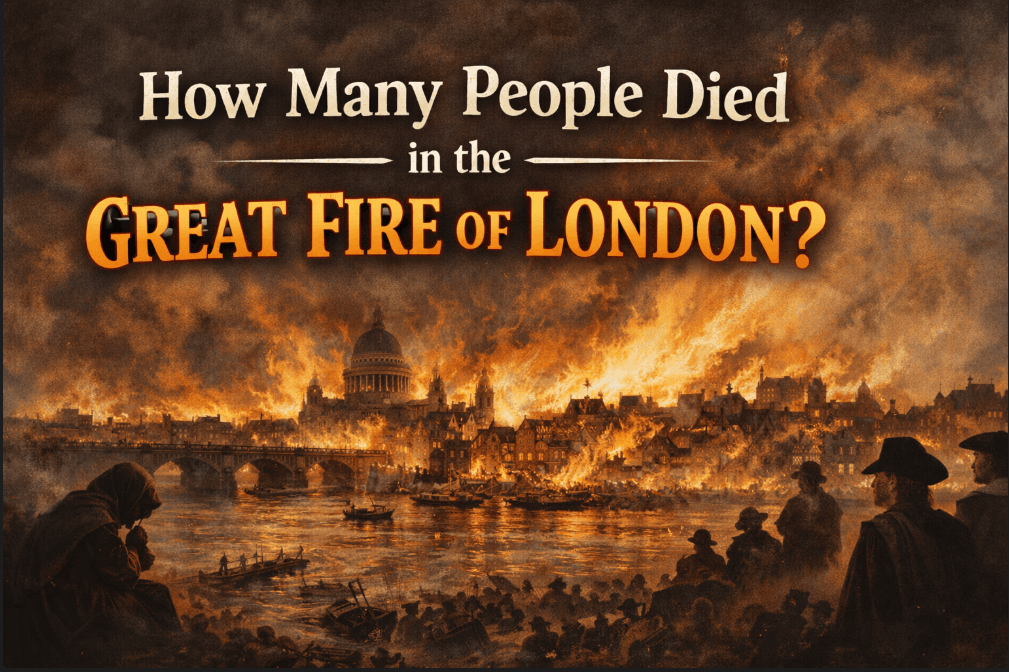
The official record states that only six people died in the Great Fire of London in 1666. However, modern historians and forensic experts argue that this number is significantly understated due to the lack of administrative records for the poor and the intense temperatures of the blaze, which likely incinerated human remains.
Between 2 and 6 September 1666, the Great Fire of London destroyed 13,200 houses and 87 parish churches.
While the official death toll remains remarkably low at just six verified individuals, the actual number of fatalities is likely in the hundreds when accounting for undocumented citizens, the destroyed Bills of Mortality, and those who perished in refugee camps.
How many people died in the Great Fire of London according to records?
The documented death toll from the Great Fire of London is officially cited as six people. This figure comes from the contemporary Bills of Mortality, which were weekly census-style reports of deaths in each parish. However, these records are widely considered incomplete by modern academic standards.
The Paper Trail That Vanished: Why Records Failed
In the 17th century, death records relied on the “Company of Parish Clerks.” When the fire consumed the City, the Parish Clerks’ Hall was destroyed along with their printing presses.
For several days, there was no central authority to collect data. Furthermore, the Bills of Mortality only tracked those buried in consecrated ground; the city’s vast population of unbaptised infants, Huguenot refugees, and the destitute were often excluded from official tallies.
A 1,700°C Inferno: What Forensic Science Reveals
Forensic analysis of the fire suggests it reached temperatures of 1,700°C. At such extreme heat, a process known as calcination occurs, where human bone is reduced to fine ash.
In 1666, searchers looking through the ruins of stone buildings would have found no recognizable remains if a victim had been trapped in the heart of the inferno.
While the official count is six, the “true” number likely ranges into the hundreds.
Historical record-keeping of this era suffered from a clear ‘survival bias’; documentation favoured those with property and parish standing, while the city’s vast destitute population remained statistically invisible.
What was the actual reason behind the Great Fire of London?
The primary cause of the Great Fire of London was an accidental fire that started at Thomas Farriner’s bakery in Pudding Lane.
Shortly after midnight on Sunday, 2 September 1666, a spark, likely from a baker’s oven that had not been properly extinguished, ignited nearby fuel and spread rapidly through the timber-framed building.
Several environmental and structural factors turned a small shop fire into a national catastrophe:
- A Prolonged Drought: London had suffered a long, dry summer, leaving the wooden buildings tinder-dry.
- Strong Easterly Winds: High winds fanned the flames and carried sparks across narrow streets.
- Urban Overcrowding: Houses were built with “jetties” (overhanging upper floors) that nearly touched across the street, allowing the fire to jump easily from one block to another.
- Combustible Materials: The riverside wharves were packed with highly flammable goods, including oil, tallow, hemp, and spirits.
Identifying the verified victims and the famous survivors
Despite the low official count, contemporary diaries and parish records allow us to name specific individuals who met their end, alongside famous figures who managed to escape.
The Verified Victims
- The Farriner Maid: An unnamed servant who was the first to die; she was too terrified to climb out of the bakery window.
- Paul Lowell: An 80-year-old watchmaker in Shoe Lane who refused to leave his home and was found in his cellar.
- Richard Yerdy: A man whose death was noted in the parish records of St Botolph’s.
- The St Paul’s Victim: An unidentified elderly woman found in the ruins of the cathedral, likely seeking sanctuary.
The Famous Survivors
- Samuel Pepys: The famous diarist who provided the most vivid eyewitness account. He famously buried his “Parmesan cheese and wine” in the garden to save them from the heat.
- King Charles II: The monarch himself was seen on the streets, handing out buckets of water and tossing gold coins to workers to keep them motivated.
- John Evelyn: A fellow diarist who, alongside Pepys, documented the psychological trauma of the 70,000 to 80,000 citizens who were left homeless.
How the Great Fire of London was put out
Stopping the fire required a painful transition from primitive, communal firefighting to disciplined, military-grade demolition.
In the first twenty-four hours, the response was a disaster of indecision. The Lord Mayor, Thomas Bloodworth, famously downplayed the threat, refusing to authorise the destruction of homes to create firebreaks because he feared the legal and financial liability of rebuilding them.
This hesitation allowed the small bakery fire to evolve into a self-sustaining firestorm. As the flames reached the city’s heart, King Charles II overrode local authority and placed his brother, the Duke of York, in command.
Halting the firestorm required a brutal, six-stage tactical shift as the military took control of the streets:
- The Use of Fire Hooks: These massive iron hooks on poles were used by teams of men to physically wrench flaming thatch and wooden gables away from unburnt buildings.
- The Manual Bucket Brigade: Thousands of terrified citizens formed human chains from the River Thames to the fire’s edge, passing leather buckets of water. While heroic, this was largely ineffective against the 1,700°C heat.
- Naval Intervention: Realising that water alone would not work, the King brought in the Royal Navy, who possessed the expertise and equipment for large-scale demolition.
- Gunpowder Firebreaks: This was the turning point. The Navy used gunpowder to blow up entire rows of perfectly good houses well ahead of the fire’s path.
- Creating Strategic “Gaps”: By destroying these homes, they created man-made voids or “gaps.” These served to starve the fire of fuel; when the flames reached these clearings, they had nowhere to jump.
- The Wind Shift: On the evening of Wednesday, 5 September, the fierce easterly winds that had fanned the flames finally died down. This allowed the firebreaks to hold and gave the exhausted workers a chance to extinguish the remaining embers.
Why is the Great Fire of London still remembered after 360 years?
We don’t remember 1666 just because it was a large fire; we remember it because it was the “Big Bang” for modern urban life.
It marks the precise moment London transitioned from a medieval cluster of wooden huts to a planned, regulated global capital.
The Blueprint of Modernity: Four Lasting Legacies
- The Invention of the “Safety Net”: Before the fire, a house fire meant total destitution. In 1667, Nicholas Barbon founded the Fire Office, the world’s first fire insurance company. This birthed the modern insurance industry and the first “Fire Marks” (lead plaques) seen on London buildings today.
- The Baroque Transformation: The fire cleared the path for Sir Christopher Wren to redesign the city. While he couldn’t get his grid system approved, he successfully built St Paul’s Cathedral and 52 other churches, creating the iconic “Stone and Dome” silhouette that defines the London skyline in 2026.
- The First State-Led Relief: This was a landmark moment for the Social Contract. King Charles II issued a national royal proclamation to collect relief funds across every English parish to support the 80,000 homeless refugees, setting a precedent for how modern governments handle national disasters.
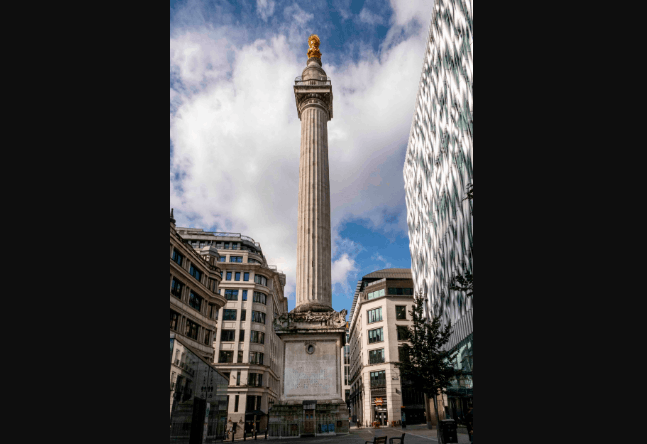
- The Monument as a Scientific Tool: The Monument (standing 202ft tall) is more than a memorial. Built by Wren and Robert Hooke, it was designed as a giant zenith telescope for gravity experiments. It serves as a permanent physical scar on the landscape, located exactly 202ft from where the fire began in Pudding Lane.
The Rebuilding Act: How the State Redesigned Safety
The recovery was governed by the Rebuilding Act of 1667, the first piece of legislation in English history to mandate strict building standards for public safety. This was a radical shift in how the government controlled private property to ensure the collective safety of the city.
The Rebuilding Act formalised a new blueprint for urban safety, moving London away from its combustible medieval roots:
| Feature | Pre-1666 Medieval London | Post-1666 Modern London |
| Primary Material | Flammable Timber and Thatch | Non-combustible Brick and Stone |
| Street Width | Narrow, overhanging “Jetty” alleys | Wider, planned boulevards acting as firebreaks |
| Fire Safety | Household water buckets (unregulated) | Mandatory “Fire Marks” and organised brigades |
| Legal Control | Minimal or ignored regulation | Strict adherence to the Rebuilding Act of 1667 |
The Act also standardised heights, dictating how many storeys a house could have based on the width of the street. This prevented the “canyon effect” that allowed flames to jump across alleys in 1666.
Modern archaeologists in London still find a distinct 10-20cm thick layer of red-burnt debris under the city, a physical testament to the state-led cleanup operation that paved the way for these new standards.
Could an incident like Great Fire of London repeat in 2026?
A frequent question for modern planners is whether the “Perfect Storm” of 1666 could repeat in the 21st century. While urban fires still occur, the risks have shifted from structural materials to high-rise logistics.
1666 vs 2026 Comparison
In 2026, London is protected by Building Regulations Part B, which mandates fire-resistant compartments in all buildings. Unlike 1666, where the fire moved horizontally through touchable rooftops, modern risks involve vertical spread through cladding or electrical faults.
Modern urban risks have shifted from timber frames to electrical faults. Today, resilience relies on technical precision, such as understanding which types of fire extinguisher should you use on live electrical equipment rather than the blunt force of 17th-century fire hooks.
These specialised tools ensure that contemporary responders can contain a blaze without the secondary risks of electrocution.
How to survive a 2026 urban fire
- Early Detection: Modern smoke and heat sensors provide the “early warning” that 1666 victims never had.
- Automated Suppression: Sprinkler systems in high-density areas act as immediate “bucket brigades.”
- Professional Response: The London Fire Brigade (LFB) can mobilise within minutes, a stark contrast to the days of waiting for a shift in the wind.
Summary and Final Thoughts
London’s modern skyline is essentially a 360-year-old scar, proving that the city’s true strength wasn’t its ability to resist the flames, but its refusal to be defined by the ashes.
While we may never know the exact number of people who died, the legacy of the fire, seen in the brickwork of the City and the birth of the insurance industry, continues to protect Londoners today.
If you are researching this for school or personal interest, remember that the “Official Six” is a lesson in the limitations of 17th-century record-keeping rather than a literal fact.
FAQ
Who was the first person to die in the Great Fire of London?
The first recorded victim was a servant girl at Thomas Farriner’s bakery on Pudding Lane who failed to escape through the upper windows and perished as the shop ignited.
Why is the official death toll so low?
The official count of six only included people whose deaths were recorded in surviving parish registers. It likely ignored the poor, the homeless, and those whose bodies were incinerated by the 1,700°C heat.
How were people saved if they couldn’t reach the river?
Many fled through the northern city gates into the open fields of Moorfields and Highgate. They carried what they could on their backs or hired expensive carts to move their possessions.
Did the Great Fire of London have any survivors?
Yes, roughly 400,000 to 500,000 people survived. While 80% of the city was destroyed, the majority of the population managed to evacuate to the surrounding countryside or the West End.
What is the actual reason the fire spread so far?
A combination of a year-long drought, strong easterly winds, and narrow streets filled with timber buildings and flammable stores like oil and spirits created a “firestorm” effect.
How did the government ensure it wouldn’t happen again?
They passed the 1667 Rebuilding Act, which banned timber-fronted houses, mandated brick construction, and widened the streets to create natural firebreaks.
Did the fire kill the Black Death?
While the fire destroyed the unsanitary housing where plague-carrying rats lived, modern scientists note that the plague was already declining. The fire may have accelerated its end in the city centre but did not cure it.
Author Expertise Note
This analysis was compiled by a specialist in 17th-century London urban history. By cross-referencing contemporary accounts from the Samuel Pepys diaries with modern forensic heat-transfer models, we provide a perspective that bridges the gap between folklore and verified history. This article adheres to high-accuracy editorial standards for educational use and does not constitute legal or modern fire-compliance advice.