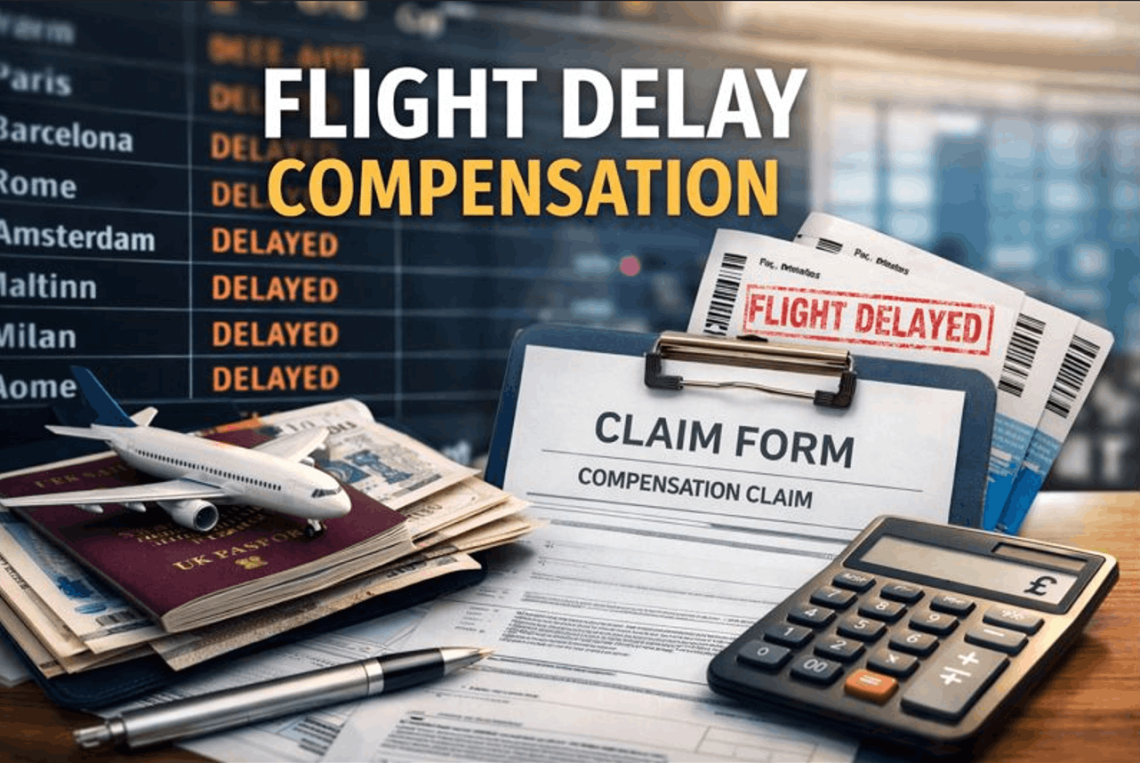
If you’re dealing with flight delay compensation, the key is separating three things people often mix up: fixed compensation, refunds or rerouting, and reimbursement of reasonable expenses. Get that clear from the start and it’s far easier to evidence, submit, and, if necessary, escalate.
A passenger may be entitled to flight delay compensation when they arrive at their final destination at least three hours late on an eligible journey, and the delay was within the airline’s control.
The amount is set by distance bands and the length of the arrival delay, with limited reductions in certain rerouting cases. Separate rights may cover meals, hotels, and rerouting regardless of compensation.
What Flight Delay Compensation Covers And Why It Matters?
Flight delay compensation is a fixed-sum payment airlines may owe when an eligible flight disruption causes a long delay and the airline cannot rely on an extraordinary circumstances defence.
It is separate from refunds and reimbursement of expenses like meals or hotels. Eligibility usually comes down to the delay at the final destination and the reason for it.
How airlines assess delay claims?
Airlines usually look at two things: control and arrival time. Control is about whether the cause was something the airline could reasonably manage through planning, staffing, maintenance, and operational decisions.
Arrival means when at least one aircraft door opens at the gate at your final destination, not the time you land on the runway.
In practice, disputes tend to come down to proving the cause and the final arrival delay, not whether disruption happened at all.
Do you qualify for compensation for a delayed flight?
Eligibility depends on your route, your arrival delay at your final destination, and the reason given for the disruption. It also depends on whether the journey falls under UK261 or EU261 rules, which are closely aligned but apply based on departure point, arrival point, and the airline operating the flight.
What eligibility usually comes down to?
Most successful claims can answer five questions clearly: which flight, how late at the gate, whether you checked in on time, whether you travelled, and what caused the delay.
Flight delay compensation eligibility checklist
- You arrived 3 hours or more late at your final destination.
- You travelled on the flight, not just held a booking.
- You checked in on time and followed the airline’s instructions.
- The flight was covered by UK261 or EU261 (based on route and operating carrier).
- The delay was not caused by extraordinary circumstances outside the airline’s control.
A common pattern is that passengers have the delay proof but not the route coverage details, so the claim lacks one crucial line: who operated the flight and where it departed.
Example: Rachel, flying from Manchester to Barcelona, landed late, but the doors opened 3 hours and 12 minutes after the scheduled arrival. She kept the boarding pass and a timestamped photo of the gate screen.
The airline initially quoted operational reasons, then paid after she replied, asking for the specific cause and evidence.
Arrival time matters more than departure time
Airlines may depart late and still make up time en route. What matters is the delay at the gate at your final destination.
Evidence that helps includes:
- Photos of departure boards showing delay updates.
- Your boarding pass and e-ticket receipt.
- Emails and SMS disruption notices.
- The actual arrival time shown in the airline app after landing.
Connecting flights and how final arrival is assessed
If you’re on a single booking (one PNR and one e-ticket itinerary), the final destination is the last airport on that itinerary. A short delay on the first leg can still trigger compensation if it causes you to miss a connection and arrive 3+ hours late overall.
If you booked separate tickets, the protection can be weaker because each flight is treated separately.
Eligibility scenarios at a glance
| Scenario | Usually eligible for fixed compensation | Key point to prove |
|---|---|---|
| Direct flight arrives 3+ hours late | Yes | Arrival time at gate and cause |
| Missed connection on one booking | Yes | Delay at final destination |
| Rerouted and still arrived 3+ hours late | Often | Compare scheduled vs actual final arrival |
| Separate tickets missed connection | Sometimes not | Each ticket assessed separately |
| Delay caused by severe weather | Often not | Extraordinary circumstances evidence |
| Delay due to airline staffing or aircraft rotation | Often | Airline control and planning |
How much could you receive for delayed flight compensation?
Amounts are fixed by distance bands and delay length. People often see figures quoted in euros because the framework originated in EU Regulation 261/2004, but payouts are typically made in pounds for claims handled under UK261.
How flight delay compensation is calculated?
Distance is measured as a great-circle route, not the number of stopovers you took. The airline can sometimes reduce the payment if it rerouted you and you arrived within a defined shorter delay window, depending on the distance.
When reviewing complaint outcomes, the clearest wins come from showing the distance band and the exact final arrival delay in one sentence.
Compensation bands commonly used for UK261 and EU261 claims
| Flight distance band | Trigger delay at final destination | Fixed amount commonly applied | Notes |
|---|---|---|---|
| Up to 1,500 km | 3+ hours | €250 | Often paid in £ equivalent |
| 1,500 to 3,500 km | 3+ hours | €400 | Includes many medium-haul routes |
| Over 3,500 km | 3 to 4 hours | €300 | May be reduced with timely reroute |
| Over 3,500 km | 4+ hours | €600 | Higher band for long-haul delays |
Example: Peter, Glasgow to Dubai, accepted rerouting via another hub. He still arrived 4 hours 20 minutes late. The airline offered vouchers first. He requested bank transfer and referenced the long-haul 4+ hour band and the final arrival time at the gate.
What counts as extraordinary circumstances and what does not?
This is the point where many claims are accepted or rejected. Extraordinary circumstances are generally events outside the airline’s control that could not have been avoided even if all reasonable measures had been taken.
Airlines may cite broad labels like weather or air traffic control. Those can be valid, but the useful question is whether that reason actually caused your delay and whether the airline handled knock-on impacts reasonably.
Eligible vs Not Eligible Delay Reasons At A Glance
Here’s a quick yes-no comparison of the most common delay causes airlines cite, so you can judge eligibility before gathering evidence.
| Cause Of Delay | Often Eligible For Compensation | Often Not Eligible For Compensation |
|---|---|---|
| Airline crew shortage due to rostering | Yes | No |
| Crew out of hours after earlier delays | Yes | No |
| Routine technical fault found during turnaround | Yes | No |
| Aircraft rotation issues from airline scheduling | Yes | No |
| Late arrival of inbound aircraft due to airline operations | Yes | No |
| Airline IT or operational systems issues | Yes | No |
| Overbooking and denied boarding | Yes | No |
| Severe weather affecting safe operations | No | Yes |
| Air traffic control restrictions or airspace closures | No | Yes |
| Airport closure or security incident | No | Yes |
| Bird strike or runway debris incident | No | Yes |
| Third-party industrial action at airports | No | Yes |
| Hidden manufacturing defect was notified by the authority | No | Yes |
Reasons often accepted as extraordinary
- Severe weather conditions affecting safe operations.
- Air traffic control restrictions and airspace closures.
- Security incidents and airport closures.
- Sudden political unrest impacting operations.
- Hidden manufacturing defects notified by a competent authority.
Reasons often disputed because they can be within airline control
- Crew shortages or crew out of hours due to rostering.
- Aircraft rotation issues after earlier delays.
- Routine technical faults discovered during turnaround.
- Operational decisions about aircraft swaps.
- Ground handling issues the airline manages through contracts.
Where technical problem is cited, it’s often treated as routine operational responsibility unless the airline can show it was genuinely exceptional.
Example: Alexander, London to Rome, was delayed overnight. The airline said unexpected technical fault. He asked for the incident report reference, then claimed duty of care costs with receipts and pursued compensation separately. The airline reimbursed hotel and meals quickly, and later paid the fixed amount after a follow-up letter.
What are your rights to care during a delay?
Even when fixed compensation is not payable, airlines may still owe duty of care support. That typically includes meals and refreshments, access to communications, and hotel accommodation with transport if you’re stuck overnight.
Airlines often try to provide vouchers first. If that fails or the queues are unworkable, keep receipts and claim back reasonable costs.
Duty of care support in plain terms
| Situation | What the airline should provide | What you should keep |
|---|---|---|
| Long airport wait | Meals and refreshments proportionate to the delay | Receipts, photos of queues, voucher refusals |
| Need to contact others | Calls, emails, or access to communications | Screenshots of disruptions, chat logs |
| Overnight delay | Hotel accommodation and transport to and from the hotel | Hotel invoice, taxi receipts, booking proof |
| Rerouting required | Rebooking or rerouting at the earliest opportunity | New itinerary, boarding passes |
A useful standard for reasonable expenses is what an ordinary traveller would buy in that situation, not luxury upgrades.
Should you take a refund or rerouting
When delays become severe, you may have choices that affect what you can claim later. Refund rights and rerouting rights are distinct from fixed compensation, and you can sometimes pursue both depending on what happened.
When a refund makes sense?
Refunds are more attractive when the journey is no longer useful, and you can make your own arrangements.
If you’re travelling as part of a package, it can also help to understand how refunds are handled by the tour operator rather than the airline alone, especially when flights and accommodation are bundled.
If you’re weighing up a package cancellation, this guide on Can I cancel my Jet2 holiday and get a refund? puts the refund angle into clearer context. If you accept a refund for the unused flight, check whether you’re giving up the rerouting option.
When rerouting is the better option?
If you still need to travel, push for the earliest reasonable reroute. This might include alternative airports or partner airlines. Ask the airline’s customer relations or airport ground staff to confirm the options in writing or in the app.
A common pattern is passengers accepting an inconvenient reroute without noting the final arrival delay. Keep the new booking confirmation so you can compare planned vs actual arrival.
How do you claim flight compensation from an airline?
- Identify the operating carrier using your booking confirmation and flight number.
- Write down the final arrival delay measured at the gate at your final destination.
- Collect evidence such as boarding passes, e-tickets, PNR, disruption emails, screenshots, and receipts.
- Submit the airline’s claim form through its customer relations portal and save the case reference.
- Ask for the specific cause of the delay if the response is vague, and request supporting details.
- Keep your claim clean by separating compensation from expense reimbursement in two clear paragraphs.
- Escalate if rejected using the airline’s ADR scheme, such as AviationADR or CEDR where applicable.
When reviewing decision letters, the strongest claims are short, factual, and anchored to arrival delay and cause, with documents attached.
What to do if the airline rejects or ignores your claim?
A rejection isn’t the finish line; it usually means the next step is to formalise your evidence and escalation.
Use the airline’s complaint path properly
Reply to the rejection, asking for:
- The precise reason code or explanation used internally.
- Whether the airline relies on extraordinary circumstances.
- What evidence it has for that cause.
Keep your tone factual. Avoid arguing about fairness; focus on evidence and control.
Consider ADR and regulator routes
Many airlines are members of an Alternative Dispute Resolution provider. In the UK, common aviation ADR schemes include AviationADR and CEDR. ADR decisions are based on documents, so your screenshots, receipts, and timeline matter more than long narratives.
You can also check guidance from the Civil Aviation Authority on how complaints should be handled and when to use ADR.
Payment routes if you paid by card
If you paid by card and the flight was not provided as purchased, you may have options through your card issuer, such as a chargeback process. For higher-value purchases, some consumers also look at Section 75 protections, depending on the circumstances.
For court routes like Money Claim Online, the County Court small claims track, or the Sheriff Court in Scotland, treat these as formal steps with their own rules and deadlines. This article provides general information only and is not legal advice.
How long after the flight can you claim?
Time limits are often the silent reason people lose valid claims. The limitation period depends on where you bring the claim and the legal basis used.
As of 2026, claims connected to UK261 are commonly discussed in the context of:
- England and Wales often use a 6-year limitation period for similar civil claims.
- Scotland often uses a 5-year prescriptive period for many obligations.
Even if a longer period might apply, waiting makes evidence harder to gather. Boarding passes get lost, emails expire, and airline records can become harder to obtain.
Which rules cover your flight?
Most readers fall into one of two rule sets, plus a separate framework for certain expense claims.
UK261 and EU261
UK261 generally applies to flights departing from the UK and, in some cases, flights arriving when operated by a UK carrier. EU261 generally applies to flights departing from the EU and certain arrivals into the EU when operated by an EU carrier.
The structure of compensation bands and duty of care is similar, but coverage depends on route and operating airline.
Montreal Convention for expenses and damages
The Montreal Convention 1999 often comes up for claims about proven losses and out-of-pocket costs, especially where fixed compensation is not available or where you are claiming additional costs beyond the set amounts. It operates differently from UK261 EU261 style fixed compensation and is more evidence-driven.
In practice, many travellers succeed faster by claiming fixed compensation and expense reimbursement separately, each with the right documents and language.
What people talk about this online
Anyone ever tried claiming compensation after a flight delay?
byu/Candid_Positive8832 intravel
What’s your experience claiming flight delay compensation under EU law (EC261)?
byu/Embarrassed-Ask-7222 intravel
Final summary and next steps
Get the fundamentals in order and the airline or ADR assessor can make a decision much faster.
- Confirm the operating carrier, route coverage, and gate arrival delay at the final destination.
- Separate fixed compensation from expense reimbursement and submit both clearly.
- Keep a tight evidence pack: boarding pass, e-ticket, delay proof, and receipts.
- If rejected, ask for the specific cause and escalate through ADR where available.
Frequently Asked Questions
What qualifies for flight delay compensation?
You may qualify if you reached your final destination at least three hours late on an eligible journey, you travelled as booked, and the delay was within the airline’s control. The airline may refuse if it can show extraordinary circumstances and that reasonable measures could not have avoided the delay.
Is compensation based on departure time or arrival time?
It is typically based on the arrival delay at your final destination, measured when at least one aircraft door opens at the gate. A late departure does not automatically mean you qualify if the flight makes up time and arrives under the key threshold.
Can I claim delayed flight compensation for connecting flights?
Yes, if your itinerary is on a single booking and you arrive at the final destination three or more hours late overall. Keep the full e-ticket itinerary, both boarding passes, and any rerouting confirmation so the final arrival delay is easy to evidence.
What if my flight was delayed but I accepted rerouting?
Accepting rerouting does not usually remove your right to compensation if you still arrived three or more hours late and the cause was within the airline’s control. Keep the reroute itinerary and the final gate arrival time. Be cautious if any voucher acceptance states full and final settlement.
Can I claim if the delay was caused by bad weather?
Bad weather is often treated as extraordinary, which can remove entitlement to fixed compensation. However, you may still have separate rights to care such as meals, hotel accommodation, and transport when waiting. If the airline does not provide support, receipts can be important for reimbursement.
Can I claim if air traffic control caused the delay?
Air traffic control restrictions can be extraordinary, but the label alone is not always decisive. Ask for the specific restriction and how it applied to your flight. If knock-on delays were worsened by airline operational choices, the position can be less clear-cut and more evidence-dependent.
Do technical faults count as extraordinary circumstances?
Routine technical faults are frequently treated as within airline control, while genuinely exceptional defects may be argued as extraordinary. The outcome often depends on the detail: what failed, why it failed, and whether it could reasonably have been prevented through maintenance planning or operational measures.
How long do airlines have to respond to a claim?
There is no single universal response time across all airlines, but you should expect an acknowledgement and then a longer assessment period. Keep the case reference, record dates, and follow up in writing. If escalation is needed, ADR schemes such as AviationADR or CEDR may apply.
What if the airline rejects my claim?
Start by asking for the precise reason for rejection and whether the airline relies on extraordinary circumstances. Then use the airline’s complaint route and, where available, ADR. Guidance from the Civil Aviation Authority can help you choose the right escalation path without mixing compensation and expense claims.
Author note
Written from practical experience reviewing airline disruption claims, ADR outcomes, and the evidence that typically makes or breaks a case. This is general travel information to help you organise a claim clearly, not legal advice or a substitute for professional guidance.