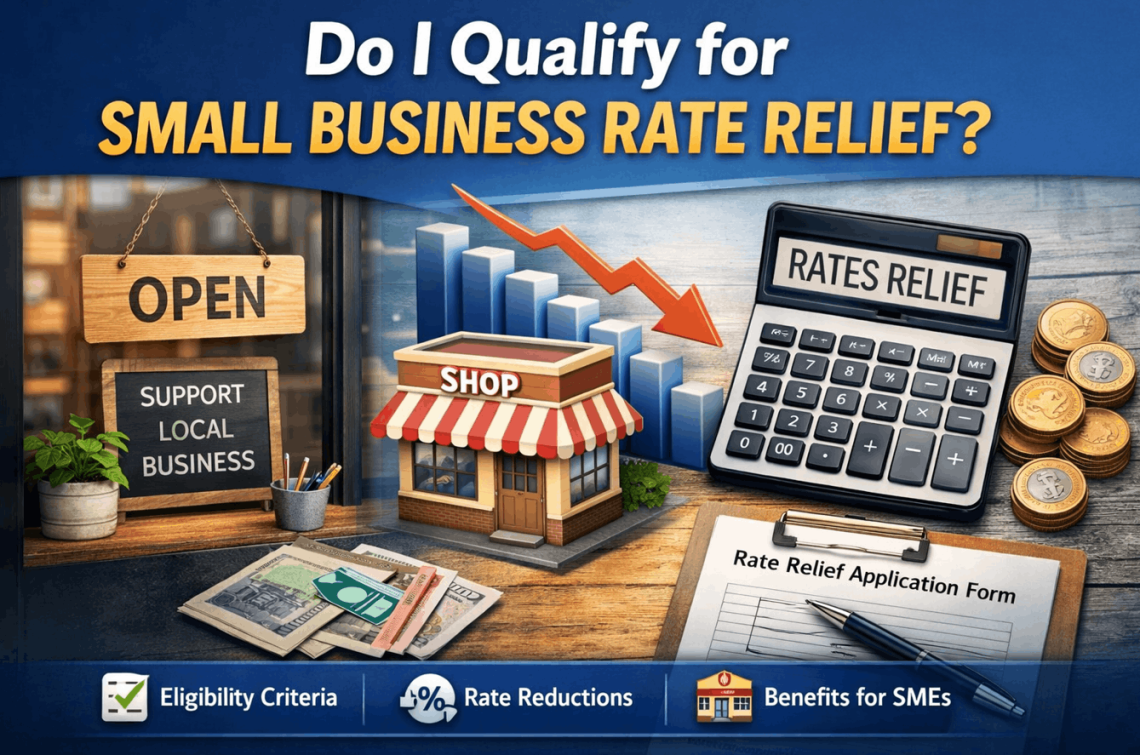
Do i qualify for small business rate relief if I occupy a business property and its rateable value is within the qualifying band, with the relief applied by the local council that issues the business rates bill.
In most cases, 100% relief is available at the lowest rateable values, then reduces on a sliding scale before ending at the upper threshold. Rules vary by nation.
Do I Qualify For Small Business Rate Relief?
Small Business Rate Relief is a reduction on your business rates bill based mainly on your property’s rateable value and how many properties your business occupies.
If you meet the criteria, the council applies either full relief or tapered relief to the bill for your main property, reducing what you pay for that financial year.
What Usually Determines Eligibility?
Rate relief decisions tend to come down to two measurable facts, plus one location detail.
- The rateable value shown for the property on the rating list.
- How many rated properties your business occupies as the ratepayer.
- Where the property is, as schemes and thresholds differ by nation.
In practice, most “yes or no” outcomes become clear once you have the rateable value and you know whether you occupy more than one property.

What rateable value qualifies for Small Business Rate Relief in England?
As of 2026, the core thresholds for the main scheme are unchanged: full relief applies at the lowest band, then tapers, then stops.
If this is the only property your business uses, the usual position is:
- 100% relief when the rateable value is £12,000 or below
- Tapered relief when the rateable value is £12,001 to £15,000
- No Small Business Rate Relief when the rateable value is £15,000 or more
England Rateable Value Bands At A Glance
| Rateable value band | Typical outcome on the bill | What it means in plain terms |
|---|---|---|
| £12,000 or less | 100% relief | You usually pay no business rates for that property |
| £12,001 to £15,000 | Tapered relief | A reducing discount as the rateable value rises |
| £15,000 and above | No SBRR | You pay business rates without this relief |
A common pattern is that people confuse rateable value with rent. Rateable value is a valuation figure for rating purposes, not your lease amount.
How do i qualify for small business rate relief if I have more than one property?
This is often where eligibility changes in ways people do not expect. The relief can still apply, but the rules tighten and the council will treat one site as the main property.
For England, after the initial 12-month period when you take on a second property, you can usually keep the relief on your main property only if both tests are met:
- None of the other properties you occupy has a rateable value above £2,899
- The total rateable value of all the properties you occupy is below £20,000 (or £28,000 in London)
If either test is not met, the relief will usually stop.
Example
A sole trader runs a small studio (rateable value £9,500) and later rents a tiny lock-up for storage (rateable value £1,200). The studio can often keep relief because the extra unit is under £2,899 and the combined total stays under the overall cap.
For sole traders, understanding the difference between personal and business finance responsibilities can also be important when managing property-related obligations. You might find it helpful to consider whether you need a business account as a sole trader, especially if you’re expanding into multiple rated premises.
How to check your rateable value quickly without guessing?
Rateable value sits on the rating list and is used to calculate the bill before any reliefs are applied.If you trade from more than one address, keeping your local business listings consistent with the property on your bill can help avoid confusion when checking occupancy details.
To confirm it, use the official rateable value check service for your nation:
- England and Wales rateable values are maintained by the Valuation Office Agency.
- Scotland valuations are handled through local Assessors coordinated by the Scottish Assessors Association.
- Northern Ireland uses a different system managed by Land & Property Services.
When reviewing bills in real cases, the rateable value on the council demand notice should match the rating list entry for that address and description.

How to claim Small Business Rate Relief and get it onto your bill?
The council acts as the billing authority and applies the relief to your account. Some apply the relief automatically when their records clearly show you qualify, while others ask for a short declaration, especially when you occupy multiple properties or your circumstances changed mid-year.
o get Small Business Rate Relief applied, confirm the rateable value on the rating list, check whether you occupy any other rated properties, then contact the council that issued the bill if the discount is missing. Councils may ask for an occupancy start date and confirmation of any other premises you occupy.
Steps To Check And Claim In The Right Order
- Find the property on the rating list and note the rateable value and description.
- Check your latest business rates bill for any relief line and the chargeable date range.
- Confirm whether you occupy any other business-rated premises, even small storage or workshops.
- If the relief is missing, contact the council business rates team and ask how they apply SBRR in your case.
- Provide any declaration they request, including business name, correspondence address, and occupation dates.
- Re-check the revised bill to confirm the relief percentage and the property it applies to.
- If your situation changes, notify the council promptly so the account stays accurate.
What changes in 2026 if your rateable value moves after revaluation?
Revaluation can shift rateable values up or down, which can move a property into or out of relief bands. As of 2026, the main qualifying thresholds for Small Business Rate Relief in England remain the same, but there is additional protection for some ratepayers who lose relief because their valuation increased.
This is often referenced as “supporting small business relief” and it can limit year-on-year bill increases for eligible properties.
Supporting Small Business Relief Caps For 2026 To 2027 In England
| Rateable value band | Cap for 2026 to 2027 | What the cap affects |
|---|---|---|
| Up to £20,000 (or £28,000 in London) | 5% | Limits the increase compared with the prior year bill |
| £20,001 to £100,000 (or £28,001 to £100,000 in London) | 15% | Limits the increase compared with the prior year bill |
| Over £100,000 | 30% | Limits the increase compared with the prior year bill |
Do you still qualify if you work from home or use part of a property?
Homeworking only links to business rates if there is a separately assessed non-domestic area or a distinct unit treated as a business property. Many people operate from home without any separate business rates liability.
Signs you might be in business rates territory include:
- A clearly separated area used only for business.
- A converted outbuilding used as a workshop with its own access.
- A studio or unit with a separate rating list entry.
- A business rates bill already being issued.
Example
A designer works from a spare bedroom with no business rates bill. They do not need SBRR because there is no non-domestic rating entry. Later, they rent a small office with its own rateable value; that office becomes the focus of eligibility.

The most common reasons people think they qualify when they do not
Confusion usually comes from mixing “small business” as a business size concept with relief rules that actually depend on property facts.
- The rateable value is above the upper threshold for the scheme.
- The business occupies a second property that breaks the £2,899 or total cap tests.
- The property is empty and the account is under different empty property rules.
- Another relief takes priority, such as mandatory charity relief.
- The council record still shows a previous occupier or incorrect occupation dates.
You can be a small company at Companies House and still not qualify, because SBRR is about the property entry and occupation, not turnover or staff headcount.
Which scheme applies where in Great Britain and Northern Ireland?
Eligibility is nation-specific. Names and thresholds differ, even though the question sounds the same.
How Schemes Compare Across Nations
| Nation | Scheme name used most often | Typical full-relief band | Key extra limit you should know |
|---|---|---|---|
| England | Small Business Rate Relief | Up to £12,000 | Multi-property rules use the £2,899 and total RV caps |
| Wales | Small Business Rates Relief | Up to £6,000 | Often limited to a small number of properties per local authority |
| Scotland | Small Business Bonus Scheme | Up to £12,000 | Combined rateable value and per-property limits can apply |
| Northern Ireland | Small Business Rate Relief | Based on Net Annual Value bands | Chain and multiple-premises restrictions can apply |
If you’re right on a boundary, the safest confirmation comes from the bill issuer, because they apply the scheme to your account based on local administration rules.
A Quick Self Check
For a quick, reliable answer, work through the checks below in order:
- Confirm the property is occupied and you are the ratepayer on the council account.
- Check the rateable value.
- Confirm whether you occupy any other business-rated premises.
- Check whether any other relief is already being applied.
- Make sure the bill’s dates match your occupation dates for the current financial year.
Checks To Confirm Do I Qualify For Small Business Rate Relief
If your rateable value is under the relevant upper threshold, your business occupies one main property, and any additional properties remain within the permitted limits, you are typically within scope for SBRR. If any one of those facts is wrong, the relief often drops to zero even if everything else looks “small”.
Short Scenarios That Reflect Typical Bills
These examples are anonymised, but they mirror common billing outcomes.
Scenario One
A hairdresser occupies a single salon rated at £11,800. The bill shows full relief and only small charges like BID levy appear. This is a straightforward “yes”.
Scenario Two
A café rated at £13,900 gets tapered relief. The owner expected zero rates, but the taper reduces relief as the valuation rises. This is a “yes, but not 100%”.
Scenario Three
A tradesperson has a workshop rated at £9,000 and later leases a yard rated at £4,200. The second property breaks the £2,899 test, so relief can fall away. This is often the moment people discover the multi-property rule.
What You Need To Do In Practice?
Most readers asking do i qualify for small business rate relief really need three documents aligned:
- The rating list entry.
- The council demand notice.
- Your occupation facts and any additional premises.
If those three match, the relief decision is usually predictable. If they do not, the fastest fix is correcting the council record.
In plain terms, do i qualify for small business rate relief comes down to your rateable value, whether you occupy the property, and how many rated properties you occupy as the ratepayer.
Put simply, do i qualify for small business rate relief is only a clear “yes” when the scheme rules for your nation match what is shown on the bill.
What People Talk About This Online
Business rates increase, rateable value changes
byu/Undecided_Germ insmallbusinessuk
Final Summary
Start with the rateable value on the rating list, then confirm how many business-rated properties you occupy as the ratepayer. If the number fits the scheme band and your occupation details are correct, the council can apply the relief to the main property bill.
If your bill does not show the discount, contact the council business rates team, provide any requested declaration, and review the revised demand notice to confirm the relief percentage and dates.
FAQs
What is Small Business Rate Relief?
Small Business Rate Relief is a discount applied to business rates for eligible properties, usually based on rateable value and whether the ratepayer occupies one main property. It can reduce the bill to zero at the lowest band or reduce it on a sliding scale before ending at the upper threshold.
Is Small Business Rate Relief automatic?
Sometimes it is, but not always. Some councils apply it automatically when their records clearly show you qualify. Others ask for a short declaration, especially if you have moved in recently, changed business details, or occupy more than one property. Check your bill for the relief line.
What rateable value qualifies for Small Business Rate Relief?
In England, full relief usually applies up to £12,000 rateable value, then tapers until £15,000, where it ends. Other nations have different thresholds and scheme names. The rateable value is shown on the rating list and on your business rates bill.
Can I get Small Business Rate Relief if I have two properties?
You may, but only in limited circumstances. In England, you can often keep relief on your main property for 12 months after taking on a second property. After that, the other properties must stay below the small-property limit and the combined total must be under the overall cap.
Can the relief be backdated if it was missed?
Councils can correct accounts when eligibility existed but wasn’t applied, but the rules and evidence requirements vary. If you believe you qualified for part of the year, ask the council business rates team to review the account history and confirm what documentation they need to reassess liability and relief.
Does working from home qualify me for Small Business Rate Relief?
Only if there is a separately assessed business-rated area or unit with its own entry and bill. Many home-based businesses have no business rates liability at all. If you receive a business rates bill for a home office or outbuilding, eligibility then depends on the rateable value and scheme rules.
Can landlords claim Small Business Rate Relief?
Usually the ratepayer in occupation claims relief, not a landlord who is not liable for the occupied property. Liability can be complex where units are vacant, short-let, or under service arrangements. The council can confirm who is liable on the account before any relief is considered.
What is the difference between SBRR and the small business multiplier?
The small business multiplier is a lower business rates multiplier that can apply to many properties below a wider rateable value threshold, even if you do not qualify for SBRR. SBRR is an additional relief that can reduce the bill further, sometimes to zero, when the property and occupation meet stricter criteria.
What if my rateable value looks wrong?
If the description, area, or use seems inaccurate, you can query the valuation through the relevant valuation body for your nation. Start by checking the rating list entry matches the property you occupy. If the valuation changes, your council bill may be recalculated, which can also affect relief eligibility.
Author Note
Written from hands-on experience reviewing business rates bills, council account corrections, and common eligibility disputes with occupiers. The focus here is practical checks, official terminology, and typical outcomes to help you verify your position quickly. This is general information, not legal advice; your council can confirm your account status.