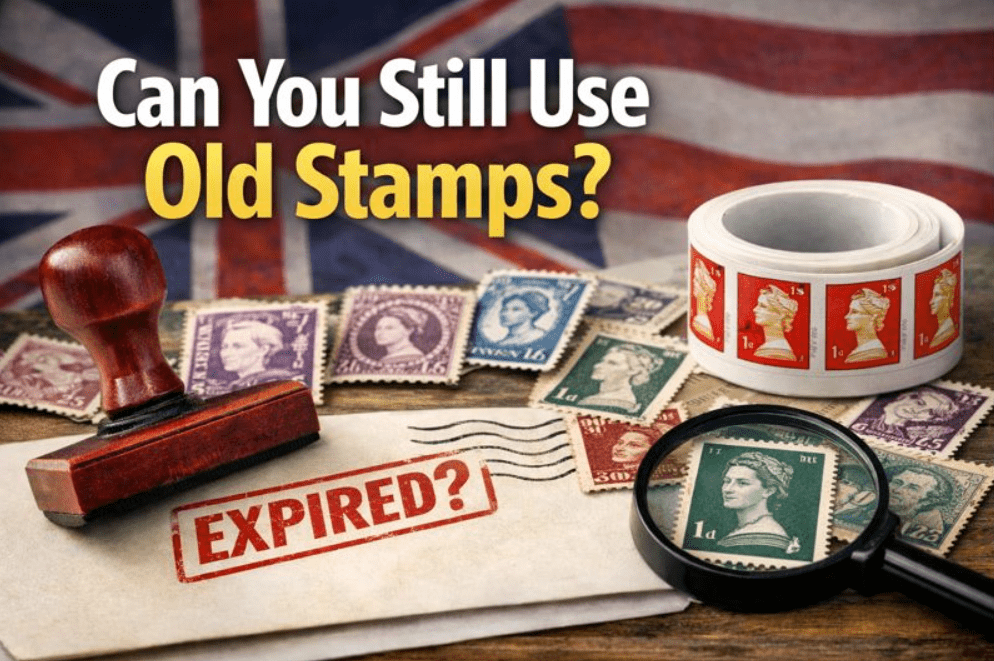
If you’re wondering can you still use old stamps in the UK, here’s the straight answer: Yes, you can still use many old stamps, but it depends on the type.
In general, non-barcoded “everyday/definitive” stamps are no longer valid for postage, while barcoded stamps are valid, and special/commemorative picture stamps and (certain) Christmas stamps without barcodes remain valid.
If you’ve got old non-barcoded definitives, you can swap them for barcoded versions using Royal Mail’s Stamp Swap Out scheme. Below, you’ll see how to check what you’ve got in seconds, and what to do next so your post isn’t delayed or charged.
Can you still use old stamps in the UK? (2026 practical guide)
The quick rule that prevents most “Fee to Pay” surprises: sort your stamps into these buckets:
- Barcoded definitive stamps (including older designs) → valid to use
- Non-barcoded definitive (everyday) stamps → don’t use; swap them out
- Special/commemorative picture stamps → valid to use
- Christmas stamps (older non-barcoded) → generally remain valid to use
- Post Office self-service kiosk postage labels → valid to use (even if they look different from standard stamps)
That’s the gist. Next, we’ll run through how to recognise each type, what happens if you use the wrong stamp, and how to swap where needed.
What counts as an old stamp in Royal Mail terms?
When people say old stamps, they usually mean one of these:
1) Definitive everyday stamps
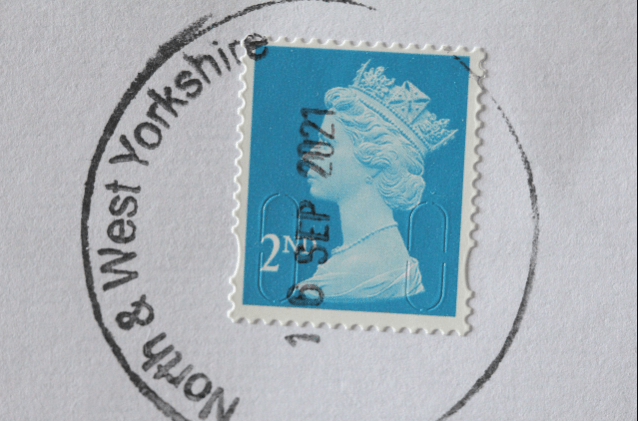
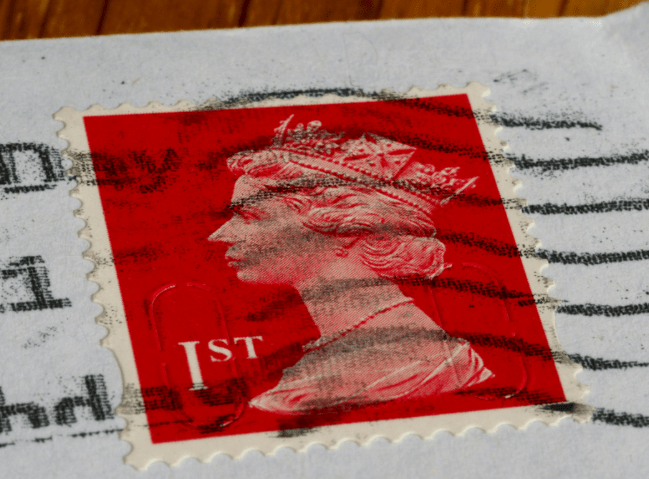
These are the standard stamps most people buy in books. Traditionally, they show the monarch’s head on a plain coloured background (or a simple regional emblem). These are the main stamps affected by the barcode change.
2) Special/commemorative stamps (picture stamps)
These are stamps issued for themes, anniversaries, cultural moments, charities, people, landmarks, and events. They’re usually colourful and illustration-heavy.
3) Christmas stamps
Seasonal Christmas designs that many people have left over from cards. People often worry that these have become invalid; most haven’t.
4) Post Office counter/kiosk printed postage
Not stamps in the traditional sense, more like printed labels showing postage paid. These can still be valid even though they don’t look like barcoded definitives.

Why did Royal Mail add barcodes to stamps?
Barcodes were introduced to modernise the system and strengthen security features. In practical terms, the barcode change is meant to make stamps harder to counterfeit and easier to verify, while also enabling newer services over time.
This matters for you because the barcode is now the easiest visual clue for whether an “everyday” stamp is valid.
Can you still use old stamps if they don’t have a barcode?
If your stamp is a non-barcoded definitive (the common everyday type), the safe answer is no.
Royal Mail introduced barcoded definitives and set an initial switch-over date of 31 January 2023, followed by a six-month grace period. After that, mail sent with non-barcoded definitives can be treated like insufficient postage and may trigger a surcharge.
Here’s what you should do instead:
- Use the Stamp Swap Out scheme to exchange non-barcoded definitives for barcoded equivalents.
The bit many people don’t realise is that you don’t need to throw them away, and you don’t usually lose out just because prices have gone up since you bought them.
Can you still use old stamps if they’re commemorative or Christmas issues?
In many cases, yes.
- Special/commemorative picture stamps generally remain valid and do not need swapping.
- Christmas stamps (including older non-barcoded Christmas designs) are generally treated differently from everyday definitives and commonly remain valid.
This is why it’s important not to follow the oversimplified internet rule of no barcode = invalid. For everyday definitives, it’s often true. For specials and Christmas stamps, it often isn’t.
How to tell what type of stamp you have (fast checks you can do at home)
You don’t need a magnifier or a collector’s guide. Use these quick checks:
Check 1: Is there a barcode?
If yes, it’s straightforward: it’s designed to be valid under the barcoded system.
Check 2: Is it a plain everyday design?
If it’s mostly a plain background with the monarch’s head and no barcode, treat it as a non-barcoded definitive and swap it out.
Check 3: Is it clearly a picture/commemorative stamp?
If it’s a themed illustration (people, events, art, charities, landmarks), it’s typically a special stamp and generally remains valid.
Check 4: Is it a Christmas stamp?
Christmas designs are commonly still valid (even when older and non-barcoded). If you have a mix of Christmas + everyday definitives in a drawer, don’t assume they share the same rules.
Check 5: Is it a printed label from a Post Office kiosk/counter?
Those are different from traditional stamps and are normally valid postage, even though they may not have the same barcode style as definitive stamps.
If you want the simplest rule: treat plain, non-barcoded everyday stamps as swap-only, and treat barcoded stamps plus picture and Christmas stamps as fine to use.
Which old stamps are still valid?
| Stamp type | Typical look | Barcode required? | Can you use it now? | What to do if not |
| Definitive everyday barcoded | Monarch head + barcode | Yes | Yes | Use normally |
| Definitive everyday non-barcoded | Monarch head, plain background, no barcode | Yes | No | Swap using Stamp Swap Out |
| Special/commemorative picture stamps | Illustrations/themes | No | Yes | Use normally |
| Christmas stamps (older non-barcoded) | Christmas-themed designs | No | Usually yes | Use normally |
| Post Office kiosk/counter labels | Printed postage label | N/A | Yes | Use normally |
Can you still use old stamps featuring QEII? What about the 1st and 2nd stamps from years ago?
These two points cause lots of confusion:
QEII vs KCIII designs
A stamp showing Queen Elizabeth II isn’t automatically old/invalid. What matters is whether it’s a valid type under the barcode rules. A QEII stamp with a barcode can still be valid.
1st/2nd class NVI stamps (No Value Indicated)
If your stamp says 1st or 2nd (rather than a money value), it’s designed to represent that service rather than a fixed price. That said, it must still be a valid stamp type.
If it’s a non-barcoded definitive NVI stamp, you typically swap it. If it’s valid (barcoded or an exempt category), you can use it for the service it represents.
Practical example: You bought a book of 1st class stamps years ago. If they’re non-barcoded everyday definitives, swap them out, and you can still post 1st class without paying the difference later.
Can you combine old stamps to make up today’s postage?
Yes, combining multiple stamps is allowed, as long as:
- The stamps you’re using are valid types, and
- The total postage covers the service, format, plus weight.
This is where many people get caught out: they focus on stamp validity but forget that format and size change the price band.
Size/weight bands that matter (so you don’t underpay)
Rates change over time, so instead of listing prices, use the bands to pick the right category first:
| Format | Max weight | Max size (L × W × D) | Typical examples |
| Letter | 100g | 24cm × 16.5cm × 0.5cm | Cards, short letters |
| Large Letter | 750g | 35.3cm × 25cm × 2.5cm | Documents, magazines |
| Small Parcel | 2kg | 45cm × 35cm × 16cm | Small boxes, bulky items |
| Medium Parcel | 20kg | 61cm × 46cm × 46cm | Larger boxes |
Quick sanity check: if your item is thicker than 0.5cm, it’s no longer a Letter. If it’s thicker than 2.5cm, it’s no longer a Large Letter. Thickness is the silent budget killer.
What happens if you use an invalid stamp or not enough postage?
Usually, Royal Mail attempts delivery, and the recipient may receive a Fee to Pay card. Fees vary by item type and the reason (insufficient postage vs invalid stamp vs no postage). It can also cause delays, and sometimes items get returned if unpaid.
In practical terms:
- Your letter might still arrive, but your recipient may have to pay to receive it.
- Your parcel might be held until the fee is paid.
- You might not find out until someone messages you with Why am I being asked to pay for this?
If you’re posting something important (legal documents, time-sensitive paperwork, valuables), it’s often safer to use a tracked service or pay at the counter so the label is correct for the format and weight.
What to do with non-barcoded definitive stamps you still have (Stamp Swap Out)
If you’ve discovered a pile of everyday non-barcoded definitives, don’t panic. You can typically exchange them for barcoded versions using Stamp Swap Out, and the scheme has been presented as open-ended (no final end date is usually emphasised to the public).
How to swap old stamps (simple step-by-step)
- Get the Stamp Swap Out form
- If you can print, download and print the form.
- If you can’t print, you can request a form to be sent to you.
- Fill in the form and prepare your stamps
- Count and group them so you’re confident in what you’re sending.
- Keep a quick photo for your own record (especially if sending a larger value).
- Post the form and stamps to the Swap Out address
- Use the official Freepost Swap Out address for standard swaps.
- For large values, consider using a secure/trackable posting option for peace of mind.
- Receive barcoded replacements back
- The idea is to replace your non-barcoded definitives with valid barcoded equivalents.
What to do now: if you’ve only got a few left, you may decide to deal with them later. If you’ve got whole books, swapping sooner reduces the chance of using an invalid definitive in a hurry.
Can you still use old stamps for parcels and international post?
Yes, if the stamps are valid types and the total covers the service.
This is especially helpful if you have:
- Special/commemorative stamps you want to use up,
- Make-up value stamps (like 10p/20p/50p/£1 values), or
- A mix of valid stamps that together add up to the correct amount.
For international mail, the format plus weight rules still apply (letters vs large letters vs parcels), and services differ by destination and speed. If you’re unsure, buying postage online or at the counter reduces risk.
Two easy mistakes that trigger fees (and how to avoid them)
- Mistake #1: Assuming every stamp must be barcoded.
Many picture commemoratives and older Christmas stamps remain usable, so you don’t need to swap everything.
- Mistake #2: Measuring like it’s a letter when it’s actually a large letter or parcel.
A slightly bulky envelope can jump into a higher category and trigger a fee even when the stamp type is valid.
If you adopt one habit, make it this: weigh and measure first, choose the service, then apply the postage.
How people talk about old stamps
Are these stamps still valid in the uk?
byu/LuxLaser inAskUK
Final summary
So, can you still use old stamps in the UK?
- Yes, if they’re barcoded, or if they’re special/commemorative picture stamps, and in many cases, older Christmas stamps.
- No, if they’re non-barcoded everyday/definitive stamps, swap those out instead.
- If you’re ever unsure, the safest path is: use barcoded stamps or pay for a label at the counter/online, especially for large letters and parcels.
And once more for clarity: Can you still use old stamps? Yes, sometimes. The stamp type decides.
FAQ
Can you still use old stamps in the UK?
Yes, you can still use some old stamps, but it depends on the type. Barcoded stamps are valid, and many commemorative picture stamps and Christmas stamps can still be valid. Non-barcoded everyday/definitive stamps usually aren’t valid for postage now, so they’re best swapped.
Which old stamps are no longer valid?
Most non-barcoded definitive everyday stamps, the common plain-background stamps, are no longer valid for postage. If you have these, the practical fix is to use the Stamp Swap Out scheme rather than risk a surcharge.
Are all non-barcoded stamps invalid?
No. A lot of people assume no barcode = invalid, but that’s not always true. The main group affected is non-barcoded definitive stamps; commemorative picture stamps and many Christmas stamps are treated differently.
Are commemorative (picture) stamps still valid in the UK?
In most cases, yes. Special/commemorative picture stamps are generally still valid and don’t need barcodes. If you’re unsure, compare the design: themed images usually indicate a commemorative issue.
Are Christmas stamps still valid without a barcode?
Often, yes. Christmas stamps are commonly exempt from the swap requirement that applies to everyday definitives. If you’re posting something important, it’s still smart to double-check current guidance before sending.
Can I use old 1st and 2nd-class stamps from years ago?
Yes, as long as the stamp type is still valid. 1st and 2nd stamps (NVI) still represent that service, but non-barcoded definitive NVIs should generally be swapped first.
Can I still use QEII (Queen Elizabeth II) stamps?
Yes. A QEII stamp isn’t automatically invalid; what matters is whether it’s a valid stamp type under current rules (for example, a barcoded definitive, or a commemorative issue).
Can I combine old stamps to make up today’s postage?
Yes. You can use multiple valid stamps together to reach the right postage for the service you want. The key is to make sure your total covers the correct format and weight (letter vs large letter vs parcel).
Can I use old stamps on parcels as well as letters?
Yes, provided the stamps are valid, and the total postage covers the parcel’s size and weight band. Parcels are where underpayment happens most often, so weighing and measuring first is the safest approach.
What happens if I use an invalid old stamp by mistake?
Your item may be delayed, and the recipient could receive a Fee to Pay notice. In some cases, it may be returned if the fee isn’t paid. If you’re unsure about a stamp, swapping or buying postage at the counter/online reduces risk.
How do I tell if my stamp is definitive or commemorative?
A simple clue: definitive stamps usually look plain and standard, while commemoratives are themed, colourful, and illustration-based. When in doubt, treat plain non-barcoded stamps as swap-only and use clearly themed commemoratives as normal.
How do I swap old non-barcoded stamps for new ones?
Use the Stamp Swap Out process: complete the official form, send your stamps as instructed, and you’ll receive barcoded replacements. If you’re swapping a larger value, consider using a tracked/secure posting method for peace of mind.
Is there a deadline for swapping old stamps?
The swap scheme has been presented as ongoing, but policies can change. If you have books of non-barcoded definitives, swapping sooner helps avoid accidentally using them later.
Where should I buy stamps to avoid counterfeits?
The safest options are Royal Mail, the Post Office, and reputable retailers. Be cautious of unusually cheap bulk stamps from marketplaces; if the price looks too good to be true, it often is.
Author expertise note
I’ve written this guide using Royal Mail’s published public guidance and widely repeated customer support outcomes to help UK senders avoid Fee to Pay surprises. I’m not affiliated with Royal Mail, and this article is for general information only, not legal advice. Postal products, fees, and policies can change, so if you’re sending something urgent, valuable, or time-sensitive, double-check the latest rules directly with Royal Mail or at your local Post Office before posting.