
The TCS London Marathon 2026 takes place on Sunday, 26 April 2026 in London, starting in the Greenwich/Blackheath area and finishing on The Mall.
This is a deep, practical guide, so by the time you finish reading, you’ll know exactly how entry works and what’s still realistic in January 2026, what the course feels like, how to train intelligently, what to sort for race week, and how to spectate without getting trapped in the biggest crowds.
London Marathon 2026
Here are the details most people want first, key details at a glance:
Core event facts
- Date: Sunday 26 April 2026
- Start area: Greenwich/Blackheath
- Finish: The Mall
- Cut-off: 8 hours (if you’re behind the required pace later on, you may be asked to continue on the pavement for safety)
- Course profile: Fast/flat by marathon standards (around 246 feet of elevation gain overall)
What to do right now?
- If you don’t have a place yet, your most realistic routes are charity places or official international tour operators.
- If you do have a place, your highest-impact actions are: commit to a training rhythm, practice fuelling, and plan logistics for the start plus pack collection.
Entry route determines your timeline, costs, and training plan. Start here

How to enter the London Marathon 2026 what’s closed what’s still possible?
The London Marathon has multiple official entry routes. The confusing part is that some routes happen very early (ballot), some are allocated through organisations (clubs/charities), and some are package-based (tour operators). In January 2026, the best route depends on what you’ve already done.
Ballot (public entry), mostly for planning future years
For the 2026 race, the public ballot window opened in late April 2025 and closed in early May 2025, with results emailed in June 2025. In practical terms, the 2026 ballot is already done if you’re reading this in 2026.
Ballot fees (when you’re offered a place) are typically:
- UK runners: £79.99
- International runners: £225
There’s also a donation option that some runners choose because it can support the event’s charity foundation and give you another chance via a second draw mechanism. If your goal is to run in London in future years, it’s worth understanding this system so you don’t leave extra chances on the table.
Charity places – the most realistic late option
If you missed the ballot or weren’t successful, charity places are the most common way runners get into the race later on. Charities receive allocations and offer spots to runners who commit to fundraising.
What you should know:
- Charity places can still be available after ballot results, but they become more competitive as race day approaches.
- Fundraising minimums vary by charity and often depend on demand and how late you apply.
- Many charities look for evidence that you can realistically raise the funds, especially if you apply late.
Next Step: Apply to a shortlist of charities you genuinely care about, and include a simple fundraising plan (workplace match, events, social reach, local community support). The more concrete your plan, the easier you make the charity’s decision.
Good For Age – fast times, capped allocation
Good For Age (GFA) is designed for UK residents who run under specific age-graded qualifying times in a certified marathon during the qualifying window. The important nuance: meeting the time does not guarantee a place, because GFA allocations are capped and can be awarded fastest first depending on volume.
UK club entry – great pathway, but often time-sensitive
UK affiliated athletics clubs can receive guaranteed entries based on membership numbers and allocation rules. This is excellent for long-term planning because clubs can provide both a pathway into the race and a training community.
But club entry is usually not something you can start in late winter and expect to use for the same April race; deadlines are commonly earlier.
Official international tour operators – guaranteed entry via package
If you’re outside the UK (or you want a bundled solution), official tour operators can sell packages that include guaranteed entry plus travel/hotel components. This is typically the most straightforward option when you want certainty, and you can budget for it.
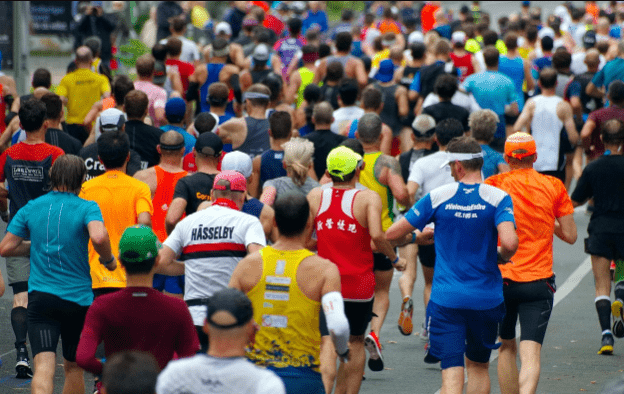
London Marathon 2026 ballot: what second ballot means and why it matter for 2027 planning?
Even though the 2026 ballot has already happened, this section is still useful because it explains the mechanism you’ll likely use for the next attempt.
The ballot process generally works like this:
- You apply during the ballot window.
- If you’re successful, you get a confirmation email and must pay/confirm by a deadline.
- If you opt into a donation-style entry, you may receive a secondary draw opportunity (often described as a second ballot).
Why this matters:
- London’s demand is enormous; over a million people have applied in recent years. So you should treat the ballot like a lottery ticket, not a plan.
- Your best London strategy is usually a two-track plan: ballot plus (charity OR club OR GFA OR tour operator).
London Marathon 2026 timeline you should understand
| Item | Timing | Why it matters |
|---|---|---|
| Ballot window (for 2026 race) | Late April to early May 2025 | Short window; set reminders for future years |
| Ballot results (for 2026 race) | June 2025 | Check spam/junk; results can arrive before you expect |
| Confirmation/payment deadline | Early-to-mid July 2025 | Missing it can mean losing your place |
| The Running Show (pack collection) | Wed 22–Sat 25 April 2026 | No pack collection on race day |
| Race day | Sun 26 April 2026 | Start Greenwich/Blackheath; finish The Mall |
Charity places for London Marathon 2026: what charities look for and how to get accepted?
Charity places aren’t just “pay a registration fee, and you’re in.” Charities have limited allocations and want runners who can actually deliver the fundraising that funds services.
What charities commonly evaluate:
- Why your cause connection is genuine (even a short paragraph helps)
- Your fundraising plan (specific beats vague)
- Your timeline (how quickly you can get early donations)
- Your reliability (some will ask about running experience or training plan)
A strong, realistic fundraising plan includes:
- A target split (e.g., “£1,000 from workplace match + £500 from an event + £1,500 from friends/family/community”)
- A calendar (what happens each month between now and April)
- A “first 2 weeks” plan (you’ll be surprised how much charities value early momentum)
A practical approach is to write a simple one-page plan and reuse it for applications. It saves time and raises your acceptance odds.

London Marathon 2026 entry routes at a glance
Which routes are realistic right now?
| Route | Best for | January 2026 reality |
|---|---|---|
| Public ballot | Anyone | Closed/drawn for 2026 |
| Charity place | UK & international | Most realistic now |
| Good For Age | UK residents with qualifying times | Time-sensitive; capped allocation |
| UK club entry | UK club members | Often allocated earlier; best for next-year planning |
| Official tour operator | Primarily international | Realistic now if the budget allows |
London Marathon 2026 Good For Age: qualifying times
Below are the commonly referenced standards for the 2026 cycle. Treat these as the benchmark you’d aim for when planning a future qualification attempt.
Good For Age qualifying times
| Age | Women | Men |
|---|---|---|
| 18–39 | sub 3:38 | sub 2:52 |
| 40–44 | sub 3:43 | sub 2:57 |
| 45–49 | sub 3:46 | sub 3:02 |
| 50–54 | sub 3:53 | sub 3:07 |
| 55–59 | sub 3:58 | sub 3:12 |
| 60–64 | sub 4:23 | sub 3:34 |
| 65–69 | sub 4:53 | sub 3:52 |
| 70–74 | sub 5:53 | sub 4:52 |
| 75–79 | sub 6:13 | sub 5:07 |
| 80–84 | sub 6:38 | sub 5:27 |
| 85–89 | sub 7:10 | sub 6:10 |
| 90+ | sub 7:45 | sub 7:20 |
Where does the London Marathon start and finish and what does the day feel like?
Start area: Greenwich/Blackheath
This is not one single start line feeling like a small race; it’s a huge, controlled funnel of thousands of runners. Your experience depends heavily on your wave/start time.
Expect:
- Early alarm
- Busy trains and queues
- Time spent waiting in start pens
- Adrenaline spikes
Finish area: The Mall
The finish is iconic and very crowded. If you’re meeting supporters, decide on a plan in advance because the mobile signal can be unreliable in dense areas.
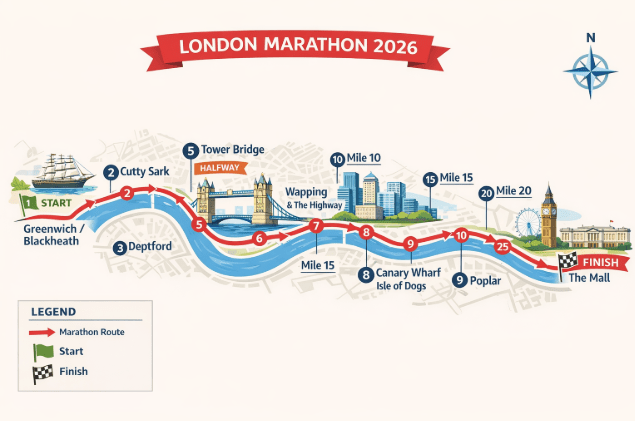
London Marathon 2026 course overview
The London course is famous for being fast and well-supported, but it has a trap: people go out too hard because the first half feels easy and the atmosphere is electric.
What the course tends to feel like:
- Early miles: crowded; rhythm can be tricky; don’t waste energy weaving
- Mid-race: you’ll settle into pace; this is where discipline pays off
- Later miles: fatigue and long straight sections can feel mentally tough
A simple pacing approach that works for most runners:
- First 5 miles: slightly easier than goal effort
- Miles 6–20: steady, controlled
- Miles 21–26.2: manage effort, focus on fuelling and form
Fuelling and hydration, what’s on course and what you should practice anyway?
Even if the course provides drinks and gels, you should treat race fuelling like a skill you train, not something you wing.
Most runners do best when they:
- Take carbs early and consistently rather than when they feel tired
- Practise with the same gel brand/flavour they’ll use on race day
- Practise drinking while moving (or grabbing cups smoothly)
A practical fuelling rule-of-thumb that works for many runners:
- Start carbs within the first 30–45 minutes
- Then keep it consistent (for many runners, every 25–35 minutes)
If you’ve never fuelled during long runs, this is the single most powerful upgrade you can make for your marathon outcome.
A London Marathon 2026 training plan approach that actually works without turning your life upside down
Rather than dumping a generic 20-week schedule, this section gives you a structure you can apply whether you’re a beginner, intermediate, or returning after time off. The goal is to arrive healthy and confident, not overtrained.
The simplest weekly structure (repeatable and effective)
- 2–3 easy runs at conversational pace
- 1 quality session (tempo OR intervals)
- 1 long run building gradually
- 2 short strength sessions (20–30 minutes)
This structure scales up or down based on your current fitness.
How long should you train for an April marathon?
- If you already run 3–4 times/week, a 16-week build is often enough
- If you’re newer: allow 20+ weeks or add a base-building phase now
Long runs: what matters most
- Build gradually (avoid big jumps)
- Include cutback weeks (every 3–4 weeks, reduce volume slightly)
- Practice race fuelling from early on
- Keep most long runs easy; save fast long runs for later if you’re experienced and resilient
Strength: the injury insurance policy
The most common marathon build issues, calf/Achilles flare-ups, IT band irritation, and plantar pain often come from sudden increases in intensity or mileage. Strength work helps you absorb training and stay consistent.
If you only do a handful of exercises, prioritise:
- Calf raises (straight and bent knee)
- Glute bridges/hip hinges
- Single-leg balance + step-downs
- Core stability (anti-rotation)
Pick a weekly rhythm you can actually sustain, then protect it with sleep and recovery. Consistency beats hero workouts every time.

London Marathon 2026 race-weekend logistics – pack collection, transport, and the stuff people forget
Pack collection (The Running Show at ExCeL London)
This is mandatory planning. You typically collect your bib and participant pack at ExCeL in the days leading up to the race. There is generally no race-day pack collection, so you must plan travel accordingly.
Transport to the start
Make a Plan A and Plan B from your accommodation to the start area. London transport on marathon morning is busy, and you do not want to rely on we’ll figure it out at 6 AM.
Bag drop and clothing
Most runners bring:
- An old layer to stay warm at the start (you can discard it)
- A clear bag plan (what goes in, what stays with you)
- A post-finish layer if it’s chilly
Pacers
There are usually pace groups spanning a wide range of finish times. If you’re using one:
- Decide in advance whether you’ll stick with it from the early miles
- Don’t surge to catch up if you fall behind, settle and rejoin naturally if possible
Race-day checklist
- Check your start time and wave details in advance
- Eat a familiar breakfast (race morning is not for experiments)
- Bring the gels you’ve trained with
- Bring safety pins (even if you think you won’t need them)
- Bring a small anti-chafe option
- Plan your meetup point after the finish
- Charge your phone and consider a small power bank
Keep it simple; overpacking usually adds stress.
Where to watch and how to meet your runner without chaos?
If you’re spectating, your job is logistics plus vibes. The mistake most supporters make is choosing the busiest spot and then getting stuck in crowds, missing the runner, or spending half the day queuing.
Good spectator strategy
- Choose a spot where your runner will be easy to spot (wider roads help)
- Prefer areas that are slightly quieter than the iconic “pinch points”
- Decide a meetup location that’s not directly on the finish line crowd crush
How to see your runner more than once?
Some stretches allow you to see runners on an out-and-back style section. If seeing them twice is a priority, pick one of those zones rather than chasing between far-apart landmarks.
Meetup plan (do this before race day)
- Plan A: Agreed meetup letter/zone
- Plan B: A landmark 10–15 minutes’ walk away, where it’s calmer and the phone signal is better
How people talk about the London Marathon 2026 online?
Final summary
London Marathon 2026 is on Sunday, 26 April 2026. If you’re still trying to get in right now, focus on charity places or an official tour operator package. If you already have your entry secured, focus on training consistency, fuel practice, and race-weekend logistics (especially pack collection and start transport).
FAQ
When is the London Marathon 2026?
London Marathon 2026 will take place on Sunday, 26 April 2026.
Is the London Marathon 2026 ballot still open?
No, ballot applications and results happened earlier in the cycle. Your realistic late options are charity or tour operator routes.
How much does it cost to run the London Marathon 2026?
Ballot fees are typically £79.99 (UK) and £225 (international) if you’re offered a ballot place.
Do I need to go to ExCeL before race day?
Yes, pack collection is normally done at the event expo (The Running Show) before race day, not on race morning.
What’s the cut-off time?
8 hours (with safety procedures if you’re behind pace late in the race).
Author expertise note
Written to be practical and decision-focused, this piece draws on official London Marathon rules/logistics and proven marathon training fundamentals. It avoids guesswork by focusing on what runners most often need: entry options, race-week planning, pacing, fuelling, and injury reduction. Always verify last-minute updates via official race communications.