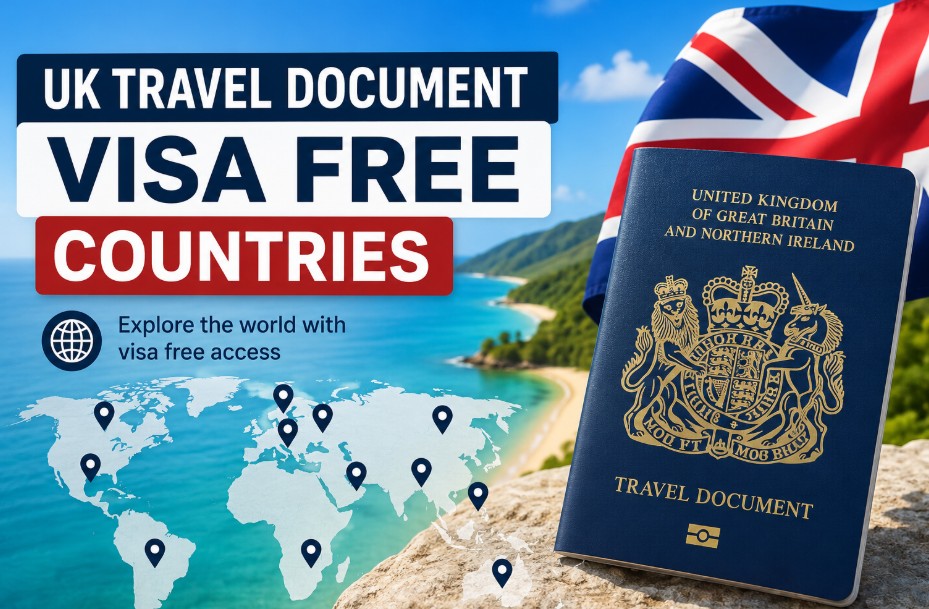
UK travel document visa free countries do not exist on a single, universal list. Instead, entry privileges depend strictly on whether you hold a 1951 Convention Document, a Stateless Person Document, or a Certificate of Travel, with each sovereign destination enforcing its own independent visa requirements for non-citizens.
What is a UK Travel Document?
A UK travel document is an administrative travel paper issued by the Home Office (UK Visas and Immigration) to individuals residing in the UK who are not British citizens and cannot obtain a national passport from their country of origin.
These booklets function as a primary identity document for international travel and serve as a safe alternative to a national passport. They come in three primary variations based on an individual’s legal status:
| Document Type | Primary Purpose | Common Colour |
| 1951 Convention Travel Document | Formally recognized refugees (and family reunion visa holders) | Blue / Geneva Passport |
| Stateless Person Document | Formally recognized stateless persons under the 1954 Convention | Red |
| Certificate of Travel | Individuals with Humanitarian Protection or Discretionary Leave | Black |
Crucial Difference: A standard British Citizen passport leverages the UK’s global diplomatic standing for vast visa-free access. A UK travel document is simply a facility to allow travel; its acceptance and visa requirements are entirely up to the individual border policies of each destination country.
Travel Document Restrictions
UK-issued travel documents, including the 1951 Convention Refugee Travel Document, the Stateless Person Document, and the Certificate of Travel, are administrative travel papers rather than passports.
While some nations may offer visa exemptions for specific document holders, many countries require a formal visa, meaning you should always confirm your status before booking.
What are the UK Travel Document Visa-Free Countries?
There is no universal, single list of visa-free countries for UK travel document holders, as sovereign nations establish their own entry policies.
Visa-free travel privileges apply almost exclusively to holders of the 1951 UN Convention Refugee Travel Document (Blue Booklet), as recognized under UNHCR international frameworks
If you hold a Stateless Person Document (Red) or a Certificate of Travel (Black), you are required to apply for a visa for almost all destinations globally.
Furthermore, visa-free entry does not mean unconditional access. For European destinations, travel is governed strictly by the Schengen Border Code 90/180-day rule, which stipulates that an individual’s cumulative stay across the entire Schengen zone cannot exceed 90 days within any rolling 180-day window.

Categorized Country Access List (For 1951 Blue Convention Documents Only)
The definitive 2026 country access list for UK 1951 Convention Document (Blue) holders permits visa-free entry to the majority of European Schengen members like France, Germany, and Italy, while enforcing full visa protocols for destinations like Denmark, the US, and Canada.
| Category | Visa Status | Allowed Countries | Key Conditions & Exceptions |
| Schengen Area (Europe) | Visa-Free (Short stays) | Germany, France, Belgium, Spain, Portugal, Austria, Switzerland, Netherlands, Sweden, Finland, Norway, Iceland, Luxembourg, Greece, Hungary, Czech Republic, Slovakia, Slovenia, Estonia, Latvia, Lithuania, Poland, Malta | Max 90 days in 180 days. Document validity must extend 3–4 months past entry. Note: Italy and Denmark require full visas. |
| Non-Schengen Europe | Visa-Free (Short stays) | Ireland, Croatia, Bosnia and Herzegovina, Montenegro, Albania, Kosovo, Georgia | Governed by regional bilateral agreements. Because standard rules change here, check if you need a passport to go to Ireland under the Common Travel Area framework before organizing alternative entry permits. |
| Outside Europe (Asia, Africa, Americas) | Visa-Free (Highly limited) | Singapore, Philippines, Tunisia, Panama, Dominican Republic, Ecuador | Frequently requires proof of a return flight, pre-arranged hotel booking, and specific remaining document validity. |
| Major Restrictions | Strictly Visa Required | United States, Canada, Australia, Japan, United Arab Emirates, Qatar | Completely excluded from automated electronic waivers (like ESTA or eTA). A formal visa and embassy interview are mandatory. |
Important Travel Tips for UK Travel Document Holders
Critical transit rules for UK travel document holders dictate linking physical booklets to online UKVI eVisa accounts, securing physical BRP cards, preparing for manual airline verification delays, printing embassy confirmation emails, and arranging mandatory airside transit visas.
- Switch to Digital eVisa Verification: The UK has heavily transitioned to digital immigration. Ensure your Home Office travel document is completely linked to your online UKVI account. Before you fly, carriers must check your digital status via a generated share code to guarantee you have the right to re-enter the UK.
- Keep Your Physical BRP Secure: Even if your physical Biometric Residence Permit (BRP) card displays an old expiration date, always carry it alongside your travel document. Border officials outside the UK frequently look for physical proof of your UK residency status.
- Expect Ground Boarding Friction: Many airline check-in desks run automated software designed only for national passports. Because their databases often do not recognize blue, red, or black travel documents, arrive at the airport early to allow time for manual verification. Navigating these complexities is essential, as mismanagement of travel paperwork can often lead to difficult scenarios, such as visa denial, which can disrupt entire family travel plans.
- Print Written Consular Confirmations: Immigration rules for non-citizens fluctuate without notice. When an embassy confirms via email that your travel document is visa-exempt, print that email thread out and carry it to present to skeptical airline staff or border guards.
- Factor in Airport Airside Transit Visas: Do not just look at your final destination. If your flight routes through Mediterranean hubs, ensure your paperwork accommodates shifting regional rules, such as reviewing if it is safe to travel to Cyprus during ongoing geopolitical shifts. Layovers in restrictive territories can cause denied boarding without an Airport Transit Visa, even if you never intend to leave the terminal.

Can I Travel Visa Free With a UK Refugee Travel Document?
Many travellers mistakenly assume that if a destination is visa-free for UK residents, it applies to them. This is a common misconception that frequently leads to denied boarding at UK airports.
While some countries allow entry to holders of a 1951 Convention travel document, the rules are highly conditional. You must check the specific visa policy of your destination country for Refugee Travel Document holders.
Never assume that your residency in the UK grants you the same visa-waiver privileges as a standard British citizen.
Strategic Steps for Border Readiness
To ensure a smooth journey, follow these steps before you finalize your travel plans:
- Check official consular portals: Visit the official government website of your destination country to review specific entry requirements for administrative travel papers.
- Contact the destination embassy: Reach out directly to the relevant consulate via email to confirm if your specific booklet color bypasses standard visa protocols.
- Secure written confirmation: Request a formal email statement from immigration officials confirming your visa-exempt status, then print it out to present at the check-in desk.
- Audit document validity timelines: Ensure your Home Office travel document has at least six months of remaining validity past your intended return date.
- Verify UK re-entry credentials: Check your digital eVisa portal and ensure your physical Biometric Residence Permit (BRP) is valid for return travel.
- Cross-reference carrier rules: Confirm your airline’s manual verification guidelines regarding non-standard travel documents to mitigate ground boarding friction.

Why Must You Never Visit Your Country of Origin?
If you hold a 1951 Convention Refugee Travel Document, your booklet explicitly states that it is valid for travel to all countries except your country of origin or the country from which you fled.
- The Risk: Returning to your home country, or even applying for a national passport from their embassy, is viewed by the Home Office as re-availment. This implies you are willingly placing yourself back under the protection of the state you claimed to flee.
- The Consequence: Re-availment provides immediate legal grounds for the Home Office to revoke
Final Summary
Travelling with a UK-issued travel document requires higher levels of preparation than standard international travel.
Always verify entry requirements directly with the destination country’s embassy, carry your BRP card, and avoid travel to your home country to protect your status. Preparation is your best defence against boarding delays and border complications.
Verified against UK Home Office immigration guidance and individual embassy consular policies.
FAQ
Can I visit the USA with a UK travel document?
No, the USA does not accept UK refugee travel documents for visa-free entry under the Visa Waiver Program. You must apply for a standard visitor visa at a US embassy, which involves an interview and biometric processing.
Can I go to Europe with a UK travel document?
You may be able to enter some European countries, but it is rarely visa-free. Most Schengen members require specific visa applications for holders of travel documents. Always verify entry requirements with the specific embassy of your destination country well in advance.
Which countries can I travel to with a UK refugee travel document?
There is no universal list. Access is granted on a case-by-case basis by each sovereign state. You must check the official visa policy of the specific country you intend to visit before making any travel arrangements.
Do I need a visa for Italy with a refugee travel document?
Yes, in most cases, holders of a UK refugee travel document require a Schengen visa to enter Italy. You must apply for this through the Italian consulate or their authorized visa processing partner while residing in the UK.
Can I use my UK travel document to return to the UK?
Yes, as long as it is valid and accompanied by your valid Biometric Residence Permit (BRP) or evidence of your settled status. Your travel document serves as your identity proof, but your immigration status allows you to re-enter.
What happens if I overstay in a Schengen country?
Overstaying can result in fines, detention, and a formal ban from the Schengen area. For refugee status holders, this can also create complications with your ongoing UK immigration status and future travel rights.
Is the UK a strong passport?
Yes, the British citizen passport is consistently ranked as one of the most powerful globally for visa-free access. However, this strength does not apply to holders of UK-issued refugee or stateless person travel documents.