If the power is still on, an electrical fire is two emergencies at once: fire and electric shock risk. That’s why the answer to which types of fire extinguisher should you use on live electrical equipment? is more specific than anything except water.
In this UK guide, you’ll learn what to use, what not to use, what to look for on the label, and when the safest move is to leave immediately.
Which types of fire extinguisher should you use on live electrical equipment?
What’s the UK best-practice rule?
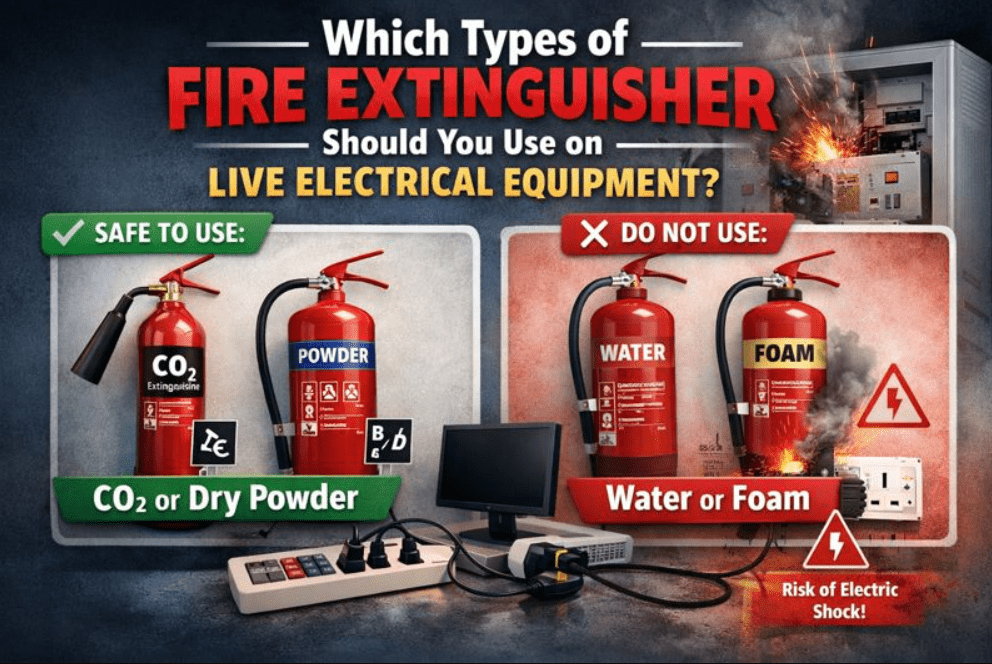
When equipment is live (energised), best practice is to use electrically non-conductive extinguishing media. In practical terms, that usually means:
- CO₂ (carbon dioxide) extinguishers
- Dry powder extinguishers (non-conductive)
- Clean agent extinguishers (specialist “no residue” options)
- Dielectric-tested water mist extinguishers only if they’re specifically marked as suitable for live electrical equipment (more on this below)
The most important safety principle is still this: if it’s safe, isolate the power first (switch off at the isolator, emergency stop, or consumer unit). If you can’t isolate safely, your threshold for not fighting it should be much lower.
Here’s what you can do next: skim the table below, then jump to the extinguisher type you actually have on site.
Is CO₂ the best extinguisher for live electrical equipment?
In many UK workplaces and homes, CO₂ is the usual first-choice for live electrical equipment because it is non-conductive and leaves no residue (so it won’t soak or coat electronics).
Where CO₂ is a strong fit?
CO₂ is commonly placed near:
- Electrical cabinets and switchgear.
- Distribution boards/consumer units.
- Office equipment and comms/IT areas.
What CO₂ can’t do and why it matters?
CO₂ works by displacing oxygen around the flame. It may not cool the fuel much, so re-ignition can happen if the heat source remains (for example, internal arcing, overheated components, or smouldering plastics). It can also be less effective in draughty areas where gas disperses quickly.
Also, CO₂ use can be risky in confined or poorly ventilated spaces. Your safety comes first.
Is dry powder safe on live electrics?
Yes, dry powder is generally considered non-conductive and suitable for fires involving live electrical equipment. It can be effective and fast-acting.
But in real settings, powder has major trade-offs:
- It can seriously reduce visibility during discharge.
- It can irritate breathing.
- It can contaminate equipment and make clean-up difficult (especially around electronics).
If you’re protecting people (not equipment), powder may still be a practical option in mixed-risk areas such as workshops. If you’re protecting valuable electronics, CO₂ or clean agent options are often preferred.
What are clean agent extinguishers and when should you use them?
Clean agent extinguishers are designed to minimise residue and collateral damage, helpful for server rooms, labs, control systems, and other sensitive kit.
If you’re selecting extinguishers for an IT or high-value environment, don’t guess. Ask your fire risk assessor or supplier to confirm:
- The extinguisher’s fire rating and suitability for the risks present.
- Whether it is intended for use on live electrical equipment.
- Servicing and maintenance expectations under UK practice.
Can you use water mist on live electrical equipment in the UK?
Sometimes, but only if it’s clearly labelled for that use. Some water mist extinguishers are dielectric tested and may be marked with guidance such as suitable for use on live electrical equipment up to 1000V at 1 metre (wording varies by manufacturer).
That marking matters because water-based does not automatically mean safe on live electrics.
What to look for on the label?
Look for explicit wording that the extinguisher is suitable for live electrical equipment and any stated voltage and distance limits. If you can’t verify that marking quickly and confidently, treat it as not suitable for live electrical equipment.
What should you NOT use on live electrical equipment?
If equipment is live, avoid extinguishers that can create or increase electrical risk unless the specific product is explicitly rated/marked for live electrical use.
That typically means you should not reach for:
- Standard water extinguishers.
- Most foam extinguishers.
- Wet chemical extinguishers (primarily designed for cooking oil/fat fires).
If you’re ever in doubt, don’t improvise, evacuate and call 999.
Are electrical fires Class E in the UK?
You may hear people say Class E for electrical fires, but in UK/European extinguisher classification, electricity isn’t treated as a separate fuel class on the extinguisher label in the same way as Class A/B/F.
A better way to think about it:
- Electricity is the hazard.
- The actual fuel is what’s burning (plastics, insulation, paper, liquids, etc.).
- Once power is isolated, you choose your firefighting approach based on the fuel.
Quick comparison for live electrical equipment
| Extinguisher type | Suitable for live electrical equipment? | Why do people choose it | Key cautions |
|---|---|---|---|
| CO₂ (black label) | Yes | Non-conductive, no residue, good for electronics | Re-ignition risk; less effective in draughts; caution in confined spaces |
| Dry powder (blue label) | Yes (non-conductive) | Strong knock-down, versatile | Messy; visibility and breathing irritation; can damage/contaminate equipment |
| Clean agent | Yes | Minimal residue, good for a sensitive kit | Specialist choice; ensure correct rating, placement, and servicing |
| Dielectric-tested water mist | Sometimes | Can cover multiple risks in one unit | Only if clearly marked for live electrical use; follow distance/voltage limits |
When should you fight the fire, and when should you get out?
This is the moment where most injuries happen; people try to “just handle it” and lose time, visibility, and their exit route.
Use this quick decision guide:
- If the fire is small, not spreading, and you have the correct extinguisher, you may be able to tackle it only if you can keep your exit behind you.
- If there is thick smoke, rapid growth, burning above head height, or you can’t isolate power safely, get out.
Let’s explore a safer way to decide in 10 seconds.
Do/Don’t checklist before you discharge an extinguisher
| Do | Don’t |
|---|---|
| Keep your exit route behind you at all times | Don’t let the fire come between you and the door |
| Isolate power if safe (isolator, emergency stop, consumer unit) | Don’t touch damaged equipment or panels if you’re unsure they’re safe |
| Use non-conductive media for live equipment (CO₂ / powder / clean agent) | Don’t use water/foam/wet chemical on live equipment unless it’s clearly rated/marked for that purpose |
| If it doesn’t go out immediately, evacuate | Don’t keep fighting while smoke builds or visibility drops |
Two real-world scenarios
Scenario 1: A small flame inside a photocopier or UPS unit (power still on).
If trained and safe to do so, a CO₂ discharge may suppress the fire quickly with minimal residue. If it doesn’t go out fast or smoke increases, close the door and evacuate.
Scenario 2: A sparking distribution board with smoke and a burning smell.
Your first goal is safe isolation (if you can do it without exposing yourself). If you can’t isolate safely or smoke is heavy, evacuate and call 999. Fire in the electrical distribution can escalate quickly.
How people talk about this online?
A cool guide to the different types of fire extinguisher and their uses
byu/giuliomagnifico incoolguides
I came across someone asking which fire extinguisher should be used when an electrical device like a laptop or computer catches fire — whether it’s CO₂ or Dry Powder.
byu/NegotiationFinal9758 inWorkplaceSafety
Final summary
For live electrical equipment, choose electrically non-conductive extinguishing media: CO₂, non-conductive dry powder, or a clean agent. Consider dielectric-tested water mist only when the label clearly confirms it’s suitable for live electrical equipment, and you follow any distance/voltage limits.
Here’s what you can do next: check the extinguishers you have (home or workplace), confirm what each one is intended for on the label, and make sure everyone knows the isolate power + keep your exit route rule.
FAQs
What is the best extinguisher for live electrical equipment in the UK?
Most commonly, CO₂ is recommended because it’s non-conductive and leaves no residue. Dry powder and clean agents can also be suitable. Use dielectric-tested water mist only if it’s clearly labelled for live electrical use.
Should you turn off the power before using a fire extinguisher?
Yes, if it’s safe to do so. Isolating power reduces shock risk and can help prevent re-ignition.
Why is water dangerous on an electrical fire?
Water can conduct electricity and increase shock risk when equipment is live, unless the specific extinguisher is designed, tested, and labelled for safe use on live electrical equipment.
Is dry powder better than CO₂ for electrical fires?
It depends on your priority. Powder can be very effective, but it’s messy and can damage equipment. CO₂ is cleaner for electronics, but re-ignition can occur, and it disperses more easily.
Author expertise note
This article is written from a practical safety perspective, informed by UK fire extinguisher selection principles, common workplace training content, and how electrical-risk incidents typically unfold in homes and workplaces. Always follow your site’s fire risk assessment, training, and the manufacturer’s instructions on the extinguisher label.