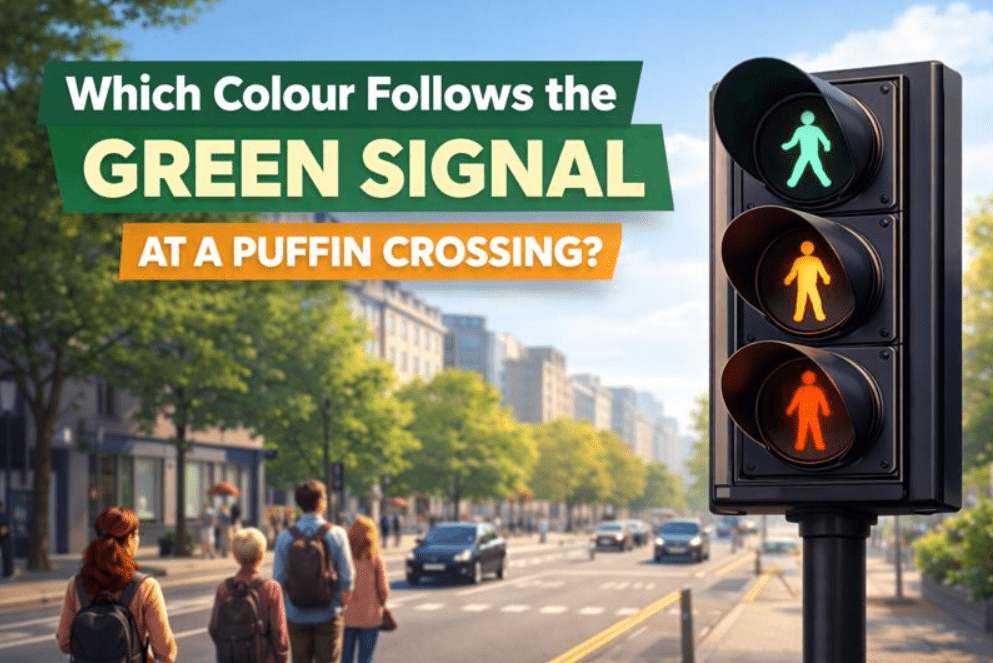
If you’ve landed here because a mock test (or real-world driving) has you wondering which colour follows the green signal at a puffin crossing?, you’re not alone. This is one of those UK-road-rule questions that feels simple, until you start mixing up puffin and pelican crossings.
In this guide, you’ll learn the correct light sequence, why people get it wrong, and how to remember it quickly, so you can answer confidently in the theory test and drive more safely in real life.
Which colour follows the green signal at a puffin crossing?
Which colour follows the green signal at a puffin crossing for drivers?
Steady amber follows the green signal at a puffin crossing (then red). That’s the theory-test-friendly answer, clear and simple. You’ll sometimes hear people mention flashing amber, but that’s linked to pelican crossings, not puffin crossings.
Is the question about the driver lights or the pedestrian lights?
A lot of confusion comes from the phrase green signal, because different people imagine different signals:
Driver signals (traffic lights)
Drivers see the standard traffic-light aspects you already know from junctions.
Pedestrian signals (red/green figure)
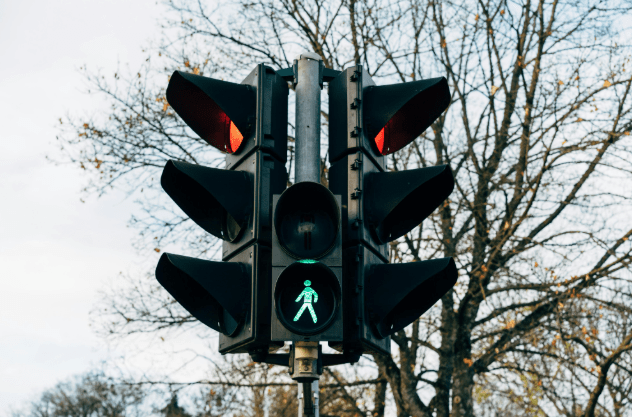
Pedestrians see the red/green figure at the crossing. Puffin crossings are designed so pedestrians can be guided from the near-side display, and the system can manage timing using detection, so the “flashing” phases people associate with older crossings are not the same here.
Here’s what you can do next: lock in that the question is usually aimed at driver signals, especially in theory-test wording.
The puffin crossing light sequence
Below is a quick reference you can remember under pressure:
| What you see (driver) | What it means | What you should do |
|---|---|---|
| Green | You may proceed if the way is clear | Continue, staying alert for late pedestrians |
| Amber | Stop at the stop line if it’s safe | Brake smoothly and stop if you can do so safely |
| Red | You must stop | Stop and wait |
| Red + amber | Get ready to move | Prepare, but don’t go until green |
What does steady amber mean at a puffin crossing?
Amber is the moment that catches learners out. The safest way to think about it is:
- If you can stop smoothly and safely at the stop line, stop.
- If stopping suddenly would likely cause a collision (for example, a vehicle close behind), continue carefully.
Let’s explore the practical mindset: Amber isn’t a speed up signal, it’s a decide safely signal.
Why there is no flashing amber phase at a puffin crossing?
This is the memory hook most people need:
- Puffin crossings are built around detection and controlled timing.
- The flashing amber idea is commonly taught with pelican crossings, which behave differently.
If you remember just one sentence, remember this: Puffin = steady amber (no flashing amber phase).
Puffin vs Pelican Crossings: the easiest way to remember the difference
This comparison helps you avoid mixing them up in exams.
| Feature | Puffin crossing | Pelican crossing |
|---|---|---|
| What follows green (driver) | Steady amber | Amber (standard sequence), but has a flashing amber phase later |
| Flashing amber for drivers | No | Yes (in its cycle) |
| Pedestrian signal style | Near-side display is common | Traditionally far-side display is common |
| “Why” it works this way | Detection helps manage timing and safety | Older-style timing includes flashing phases |
What should pedestrians do at a puffin crossing?
Even if you’re reading this as a driver, it helps to understand what pedestrians are trying to do, because it predicts behaviour.
When should you start crossing?
Only start crossing when the pedestrian signal indicates it’s safe and traffic has stopped.
What if the signal changes while you’re already crossing?
If you’ve already begun crossing, focus on finishing safely, don’t panic, don’t turn back into traffic.

Common learner mistakes and how to avoid them?
Here are the patterns that cause wrong answers in mock tests and hesitation on the road:
- Expecting flashing amber at a puffin crossing.
- Treating green as “guaranteed clear” (pedestrians can still be finishing).
- Braking harshly on amber when you’re too close to stop safely.
- Moving off the instant your light changes without re-checking the crossing is clear.
Here’s what you can do next: practise saying the answer out loud, green is followed by steady amber, until it feels automatic.
Quick-reference cheat sheet
| If you’re asked | Your answer |
|---|---|
| Which colour follows the green signal at a puffin crossing? | Steady amber |
| Is there a flashing amber at a puffin crossing? | No |
| Why do people confuse this? | They mix puffin with pelican crossings |
How people talk about this online?
can someone explains the purpose of flashing amber lights on traffics lights
byu/Rever2d indrivingUK
Any tips and tricks on how to remember the differences between crossings?
byu/daydreamingtulip inLearnerDriverUK
Final summary
Which colour follows the green signal at a puffin crossing? Steady Amber. That’s your direct, correct answer, and the detail that helps you stay consistent is remembering that puffin crossings don’t use a flashing amber phase.
FAQ
Which colour follows the green signal at a puffin crossing?
Steady Amber.
Which colour follows the green signal at a puffin crossing in the theory test?
Steady Amber, this is a classic test question.
Is it steady amber or flashing amber at a puffin crossing?
Steady Amber. Puffin crossings do not use flashing amber for drivers.
How do I remember puffin vs pelican quickly?
A simple rule of thumb: Puffin = Steady Amber (no flashing amber phase). Pelican is the one people associate with flashing amber in its cycle.
Author expertise note
This guide is written in a theory-test-friendly format based on common UK learning outcomes: signal order, safe stopping decisions on amber, and the key distinction learners are expected to know between puffin and pelican crossings.