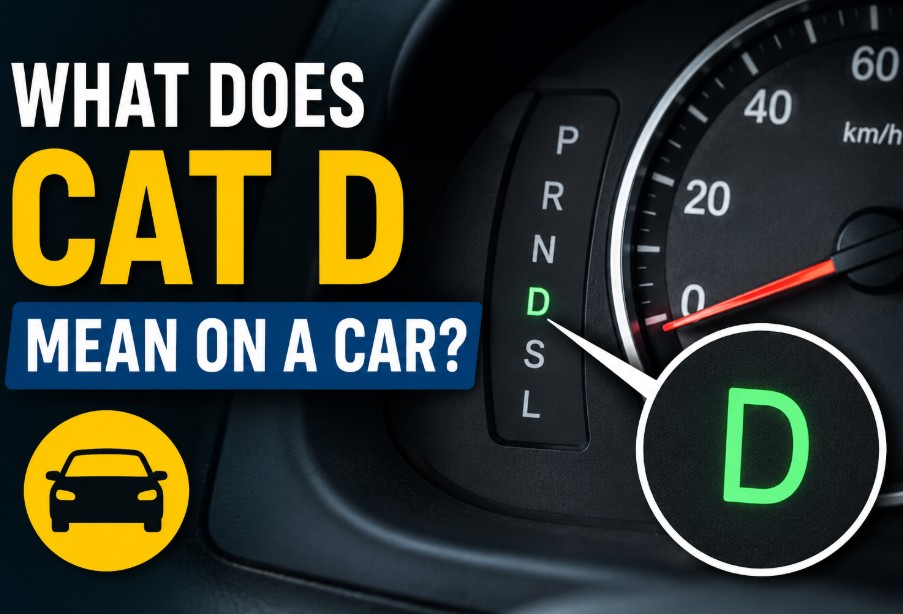
A Category D (Cat D) car is a vehicle that has been officially declared an economic total loss by an insurance company. This occurs when the cost of repairs, parts, storage, and administrative fees exceeds the vehicle’s market value, despite the car only sustaining non-structural damage.
In the UK, these vehicles are legal to drive once repaired and MOT-certified, provided the history is fully disclosed.
What does Cat D mean on a Car?
A Category D classification confirms that an insurance company wrote off a vehicle for financial reasons rather than structural integrity. It signifies the car is non-structurally damaged, meaning the chassis, safety cell, and crumple zones remain sound, making it a potentially viable, lower-cost purchase if repairs were completed correctly.
In the UK motor trade, a vehicle becomes an economic write-off when the combined cost of original manufacturer parts, specialist labour, and incidentals exceeds a threshold typically set between 50% and 70% of the vehicle’s pre-accident market value.
At its core, a Cat D car is structurally sound. The write-off decision is an economic calculation rather than a reflection of a destroyed frame.
Because damage is often limited to cosmetic panels, bolt-on components, or minor electrical issues, these vehicles can pass a standard Ministry of Transport (MOT) test and legally return to public highways.
In simple terms, insurers write these cars off when the repair bill, including parts, labour, and incidentals, becomes too high relative to the car’s market value.
When calculating these overheads, insurers must factor in extended workshop garage times, which can vary significantly depending on how long a car service takes or how complex the structural diagnostics are.
What Does Cat D Mean on a Car Insurance?
To an insurer, a Cat D marker is a permanent record on the Motor Insurance Anti-Fraud and Theft Register (MIAFTR) that stays with the vehicle for life.
It signals to future owners and underwriters that the car has been a total loss, often impacting future premium costs and insurance eligibility.
When a vehicle undergoes this process, the insurance company retains the salvage title and sells the vehicle to recover losses.
For any subsequent owner, this classification serves as a permanent notification that the vehicle must meet specific roadworthiness standards.

Does Category D Still Exist in the UK Vehicle Grading System?
No, the Category D marker does not exist for new claims today. As of October 2017, the Association of British Insurers (ABI) replaced the old financial-based system with a new, safety-focused framework.
The historical categories were completely phased out for new claims and replaced by a more descriptive, safety-first framework:
- Category N (Non-Structural): This directly replaced Category D. It denotes that the vehicle has sustained non-structural damage but was written off economically.
- Category S (Structural): This replaced Category C. It signifies that the vehicle has suffered structural damage to its chassis or frame but remains safely repairable by professional technicians.
This change wasn’t applied to older vehicles, so if a car was written off before October 2017, the Cat D marker stays on its record for good. Thousands of these legacy vehicles are still legally bought, sold, and driven across the UK used market today.
What is the difference between Cat D and Cat C?
The fundamental difference between Cat D and Cat C lies entirely in the repair-to-value ratio calculated by the insurer under the pre-2017 financial evaluation system.
While both categories allowed the vehicle to be safely repaired and returned to service, they represented vastly different levels of financial liability for the insurance firm.
Comparison of Legacy UK Insurance Write-Off Categories
| Evaluation Metric | Category D (Legacy Non-Structural) | Category C (Legacy High-Cost Salvage) |
| Financial Definition | Repair costs were less than the vehicle’s pre-accident market value but uneconomical due to peripheral expenses. | Repair costs exceeded the vehicle’s total pre-accident market value. |
| Typical Damage Severity | Light cosmetic, minor electrical, bolt-on panels, or unblemished theft recoveries. | Significant bodywork impact, front-end damage, or heavy component displacement. |
| Structural Impact | Strict zero-compromise policy on the main chassis rails, pillars, and floor pan. | May include structural distortion that requires specialised alignment jigs to correct. |
| Historical Requirement | Could return to the road immediately after a successful MOT test. | Required a mandatory Vehicle Identity Check (VIC) before 2015 to confirm identity. |
| Modern Equivalent | Category N (Non-Structural Repairable) | Category S (Structural Repairable) |
When reviewing historic trade logs, professionals know that a Cat C marker implies a much more severe impact history than a Cat D marker.
Take, for example, a luxury saloon that was stolen and later recovered. The chassis might be perfect, but if the interior was stripped and the cost of replacing it through a main dealer was too high, the insurer would write it off as a Cat D, even though the car was never actually in a crash.
Which category is better: Cat N or Cat S?
When evaluating a modern used vehicle, Category N is inherently better and safer for the average consumer than Category S.
Because Category N vehicles haven’t suffered structural damage to vital safety components like pillars or crumple zones, there is much less risk of a hidden repair that could compromise the car’s safety.
What Does Cat D Mean on AutoTrader When Buying a Car?
On platforms like AutoTrader, a Cat D or Cat N marker indicates that the vehicle has a verified total loss record from the MIAFTR database.
Dealers are legally obligated to disclose this, but private sellers have no statutory requirement to volunteer this information unless asked.
Always verify the status using an independent HPI check. If a private seller hides this information, you have very little legal recourse under the Consumer Rights Act unless you can prove you were explicitly misled in writing.

How to Verify Vehicle Salvage History? (Step-by-Step)
To safely purchase a vehicle with a history, you must perform five mandatory checks: verify the listing data, inspect the V5C logbook, run an independent HPI report, audit the government MOT history, and commission a professional vehicle inspection from a service like the AA or RAC.
Some dishonest sellers buy cheap Cat D salvage, carry out quick-fix cosmetic repairs with filler, and sell them privately to sidestep the strict disclosure rules that professional dealers must follow.
If you purchase a written-off car from a private individual without checking its history first, you have very little legal recourse under the Consumer Rights Act unless you can prove they explicitly misled you in writing.
Is category D bad for buyers? Pros and cons
Purchasing an insurance write-off is not an inherently bad decision; it is an economic trade-off that requires strict due diligence.
When navigating this sector of the used market, you must weigh the substantial upfront financial savings against the long-term logistical complications.
The Pros
- Substantial Discount Rates: A Cat D vehicle typically commands a retail price that is 20% to 40% lower than an identical model with a clean history. This makes it an exceptionally cost-effective option if you intend to run the vehicle until the end of its operational lifespan.
- Guaranteed Structural Integrity: Because the insurance designation strictly dictates that no structural elements were compromised, you can drive with the peace of mind that the car’s primary safety cell will perform exactly as factory-engineered in a future collision.
- Cosmetic Bargains: Older cars are often written off for minor car park scrapes simply because the cost of genuine manufacturer parts and professional paint blending outweighs the car’s current book value. This quirk of the insurance industry can land you a mechanically perfect runner for a fraction of the market price.
The Cons
- Elevated Insurance Costs: Many mainstream UK underwriters view a repaired total loss as a significantly higher risk profile. You may find that some firms refuse to offer comprehensive coverage entirely, while others will inflate your annual premium to a degree that gradually erodes your initial upfront savings.
- Diminished Resale Value and Liquidity: The Cat D classification is tied to the vehicle’s identity permanently. When you decide to sell the vehicle, you will face a much smaller pool of prospective buyers, and mainstream dealerships will routinely reject the car for part-exchange.
- The Threat of Safety Deficiencies: While the metal structure may be straight, cut-price salvage repairs often skimp on hidden electronic components. A common issue found during professional audits is the installation of dummy bypass resistors instead of replacing expensive deployed airbag modules or anti-lock braking sensors.

Final Summary and Next Steps
Buying a car with a Category D marker is not inherently dangerous, but it requires strict due diligence. By focusing on professional inspections and ensuring the price reflects the 25%–30% discount, you can secure a reliable vehicle for a fraction of the market cost.
Always prioritise an independent HPI check and a professional inspection before transferring any funds.
Before handing over any funds for a Cat D or Cat N vehicle, ensure you call your current motor insurance provider to get an exact premium quote, review the complete DVSA MOT history online, and invest in a comprehensive, independent vehicle inspection.
Taking these practical steps ensures you secure a reliable asset while eliminating the risk of unexpected financial liabilities down the line.
FAQ about What does Cat D mean on a car?
What is Category B car mean, and can it be repaired?
A Category B car has sustained severe structural or mechanical damage. By UK law, its shell must be permanently crushed, and it can never return to the road, though clean non-structural parts can be salvaged for use on other vehicles.
What are D-class cars?
Do not confuse insurance categories with the European vehicle segmentation. A D-segment or D-class car refers to a large family car or compact executive vehicle size standard, such as a BMW 3 Series or Volkswagen Passat, completely unrelated to write-off markers.
Can a Cat D car be removed from the database?
No. Once an insurance company logs a vehicle on the MIAFTR system as a Category D or Category N total loss, that designation remains a permanent part of the vehicle’s history report and cannot be erased or expunged.
Do I need a special MOT test for a Cat D car?
No special test is required. A repaired Cat D vehicle takes the standard UK MOT test. However, the testing technician will pay close attention to any visible steering, suspension, or braking components that show signs of post-accident replacement.
How much cheaper should a Cat D car be?
As a general rule in the UK motor trade, a Cat D car should be priced at least 25% to 30% below the clean retail market value for that exact make, model, mileage, and year.
Can I get a loan or finance on a Cat D car?
It is exceptionally difficult. Most mainstream hire purchase (HP) or personal contract purchase (PCP) finance providers in the UK will flatly refuse to underwrite an agreement for any vehicle carrying a historic total loss marker.
Is a Cat D car harder to insure?
Yes. Many mainstream insurers will either refuse to quote for a vehicle with an insurance category D marker or place it into a higher premium bracket, making it essential to secure a quote before purchasing.