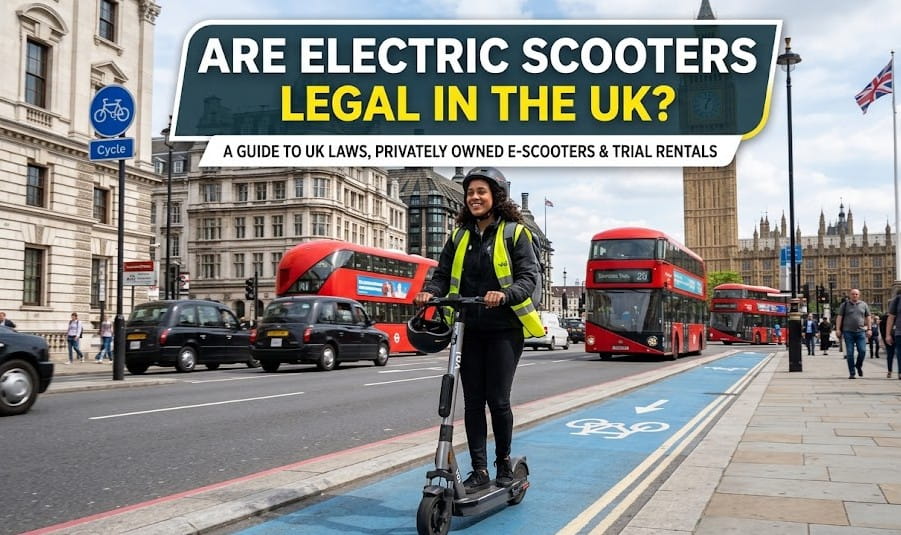
No, privately owned electric scooters are not legal to ride on public roads, pavements, or cycle lanes in the UK as of 2026. They are strictly restricted to use on private land with the landowner’s permission. Conversely, government-approved rental electric scooters are 100% legal to ride on public roads and cycle tracks within official local trial areas.
Are Electric Scooters Legal in the UK? (The Private vs. Rental Divide)
In the UK, e-scooter legality depends entirely on ownership. Privately owned e-scooters can legally be bought and used on private land with the landowner’s permission. However, the Department for Transport (DfT) strictly bans them from all public infrastructure, including roads, pavements, and cycle tracks, leaving retail buyers facing fines and police enforcement.
The Private E-Scooter Regulation
In the UK, e-scooter legality depends entirely on ownership. Privately owned e-scooters can legally be bought and used on private land with the landowner’s permission.
However, the Department for Transport (DfT) strictly bans them from all public infrastructure, including roads, pavements, and cycle tracks, leaving retail buyers facing fines and police enforcement.
Under current UK legislation, you can legally purchase, own, and ride an electric scooter on private land, provided you have explicit permission from the property or landowner.
However, even on private domestic property, homeowners must stay informed of broader regulations, such as the new driveway rule.
The Rental E-Scooter Exception
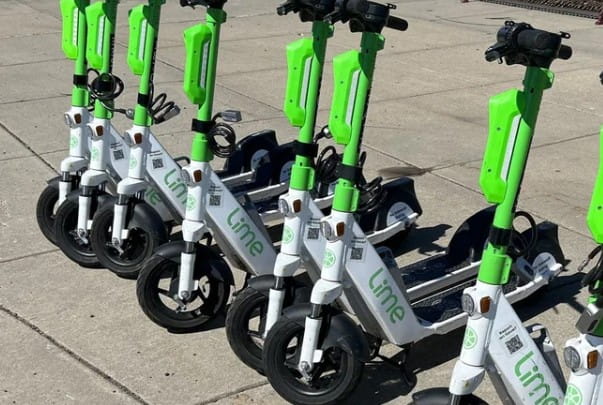
Conversely, government-approved rental trial schemes, managed by local councils alongside operators like Lime, Voi, and Dott, are completely legal on public roads and cycle lanes.
These fleet vehicles are structurally modified, geofenced, and insured, making them the sole legal method for riding an e-scooter on public infrastructure.
What is the Current Legal Status of E-Scooters Across the UK?
Across the UK, the legal status of an e-scooter depends entirely on where it is ridden and whether it belongs to a registered trial fleet. Public pavements are globally banned for all e-scooters, while public roads and cycle lanes are exclusively open to official rental schemes.
To stay on the right side of the law, it is vital to look at exactly where these vehicles can and cannot be used under current UK rules
Are electric scooters legal on UK roads and cycle lanes?
Yes, but only official rental trial e-scooters are legally permitted on public roads and designated cycle lanes. Privately owned e-scooters are completely banned from these spaces.
Even within an authorised rental scheme, riders are prohibited from taking the vehicles onto motorways or high-speed dual carriageways.
Are electric scooters legal on UK pavements?
No, electric scooters are never legal to ride on public pavements or walkways under any circumstances, regardless of whether they are privately owned or part of an official rental trial.
Pavements are legally reserved for pedestrians, and riding a motorised transporter on them violates section 72 of the Highway Act 1835.
Are electric scooters legal in England, Scotland, and Wales?
The overarching ban on private e-scooters in public remains identical across England, Scotland, and Wales because road traffic legislation is governed centrally by the UK Parliament. However, local implementation of rental trials varies significantly by region.
For instance, while numerous trials thrive across England, Scotland’s involvement is highly limited, meaning that in almost all Scottish municipalities, all public e-scooter usage remains entirely unlawful.
Are e-scooters legal in London?
In London, enforcement and regulations are particularly strict. While Transport for London (TfL) operates a highly successful, strictly geofenced rental trial across select boroughs, a blanket safety ban applies to all personal micro-mobility devices.
Following a series of severe lithium-ion battery fire incidents investigated by the London Fire Brigade, TfL has enforced a blanket ban prohibiting passengers from carrying privately owned e-scooters or e-unicycles on the London Underground, Overground, Elizabeth Line, DLR, buses, or trams.
What is the Milton Keynes e-scooter trial, and are they legal there?
Milton Keynes hosts one of the longest-running and most expansive government-approved rental trials in the country. In this specific region, rental e-scooters are entirely legal and widely integrated into the public transport network.
They are uniquely permitted to operate across the city’s extensive Redway network, a dedicated system of shared-use paths for cyclists and pedestrians, provided riders adhere to automated localised speed reductions.
Why Are Electric Scooters Banned on Public Roads But Electric Bikes Are Legal?
Electric scooters are banned from public roads because they are classified as motor vehicles and cannot meet strict vehicle construction laws. Conversely, electric bikes are legal because they are classified as bicycles under the Electrically Assisted Pedal Cycles (EAPC) framework.
The stark contrast between the absolute prohibition of private e-scooters and the widespread legal acceptance of electric bicycles causes significant public confusion. The reason for this divergence comes down to statutory classification.
What is an e-scooter according to the law?
According to UK law, the Department for Transport (DfT) legally classifies electric scooters as powered transporters. Because they are propelled entirely by an electric motor without manual assistance, they are legally treated as motor vehicles alongside cars and motorcycles.
How does the Road Traffic Act 1988 restrict micromobility?
Under the Road Traffic Act 1988, any vehicle classified as a motor vehicle must comply with strict construction and use regulations.
To be legally driven on a public road, a traditional motor vehicle requires ongoing maintenance, often causing owners to wonder how long a car service takes, alongside vehicle type approval, visible registration plates, annual road tax, a valid MOT, and compulsory third-party insurance.
Because standard consumer e-scooters lack visible rear signalling lights, standardised braking systems, and fixed registration points, they cannot obtain type approval, making public insurance unavailable and public use illegal.
Are electric bikes legal in the UK?
Yes, electric bicycles are fully legal on public roads and cycle paths because they bypass the motor vehicle classification entirely. They fall under the specialised regulatory framework of Electrically Assisted Pedal Cycles (EAPCs).
To retain this legal status, an EAPC must meet strict criteria: it must feature functional pedals that can propel it, the electric motor must only assist when the rider is actively pedalling (pedal-assist), the motor’s continuous power output cannot exceed 250 Watts, and the electrical assistance must automatically cut out when the bike reaches a speed of 15.5 mph.
Because they are legally treated as standard bicycles, EAPC riders require no driving licences, insurance, or registration.
Who Banned E-Scooters in the UK?
The current restrictions on personal e-scooters are not the result of a sudden modern ban; rather, they are the automatic consequence of historical transport laws that were drafted long before micro-mobility technology existed.
The historical legislative framework behind the restriction
The primary legal barrier is the Highway Act of 1835, coupled with the Road Traffic Act 1988. These laws effectively made it illegal for any motorised or mechanically propelled vehicle to use public pavements or roads without formal vehicle type registration.
Parliament did not intentionally target modern e-scooters for a ban; instead, the technology emerged into a rigid legal framework that lacked a matching vehicle category.
When Will Private E-Scooters Become Legal?
Private e-scooters are not expected to become legal for public use in the UK until at least late 2028 or 2029.
The UK Parliament is currently reviewing early frameworks, such as the E-scooters (Review and Awareness) Bill introduced in early 2026, but permanent legislation to legalise private models remains on hold while national rental trials run until May 2028.
Why did the Department for Transport extend national rental trials to May 2028?
The Department for Transport extended national rental trials to 31 May 2028 to gather crucial data on safety, pedestrian impact, and battery stability before drafting permanent micro-mobility legislation.
For safety regulators, the data gathered so far has been the driving force behind these decisions. The Department for Transport originally launched localised rental trials in July 2020 to observe market integration.
To fully close persisting evidence gaps regarding mechanical safety, pedestrian impact, and battery stability, the DfT officially extended all live national rental trials until 31 May 2028.
This extensive data-gathering phase ensures that lawmakers have a robust evidence base before drafting permanent legislation.
Are any privately owned electric scooters legal to ride in public?
No, there are currently absolutely no privately owned electric scooters that are legal to ride in any public space in the UK. Every single consumer model sold on the retail market lacks the type approval required for public road registration, meaning any private e-scooter ridden on a public street is operating outside the law.
Under current rules, retail consumer models are restricted entirely to enclosed private property with explicit permission from the landowner. Public highways, cycle tracks, pavements, and pathways remain the exclusive legal domain of official, government-backed rental trial schemes.
Age, Licensing, and Operational Rules for Legal E-Scooter Use
To legally ride an authorised trial e-scooter in the UK, you must be at least 16 years old, hold a valid full or provisional driving licence, unlock the vehicle via an official app, and stay within the geofenced trial boundary.
To legally operate an authorised trial e-scooter, riders must complete a structured verification process before unlocking the vehicle:
- Download the approved local operator application (such as Lime, Voi, or Dott).
- Scan and upload a valid, eligible full or provisional UK driving licence.
- Complete the brief, mandatory in-app safety and parking tutorial.
- Verify that the unique identification number (UIN) on the vehicle’s column matches the application.
- Confirm that the automatic third-party motor insurance policy has been activated for the trip duration.
- Manually kick-start the scooter to 3 mph before engaging the thumb throttle.
- Stay strictly within the local council’s geofenced trial boundary to avoid automatic motor shutdown.
How old do you have to be to ride an electric scooter in the UK?
You must be at least 16 years old to legally ride a rental electric scooter in the UK. However, certain local councils and individual rental operators choose to raise this minimum age limit to 18.
Can a 14-year-old drive an electric scooter in the UK?
No. A 14-year-old cannot legally ride a rental e-scooter in a public space, as they do not meet the minimum age criteria and are ineligible to hold a provisional UK driving licence.
Are kids’ electric scooters legal to use anywhere outside private land?
No. Children’s electric scooters are subject to the same statutory constraints as adult models. They cannot be legally ridden on public pavements, parks, or quiet residential roads under any circumstances; their use is restricted strictly to enclosed private properties.
What is the speed limit of an electric scooter in official trials?
Under national DfT regulations, the absolute maximum speed limit for a legal rental e-scooter is capped electronically at 15.5 mph. Furthermore, operators utilise automatic geofencing to lower this speed limit to 8 mph or less when a rider enters heavily pedestrianised go-slow zones.
Do you need a driving licence?
Riders must hold a valid UK provisional or full driving licence with a Category Q, AM, A, or B entitlement to use a rental e-scooter.
While a Compulsory Basic Training (CBT) certificate is mandatory for mopeds and light motorcycles, the government has modified the Motor Vehicles Regulations to explicitly exempt legal rental e-scooter users from needing a CBT certificate.
Insurance, Safety, and Everyday Restrictions
Insurance is mandatory for all public e-scooter operations; for legal rentals, it is provided automatically via the app. Furthermore, private businesses and transport networks retain full legal rights to ban e-scooters from their premises due to fire safety concerns.
Operating any micro-mobility device requires strict adherence to public safety standards and commercial property rules.
Do you need insurance for an electric scooter in the UK?
Yes, third-party motor insurance is a strict statutory requirement. For legal rental trials, this mandatory insurance is provided automatically by the rental operator and integrated directly into the minute-by-minute rental cost.
For private e-scooters, insurance companies cannot issue public liability policies because the vehicles lack road-legal type approval.

Can you take e-scooters in shops, businesses, or supermarkets?
No. Private retail establishments, supermarkets, and corporate office complexes possess full legal authority to ban e-scooters from entering their premises.
Due to safety concerns regarding indoor lithium-ion battery storage and pedestrian obstruction, most major UK high-street brands require riders to park vehicles externally in designated terminal bays.
Are e-scooters safe?
Public safety evaluations reveal mixed outcomes. While rental models feature robust commercial-grade manufacturing, dual braking systems, and regulated speed caps, uncertified private imports often present severe risks.
Independent fire safety investigations have highlighted a rising trend in residential property blazes caused by substandard, unregulated private lithium-ion batteries and unapproved charging accessories purchased online.
E-Scooter Regulations
| The Common E-Scooter Myth | The Legal Reality in the UK |
| It’s legal to ride private e-scooters on quiet residential backstreets. | All public roads, regardless of traffic density, are subject to the blanket private ban. |
| If I ride below 15 mph on a public pavement, the police cannot fine me. | Riding any motorised transporter on a public footpath violates section 72 of the Highway Act 1835. |
| You don’t need a driving licence to operate any form of e-scooter. | Official trial rentals strictly require an active, valid full or provisional UK driving licence. |
Are Electric Scooters Legal in the UK? (Reddit Insights)
Discussions on forums like Reddit reveal a massive gap between strict statutory laws and variable street-level policing, with users warning that targeted police checkpoints frequently lead to sudden vehicle confiscations and licence points.
A common pattern observed across digital discussion boards like Reddit involves a significant disconnect between statutory law and daily street enforcement.
On subreddits such as r/AskUK and r/ElectricScooters, users frequently note that while thousands of people commute daily on personal e-scooters, the level of active policing varies dramatically depending on the region.
Riders on these forums often warn peers that during targeted road safety campaigns, Metropolitan or regional police forces regularly establish checkpoints, resulting in sudden, widespread vehicle confiscations and severe driving record penalties for unsuspecting commuters.
What Happens If You Get Caught with a Private E-Scooter in the UK?
If caught riding a private electric scooter in public, police can issue a £300 fine, add 6 penalty points to your driving licence, and immediately seize and compound the vehicle under Section 165 of the Road Traffic Act.
Riding an unapproved, uninsured private e-scooter in a public place is treated by law enforcement with the same gravity as operating a car without insurance, or navigating the exceptionally rare circumstances where it is legal to drive without an MOT certificate.
If a rider is intercepted by the police while operating a private e-scooter on a public highway, law enforcement officers will execute specific enforcement steps:
- The officer will signal the rider to halt immediately and safely dismount from the highway.
- The rider’s identity and driving licence status will be verified using the Police National Computer (PNC).
- The officer will issue a Fixed Penalty Notice (FPN) for operating a motor vehicle without compulsory insurance.
- A secondary penalty charge may be issued if the rider is operating the vehicle on a public pavement.
- The officer will summon an authorised recovery vehicle to systematically seize and compound the e-scooter.
- The rider will be handed documentation detailing the statutory steps required to contest the charge or claim the vehicle.
Operating a personal e-scooter unlawfully carries severe consequences. According to official guidelines issued by the National Police Chiefs’ Council (NPCC), the standard statutory penalties enforced across UK roads are detailed in the schedule below:
| Offence Category | Statutory Penalty Imposed | Impact on Driving Record |
| Driving Without Third-Party Insurance | £300 Fixed Penalty Fine | 6 Penalty Points added to the licence |
| Riding on a Public Pavement | £50 Fixed Penalty Notice | Non-endorsable fine |
| Riding Without a Valid Driving Licence | Up to £1,000 fine | 3 to 6 Penalty Points added to the licence |
| Vehicle Seizure (Section 165 Act) | Confiscation and compounding fees | Risk of permanent vehicle destruction |
| Riding Under the Influence (Drunk Driving) | Court-imposed unlimited fine | Mandatory 12-month driving disqualification |
Private E-Scooters vs. Rental Schemes vs. E-Bikes
To help you choose a fully legal transport method, the breakdown below compares the primary structural and legal differences between the three main micro-mobility choices available on UK streets.
| Regulatory and Operational Criteria | Privately Owned E-Scooters | Government-Approved Rental E-Scooters | Electrically Assisted Pedal Cycles (EAPCs) |
| Legal Public Road Access | Strictly Illegal | Completely Legal (Trial zones only) | Completely Legal Nationwide |
| Permitted on Public Pavements | No | No | No |
| Maximum Speed Capability | Variable (often exceeds 20-30 mph) | Electronically capped at 15.5 mph | Motor cuts out strictly at 15.5 mph |
| Minimum Age Requirement | None (Private land use only) | 16 to 18 Years old | 14 Years old |
| Driving Licence Mandate | N/A | Full or Provisional (Category Q) | None Required |
| Compulsory Insurance Type | Unavailable for public highway use | Provided automatically by the fleet operator | None Required |
| Registration or Number Plates | Cannot obtain type approval | Unique Identification Number (UIN) | None Required |
What does this mean for Your Commute?
Navigating the complex landscape of UK micro-mobility requires a clear understanding of current legislation. While personal electric scooters remain restricted to private land, government-approved rental trials offer a legitimate, sustainable alternative for urban transit.
For anyone aiming to support eco-friendly travel or cut down on commute times, switching to a compliant Electrically Assisted Pedal Cycle (EAPC) is currently the smartest move. This alternative is particularly relevant given broader discussions around why UK drivers are delaying the electric vehicle transition to cars.
Ultimately, navigating e-scooter laws means understanding the strict divide between private restrictions and legal trials for UK commuters in 2026.
While personal models remain grounded, e-bikes offer a reliable, completely legal path to green commuting on public roads without the licensing hurdles. Verified against official Department for Transport (DfT) and Road Traffic Act statutory parameters.
FAQ about Are electric scooters legal in the UK?
Can I ride my private scooter on a bridleway or public footpath?
No. Public footpaths, bridleways, and restricted byways are all components of the public highway network. Operating a privately owned e-scooter in these ecological or pedestrian spaces remains entirely illegal under UK traffic laws.
What are the penalties for riding an e-scooter under the influence of alcohol?
Because e-scooters are legally classed as motor vehicles, standard drink-driving laws apply. Getting caught riding a rental or private e-scooter while intoxicated can result in a mandatory driving ban, severe court-imposed fines, or a prison sentence.
Are electric scooters legal across Europe compared to Britain?
No, the UK is a strict legislative outlier. In many European nations, including Germany and France, personal e-scooters are fully legal under clear national frameworks that govern speed, braking, and mandatory third-party insurance, whereas Britain restricts public use entirely to council-approved trials.
Do I need a helmet to ride a legal rental e-scooter?
No. While wearing an approved bicycle helmet is highly recommended by safety groups and the Department for Transport, it is not a mandatory legal requirement under current trial parameters.
Can the police destroy my private e-scooter if it is seized?
Yes. If your private e-scooter is seized under Section 165 of the Road Traffic Act and you fail to pay the statutory recovery fees within the designated timeframe, the police can legally destroy or recycle it.
Are there any specific weight limits for trial e-scooters?
Yes. To ensure public safety, the Department for Transport regulates that participating rental trial e-scooters must not exceed a maximum unladen vehicle mass of 55 kilograms.
Can two people ride a rental e-scooter simultaneously?
No. All legal trial e-scooters are strictly designed and legally certified to transport no more than one person at a time. Carrying a passenger is an offence that can result in fines.